Clinical-trial registries are structured public records describing planned, ongoing, completed, terminated, and sometimes reported clinical studies. They improve transparency by preserving key information about study identity, sponsorship, design, recruitment, outcomes, and results. A registry record is an important evidence source, but it is not equivalent to peer review, regulatory authorization, proof that a study is well designed, or evidence that an investigational product is safe or effective. Reading a registry requires attention to what each field means—and to what it does not mean. [1-8]
Registration numbers
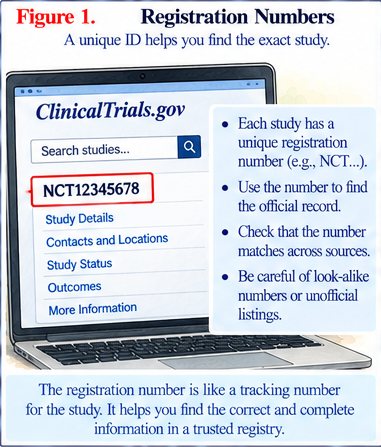
A registration number is a unique identifier assigned to a study record by a trial registry. On ClinicalTrials.gov this identifier is the NCT number. Other registries use their own identifiers, and some studies may appear in more than one registry. [1-8]
The identifier is valuable for tracking a study across protocols, publications, regulatory documents, presentations, and updates. It does not indicate study quality, regulatory approval, or favorable results. Investigators and clinicians should verify that a publication or treatment claim actually corresponds to the same registered study rather than relying on a similar title. [1-8]
Sponsors
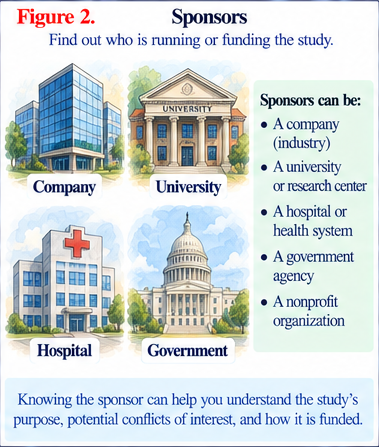
The sponsor field identifies the organization or entity responsible for initiating or overseeing the study as defined by the applicable registry and regulatory framework. Sponsors may include universities, hospitals, companies, government agencies, nonprofit organizations, or other institutions. Collaborators may provide additional support without being the primary sponsor. [1-8]
Sponsorship should be disclosed and examined, but it should not be used as an automatic proxy for validity. Commercial, academic, governmental, and nonprofit studies can each be rigorous or flawed. Interpretation should focus on study design, sponsor roles, conflicts of interest, data access, analysis, reporting, and publication rights. [1-8]
Study phase
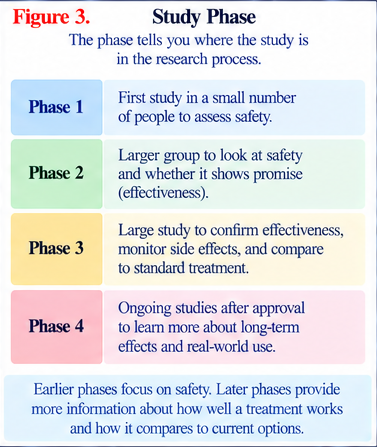
Study phase describes the developmental stage of certain interventional studies. Phase 1 commonly emphasizes initial human safety, tolerability, feasibility, and dose-related questions; Phase 2 further evaluates dose and preliminary efficacy; Phase 3 generally provides larger confirmatory evidence; and Phase 4 refers to studies after authorization or marketing in applicable settings. [1-8]
Not every registered study has a conventional phase. Device studies, behavioral interventions, observational studies, and some biologic studies may be listed as not applicable or use other design descriptors. A phase label does not by itself establish methodological quality or clinical effectiveness. [1-8]
Recruitment status
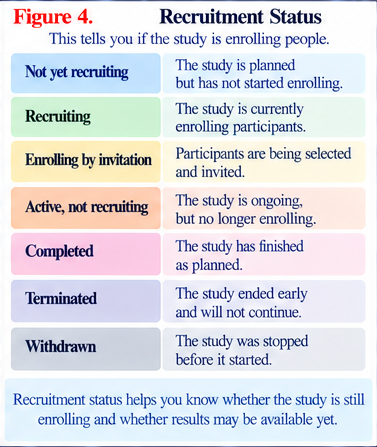
Recruitment status describes whether a study is currently enrolling or otherwise active. Common registry categories can include not yet recruiting, recruiting, enrolling by invitation, active but not recruiting, suspended, terminated, withdrawn, and completed. [1-8]
Recruiting means that the study is seeking eligible participants; it does not mean the intervention has been proven beneficial. Completed means study activity reached its defined completion point; it does not mean results were positive or even publicly posted. Terminated and withdrawn studies should be examined for the stated reason rather than assumed to have failed for efficacy or safety. [1-8]
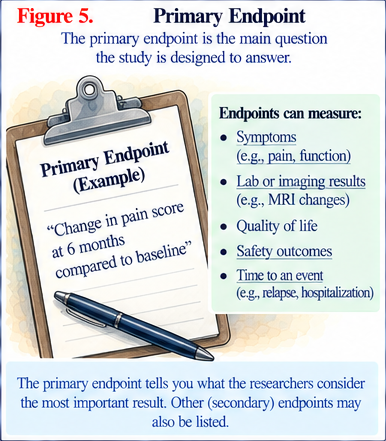
Primary endpoint
The primary endpoint is the main prespecified outcome used to answer the principal study question. Registry records may describe the outcome measure, measurement method, and time frame. Comparing the registered primary endpoint with later publications can help identify changes in outcome definitions, timing, or emphasis. [1-8]
A registry entry may be updated legitimately as a protocol evolves. The critical issue is transparency: investigators should distinguish changes made before outcome data were known from changes made after results could influence decisions. Secondary and exploratory outcomes should not be promoted to primary status merely because they are more favorable. [1-8]
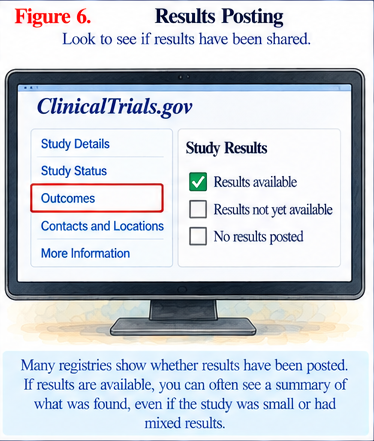
Results posting
Some registries permit or require structured posting of study results, including participant flow, baseline characteristics, outcome measures, and adverse events. Results posting can make findings available even when no journal article has been published and can reduce publication and selective-reporting bias. [1-8]
Posted registry results should still be critically appraised. They may provide less narrative context than a full publication, and discrepancies can occur between registry data, conference reports, publications, and regulatory documents. Failure to find posted results does not prove that a study was negative, but it identifies an important transparency gap. [1-8]
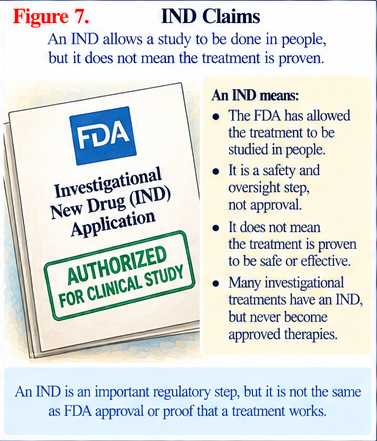
IND claims
An Investigational New Drug application, or IND, is a U.S. regulatory mechanism that can permit an investigational drug or biologic to be studied in humans when applicable requirements are met. A registry may contain information supplied by the sponsor about regulatory status, but the existence of a registered trial does not itself prove that an IND exists, is active, applies to the product being marketed, or covers a particular patient's treatment. [1-8]
Claims such as 'FDA registered,' 'FDA listed,' 'under an IND,' or 'part of a clinical trial' should be verified precisely. An IND is not FDA approval of the investigational product and is not an endorsement of efficacy. When regulatory status matters, the exact product, protocol, sponsor, indication, and applicable regulatory documentation should be confirmed. [1-8]
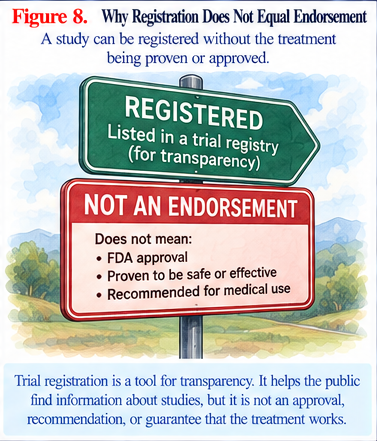
Why registration does not equal endorsement
Trial registries are designed primarily for transparency and public accountability. Registration records are generally submitted by study sponsors or investigators, and registry inclusion should not be interpreted as independent validation of the scientific rationale, product quality, ethics, safety, efficacy, or commercial claims surrounding the intervention. [1-8]
A clinic or company therefore should not cite a registry listing as evidence that a government agency, registry operator, university, or ethics body endorses the treatment. The appropriate questions are whether the study is legitimate, whether the product and protocol match the claim, what regulatory oversight applies, what results have been generated, and what the total evidence shows. [1-8]
Clinical takeaway
A registry is best used as an audit trail. The registration number identifies the study; sponsor information identifies responsibility; phase and recruitment status describe development and activity; the primary endpoint shows the prespecified main question; results posting reveals available outcomes; IND claims require separate regulatory verification; and registry inclusion itself conveys no endorsement. [1-8]
Cross-checking a registry record
A careful review compares the registry with the protocol, statistical analysis plan, publications, conference abstracts, regulatory materials, and sponsor claims when available. Important discrepancies include changed primary outcomes, altered time frames, unexplained enrollment differences, missing adverse events, inconsistent product descriptions, or claims based on a different study than the one cited. [1-6]
Regenerative-medicine considerations
For MSC and EV trials, broad labels such as 'stem cells' or 'exosomes' are inadequate for identity verification. The registry and associated records should be checked for tissue source, donor characteristics, manufacturing, culture or isolation method, characterization, potency, dose, route, schedule, indication, and product handling. A registration number cannot make materially different products equivalent. [3-8]
Safety and patient protection
A recruiting registry record may help patients locate research opportunities, but enrollment decisions require more than registry status. Investigators should confirm informed-consent procedures, ethics or institutional review, regulatory oversight when applicable, eligibility, foreseeable risks, alternatives, costs, follow-up, and who is responsible for research-related injury or complications. [1-8]
Bottom-line evidence statement
Clinical-trial registration is evidence of public study registration—not evidence that the treatment works and not an endorsement by the registry or regulator. Registries are most valuable when used to verify what investigators planned, identify who is responsible, track study status, locate posted results, and compare later claims with the original public record. [1-8]