Plain-language overview
Clinical-trial registries are public databases that contain structured information about research studies. They can help patients and clinicians identify a study, see who is responsible for it, understand what researchers planned to measure, check whether the study is recruiting, and sometimes see posted results. [1-8]
A registry listing is useful for transparency, but it is not proof that a treatment works. Registration does not mean that the registry, FDA, another government agency, a university, or an ethics committee endorses the treatment. A registry record should be read as a public study record—not as a seal of approval. [1-8]
Registration numbers
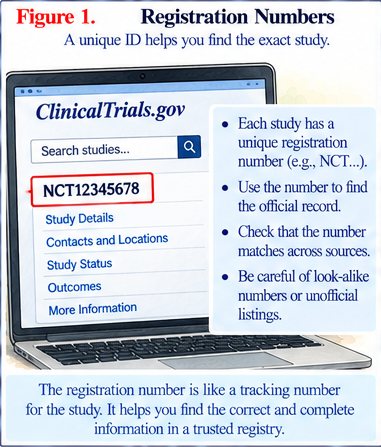
A registration number is a unique identifier assigned to a study by a trial registry. On ClinicalTrials.gov, the identifier is called an NCT number. Other registries use different numbering systems. [1-8]
The number helps patients and clinicians track the same study across registry updates, journal articles, conference presentations, and other records. It does not tell you whether the study is good, whether the results are positive, or whether the treatment is approved. [1-8]
Sponsors
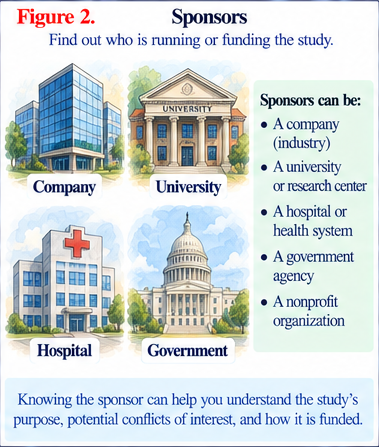
The sponsor is the organization or entity responsible for initiating or overseeing the study under the applicable rules. A sponsor might be a university, hospital, company, government agency, nonprofit organization, or another institution. [1-8]
Who paid for or sponsored a study matters because financial and institutional interests should be transparent. But sponsorship alone does not tell you whether the study is trustworthy. Industry-funded research can be rigorous, and academic or nonprofit research can have weaknesses. The study itself still needs to be evaluated. [1-8]
Study phase
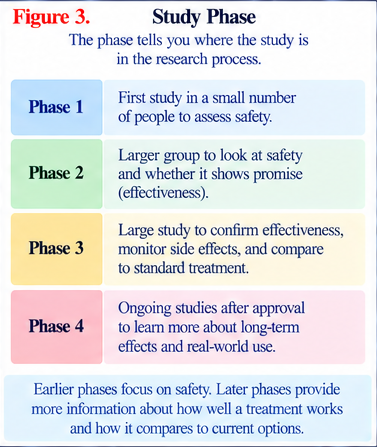
Study phase describes the developmental stage of certain clinical trials. Phase 1 commonly focuses on early safety, tolerability, feasibility, and dose questions. Phase 2 further examines dose and preliminary effectiveness. Phase 3 usually provides larger confirmatory evidence. Phase 4 generally refers to studies after authorization or marketing in settings where that classification applies. [1-8]
Not every registered study has a phase. Some observational studies, device studies, behavioral studies, and other research may be listed as not applicable. A phase number tells you where a study sits in development; it does not prove that the treatment works. [1-8]
Recruitment status
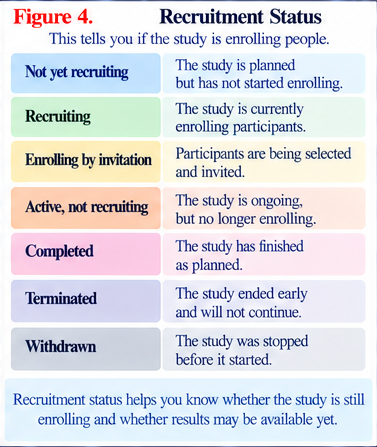
Recruitment status tells you whether a study is currently enrolling or otherwise active. A registry may describe a study as not yet recruiting, recruiting, enrolling by invitation, active but not recruiting, suspended, terminated, withdrawn, or completed. [1-8]
Recruiting means that investigators are looking for eligible participants. It does not mean the treatment has already been shown to work. Completed means the study reached its defined completion point; it does not mean the results were positive. If a study was terminated or withdrawn, the stated reason should be examined. [1-8]
Primary endpoint
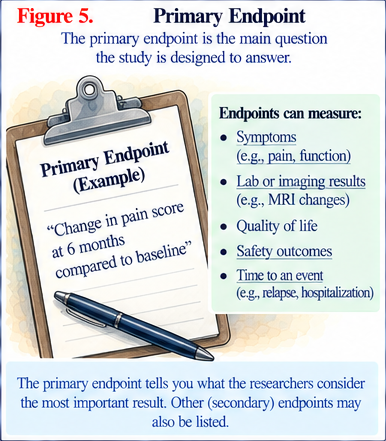
The primary endpoint is the main outcome researchers planned to use to answer the study's principal question. The registry may tell you exactly what will be measured and when it will be measured. [1-8]
This field is especially useful when results are later published. Patients and clinicians can compare the original registered endpoint with the outcome emphasized in the final report. Legitimate changes can occur, but important changes should be explained rather than hidden. [1-8]
Results posting
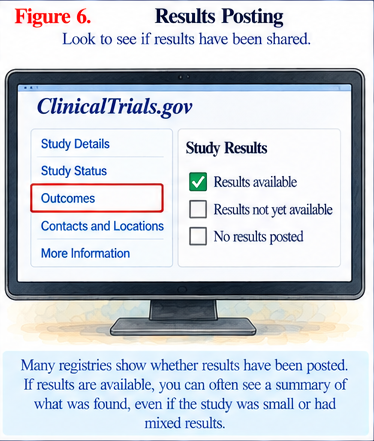
Some trial registries allow or require study results to be posted directly in the registry. These results may include how participants moved through the study, baseline characteristics, outcome measurements, and adverse events. [1-8]
Registry results can be valuable because they may appear even when no journal article has been published. They still need critical review. A registry table may provide less explanation than a full scientific paper, and differences can sometimes appear between registry results and later publications. [1-8]
IND claims
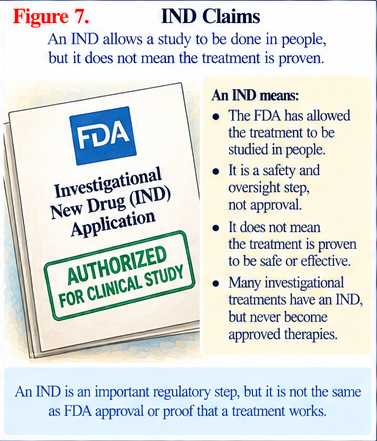
IND stands for Investigational New Drug application. In the United States, an IND is a regulatory mechanism that can allow an investigational drug or biologic to be studied in people when applicable requirements are met. [1-8]
An IND is not FDA approval of the treatment and is not proof that the treatment is effective. A clinic saying that a product is 'under an IND,' 'FDA registered,' or 'part of a clinical trial' should be able to explain exactly which product, study, sponsor, protocol, and indication the claim refers to. The registry listing itself does not prove that an IND exists or applies to a patient's treatment. [1-8]
Why registration does not equal endorsement
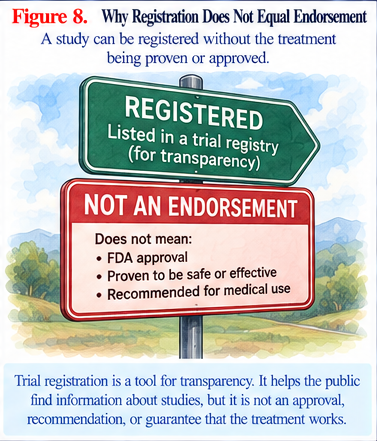
Trial registries are designed to improve transparency. Most study information is submitted by the sponsor or investigators. Being listed does not mean that the registry independently tested the product or concluded that it is safe, effective, or scientifically sound. [1-8]
A registry number should therefore never be used as if it were a government or scientific endorsement. The important questions are whether the study is legitimate, whether the product being offered is actually the product in the registered study, what oversight applies, what results exist, and what the total evidence shows. [1-8]
How to use a registry record
Think of the registry as an audit trail. The registration number identifies the study. The sponsor field shows who is responsible. Phase and recruitment status describe development and activity. The primary endpoint shows the main planned question. Results posting may show what happened. IND claims require separate verification. None of these fields, alone or together, constitute endorsement. [1-8]
Compare the registry with later claims
If a clinic, company, investigator, or publication cites a registered study, confirm that the registration number matches the study being discussed. Compare the registered treatment, patient population, dose, route, primary outcome, and time frame with the later claim. A similar title or a broad phrase such as 'stem-cell trial' is not enough. [1-6]
Why exact product identity matters
Stem-cell and extracellular-vesicle products can differ substantially even when they have similar names. Tissue source, donor characteristics, manufacturing, culture or isolation methods, storage, potency, dose, route, and treatment schedule may all matter. A registry number for one product cannot validate a materially different product. [3-8]
Safety and participation
A recruiting study may represent a legitimate research opportunity, but patients still need informed consent and clear information about eligibility, risks, alternatives, costs, follow-up, oversight, and who is responsible for complications. Recruitment status is not a safety rating. [1-8]
Bottom line
Clinical-trial registration is evidence that a study has a public registry record. It is not evidence that the treatment works, is FDA approved, or is endorsed by the registry. The value of the registry is that it lets patients and clinicians check what was planned, who is responsible, whether the study is active, what outcomes were specified, and whether results were eventually reported. [1-8]
Questions patients should ask
• What is the exact registration number for the study?
• Who is the study sponsor?
• What phase is the study, if a phase applies?
• What is the current recruitment status?
• What is the registered primary endpoint?
• Have results been posted, and do they match what is being claimed?
• If someone says the treatment is under an IND, what exact study, product, sponsor, and protocol does that IND cover?
• Is anyone using the registry listing as if it were FDA approval or an endorsement?
• Is the treatment being offered to me actually the same product and protocol described in the registry?