Evidence grading is the structured process of judging how much confidence should be placed in a body of evidence and how strongly that evidence supports a clinical conclusion. It is not a vote based on the number of positive studies, nor is it determined by regulatory status alone. Certainty depends on study limitations, magnitude and stability of effect, consistency, directness, precision, publication and reporting concerns, and the exact clinical question. The balance between benefit and harm is a related but distinct judgment. For mesenchymal stromal cell (MSC), extracellular-vesicle (EV), and other regenerative interventions, grading must remain specific to the actual product, manufacturing process, dose, route, indication, population, comparator, endpoint, and follow-up. [1-8]
Certainty of evidence
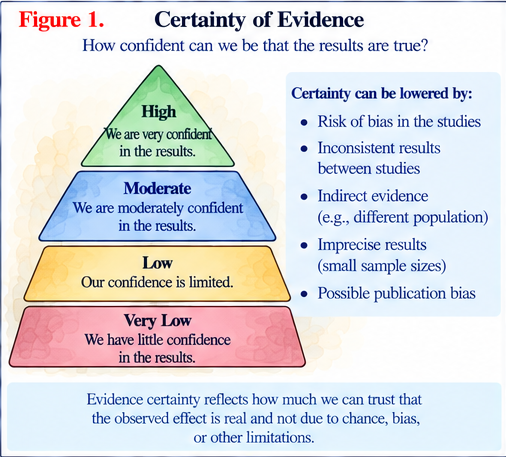
Certainty of evidence describes confidence that the estimated effect is sufficiently close to the true effect for the decision being considered. Frameworks such as GRADE commonly classify certainty into categories such as high, moderate, low, or very low, while requiring explicit reasons for judgments. [1-8]
Certainty is assessed across a body of evidence, not assigned solely from study design. Randomized evidence can be downgraded for risk of bias, inconsistency, indirectness, imprecision, or publication bias; nonrandomized evidence can sometimes become more persuasive when effects are large, confounding would plausibly reduce rather than create the observed effect, or other framework-specific considerations apply. The reasoning should be transparent rather than reduced to a label. [1-8]
Magnitude of effect
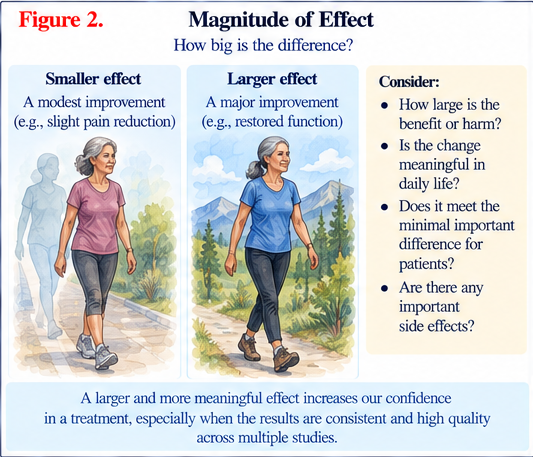
Magnitude of effect describes how large the observed benefit or harm is. Relative measures such as risk ratios or hazard ratios can be useful, but absolute effects often provide more clinically interpretable information because they incorporate baseline risk. [1-8]
A large apparent effect may increase confidence when it is robust and unlikely to be explained by bias or confounding. A statistically significant but very small effect may have little clinical importance. Magnitude should therefore be interpreted with confidence intervals, baseline risk, outcome importance, durability, harms, and patient priorities. [1-8]
Consistency
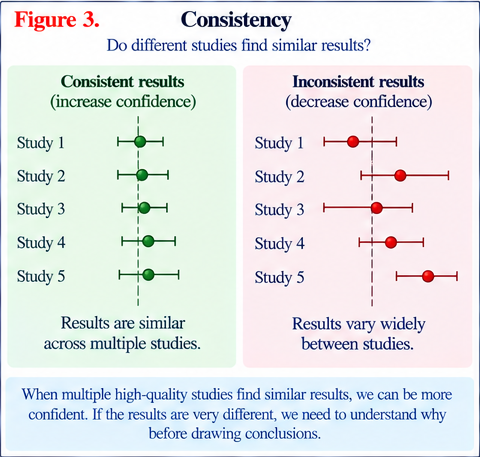
Consistency asks whether independent studies produce effects that are similar in direction and reasonably compatible in magnitude. Repeated findings across investigators, centers, populations, and methods can strengthen confidence that a result is not an isolated occurrence. [1-8]
Inconsistency should be investigated rather than averaged away. Differences may reflect product source, manufacturing, dose, route, disease stage, patient selection, comparator, endpoint, follow-up, or study quality. Genuine heterogeneity can be scientifically informative and may identify which patients or products differ in response. [1-8]
Directness
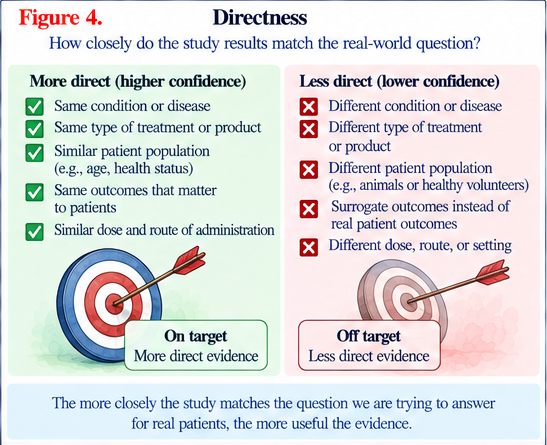
Directness asks how closely the available evidence matches the clinical question of interest. Direct evidence studies the relevant population, intervention, comparator, and patient-important outcomes under conditions sufficiently similar to the intended use. [1-8]
Evidence becomes indirect when conclusions require important extrapolation—for example from animals to humans, one disease to another, a surrogate biomarker to clinical benefit, one route to another, or one cell or EV product to a materially different product. Indirect evidence can be valuable, but the inferential step should be explicit. [1-8]
Precision
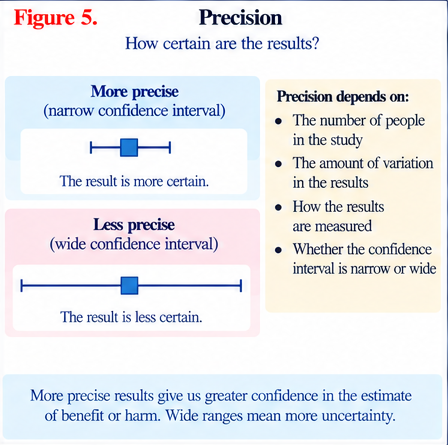
Precision describes how narrowly the data estimate the treatment effect. Confidence intervals are central: narrow intervals may support a stable conclusion, whereas wide intervals can leave clinically important benefit, little effect, and harm simultaneously plausible. [1-8]
Precision depends on sample size, event frequency, variability, study design, and the amount of information accumulated across studies. A nonsignificant result can still be precise enough to exclude an important benefit, while a statistically significant result can remain too imprecise to determine the true magnitude reliably. [1-8]
Risk-benefit balance
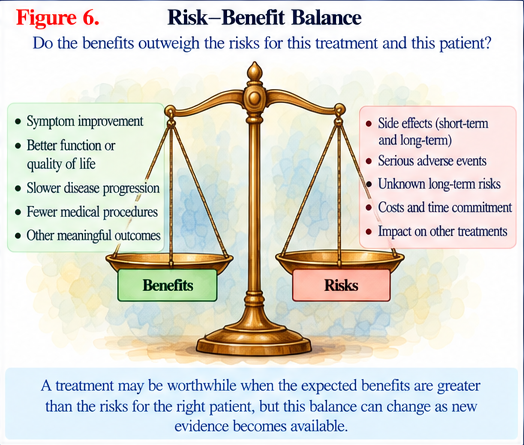
Risk-benefit balance integrates the expected benefits of an intervention with known and potential harms for a defined clinical context. It depends not only on effect estimates but also on outcome importance, certainty, baseline risk, alternatives, reversibility of harms, durability, patient preferences, and uncertainty. [1-8]
A favorable risk-benefit balance in one setting does not automatically transfer to another. A higher-risk intervention may be reasonable for a severe condition with few alternatives but unacceptable for a mild condition with effective standard therapy. Evidence certainty and benefit-risk judgment should therefore be reported separately even though they inform one another. [1-8]
Clinical takeaway
Evidence grading asks how certain we are, how large the effect is, whether findings are consistent, how directly they answer the clinical question, how precise the estimate is, and how benefits compare with harms. These dimensions should be considered explicitly rather than collapsed into a simple positive-versus-negative judgment. [1-8]
Evidence level versus development and regulatory status
Evidence level, development stage, regulatory status, guideline position, and manufacturing quality are separate labels. An investigational product can have promising or even relatively strong evidence for a defined question without authorization; an authorized product can retain uncertainty for particular populations, outcomes, or long-term risks. Regulatory status should not be used as a substitute for grading the scientific evidence. [1-6]
Positive, negative, and inconclusive evidence
Positive evidence should be downgraded when bias, inconsistency, indirectness, or imprecision weakens confidence. Negative evidence should be strengthened when precise, direct, consistent studies exclude a clinically important effect. Inconclusive evidence should remain inconclusive when the data are compatible with materially different outcomes. The direction of the result does not determine its evidentiary quality. [1-8]
Regenerative-medicine considerations
For MSC and EV studies, evidence grading can be invalidated by treating heterogeneous products as interchangeable. Certainty about one product cannot automatically be assigned to another with different tissue source, manufacturing, characterization, potency, dose, route, or storage. Apparent inconsistency may sometimes represent true product or population heterogeneity rather than random noise. [3-8]
Bottom-line evidence statement
A defensible evidence grade is a transparent judgment, not a numerical decoration. It should state the exact clinical question, identify the evidence base, explain downgrading or upgrading judgments, separate certainty from benefit-risk and regulatory status, and make uncertainty visible. The same grading rules must apply whether the evidence favors, disfavors, or fails to resolve the value of a regenerative intervention. [1-8]