Plain-language overview
Evidence grading is a structured way of asking how much confidence we should place in a group of studies. It is not simply a count of how many studies were positive. Researchers also ask how well the studies were conducted, how large the effects were, whether different studies agree, how closely the evidence matches the patient and treatment being considered, and how much uncertainty remains. [1-8]
For stem-cell and extracellular-vesicle treatments, evidence grading must stay tied to the exact product. Two treatments with similar names may differ in tissue source, manufacturing, dose, route, storage, potency, or patient population. Evidence for one product should not automatically be transferred to another. [1-8]
Certainty of evidence
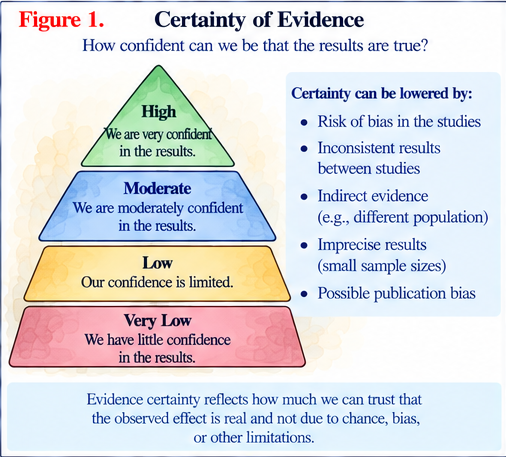
Certainty of evidence describes how confident we are that the estimated treatment effect is close enough to the true effect to support a decision. Evidence-grading systems may describe certainty as high, moderate, low, or very low. [1-8]
A randomized trial does not automatically create high-certainty evidence, and an observational study does not automatically mean the evidence is useless. Problems such as bias, inconsistent results, indirect evidence, wide uncertainty, or missing studies can lower confidence. The reasons for the grade should be explained. [1-8]
Magnitude of effect
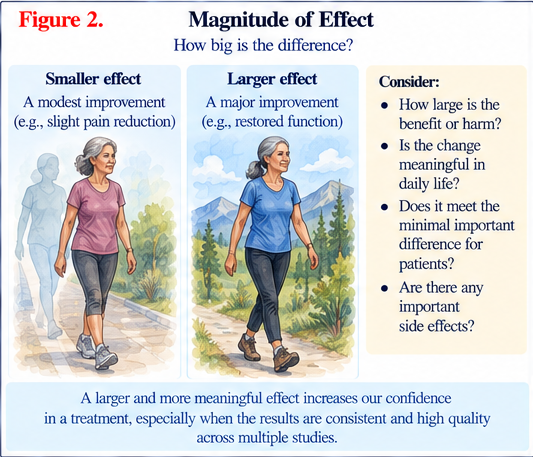
Magnitude of effect means how large the observed benefit or harm is. A treatment might reduce risk by a large proportion but produce only a small absolute difference if the original risk was already low. [1-8]
A statistically significant effect can still be too small to matter clinically. A large effect can be more persuasive when it is consistent, precise, and unlikely to be explained by bias. The actual size of the benefit should therefore be considered alongside side effects, durability, and what matters to patients. [1-8]
Consistency
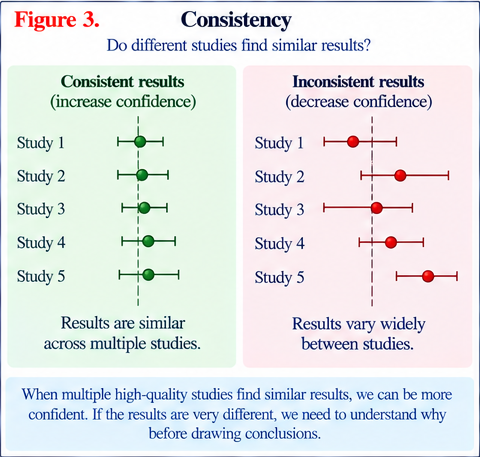
Consistency asks whether different studies point in a similar direction and show reasonably compatible results. Repeated findings across different researchers, centers, and patient groups can increase confidence. [1-8]
When studies disagree, the disagreement should be investigated rather than simply averaged away. Differences in the product, dose, route, disease severity, patient selection, comparison treatment, outcome, or study quality may explain why results differ. [1-8]
Directness
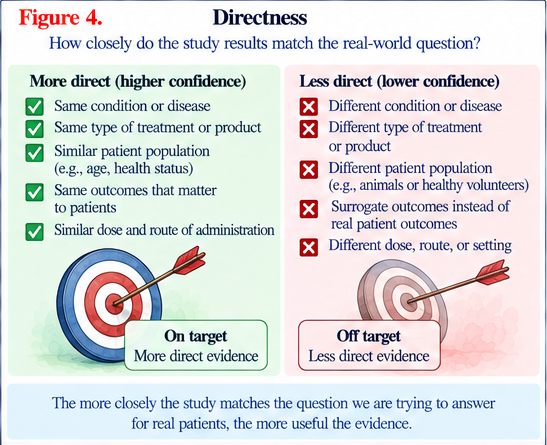
Directness asks how closely the available evidence matches the question being asked. The most direct evidence studies patients like the patient of interest, uses the same treatment and comparison, and measures outcomes that matter clinically. [1-8]
Evidence becomes less direct when we must make an important leap—for example from animals to humans, from one disease to another, from a laboratory marker to patient benefit, or from one stem-cell or extracellular-vesicle product to a substantially different product. [1-8]
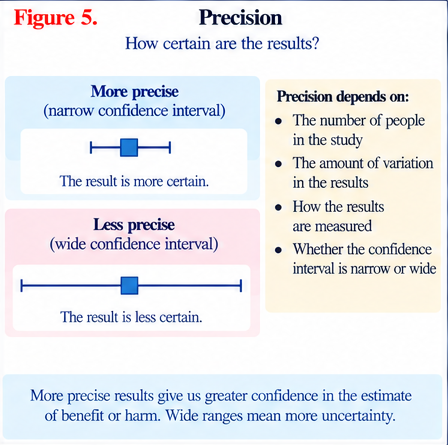
Precision
Precision describes how much uncertainty surrounds an estimate. Confidence intervals are commonly used to show this. A narrow interval usually means the effect has been estimated more precisely; a wide interval means greater uncertainty. [1-8]
A study can fail to reach statistical significance yet still be precise enough to rule out an important benefit. Another study can be statistically significant but still have an interval wide enough that the true size of the benefit is uncertain. The interval matters more than a simple positive-or-negative label. [1-8]
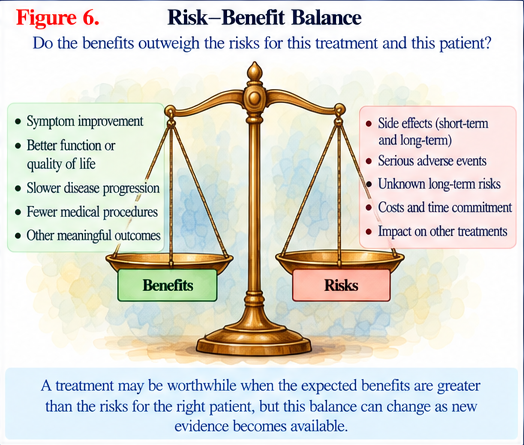
Risk-benefit balance
Risk-benefit balance compares the expected benefits of a treatment with its known and possible harms. The balance depends on how serious the condition is, how effective existing treatments are, how large and durable the expected benefit is, how certain the evidence is, and how serious or reversible the risks are. [1-8]
The same treatment can have a different risk-benefit balance in different situations. A higher-risk experimental treatment may be more reasonable for a severe condition with few alternatives than for a mild condition with effective standard treatment. [1-8]
How the grading pieces fit together
Evidence grading asks several different questions at once: How certain are we? How large is the effect? Do studies agree? Does the evidence directly match the patient and treatment? How precise is the estimate? And how do expected benefits compare with possible harms? None of these questions should be replaced by a simple statement that the evidence is 'positive' or 'negative.' [1-8]
Evidence versus regulatory status
Scientific evidence, stage of development, regulatory status, guideline recommendations, and manufacturing quality are related but different. A treatment can have promising evidence and still be investigational. An authorized treatment can still have important unanswered questions. Regulatory status should therefore not be used as a substitute for examining the evidence itself. [1-6]
Positive, negative, and inconclusive evidence
Positive results deserve less confidence when studies are biased, inconsistent, indirect, or imprecise. Negative results become more convincing when good studies consistently and precisely rule out an important benefit. When the available data still allow very different conclusions, the correct grade may be uncertainty rather than forcing the evidence into a positive or negative category. [1-8]
Why product identity matters
In regenerative medicine, apparent disagreement between studies may sometimes reflect genuinely different products rather than random inconsistency. Tissue source, manufacturing, purification, storage, potency, dose, route, and patient population should be checked before deciding that studies are testing the same treatment. [3-8]
Bottom line
A useful evidence grade should make uncertainty visible. It should explain what studies were considered, why confidence was increased or reduced, how directly the evidence applies, how large and precise the effect is, and how benefits compare with harms. The same rules should be used whether the evidence favors, disfavors, or does not yet resolve the value of a treatment. [1-8]
Questions patients should ask
• How certain is the evidence for this exact treatment and condition?
• How large was the benefit, not just whether it was statistically significant?
• Did different studies produce similar results?
• Do the studies involve patients like me?
• Was the exact product, dose, and route similar to what is being proposed?
• How wide were the confidence intervals?
• Could an important benefit or harm still be hidden by uncertainty?
• What are the expected benefits compared with the known and possible risks?
• Is the treatment investigational, and is that status being kept separate from the scientific evidence?