Evidence hierarchies organize study designs according to the kinds of questions they can answer and their typical vulnerability to bias. They are useful shorthand, but they are not automatic rankings of truth. A well-conducted observational study may be more informative than a poorly executed randomized trial for some questions, and a meta-analysis cannot repair fundamentally weak or heterogeneous primary studies. For mesenchymal stromal cell (MSC), extracellular-vesicle (EV), and other regenerative interventions, evidence must also remain specific to product source, manufacturing, dose, route, indication, population, comparator, endpoint, and follow-up. [1-8]
Case reports
A case report describes the clinical course of an individual patient. It can identify an unexpected response, unusual adverse event, novel disease presentation, or hypothesis worthy of further study. [1-8]
Case reports cannot establish treatment efficacy because there is no concurrent comparison group and because natural history, placebo effects, regression to the mean, co-interventions, selective observation, and reporting bias cannot be separated reliably from the treatment effect. They are signals, not confirmatory evidence. [1-8]

Case series
A case series describes multiple patients who received a treatment or shared a clinical feature. It can reveal patterns of response, feasibility, procedural complications, dose experience, or uncommon adverse events and may be valuable during early clinical development. [1-8]
Without an appropriate comparison group, a case series remains vulnerable to selection bias, changes in background care, natural disease variation, and selective reporting. Increasing the number of cases improves descriptive precision but does not by itself create a causal comparison. [1-8]

Observational studies
Observational studies examine exposures, treatments, and outcomes without random assignment. Cohort, case-control, registry, database, and other real-world designs can study large populations, uncommon harms, long-term outcomes, treatment patterns, and patients who may be excluded from randomized trials. [1-8]
The principal challenge is confounding: people who receive one treatment may differ systematically from those who receive another. Design and analytic methods such as matching, stratification, regression adjustment, propensity methods, instrumental-variable approaches, and target-trial emulation can reduce some bias, but unmeasured confounding may remain. [1-8]

Controlled trials
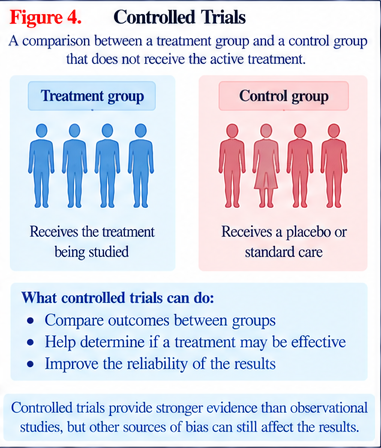
A controlled trial compares an intervention group with a concurrent comparison group receiving placebo, sham procedure, standard care, another active treatment, or another defined strategy. A concurrent control improves causal interpretation by providing an estimate of what would have happened without the investigational intervention under similar study conditions. [1-8]
Controlled does not necessarily mean randomized. Nonrandomized controlled trials can remain vulnerable to selection and confounding. The strength of inference depends on how the control was chosen, baseline comparability, co-interventions, blinding, outcome assessment, missing data, and analysis. [1-8]
Randomized trials
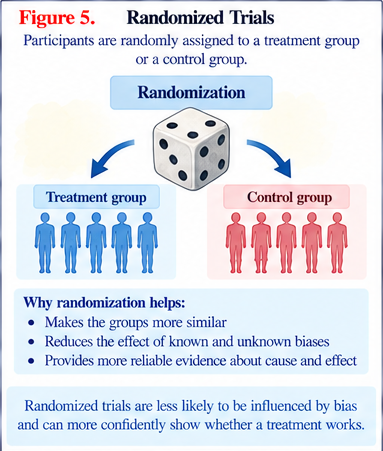
Randomized controlled trials assign participants to treatment strategies by chance. When randomization is properly generated and concealed, it reduces systematic baseline differences in measured and unmeasured prognostic factors and provides a strong design for estimating causal treatment effects. [1-8]
Randomization does not guarantee validity. Poor allocation concealment, lack of blinding, differential attrition, protocol deviations, selective reporting, small samples, inappropriate endpoints, manufacturing inconsistency, or inadequate follow-up can substantially weaken a randomized trial. Its applicability may also be narrow if enrollment is highly selective. [1-8]
Systematic reviews
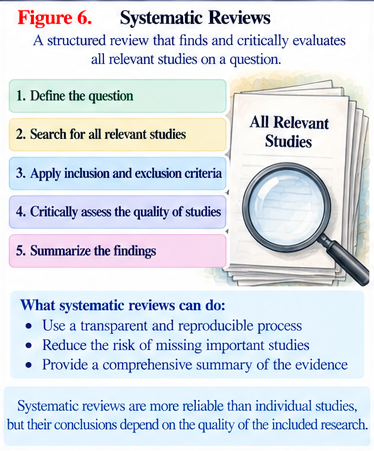
A systematic review uses explicit, reproducible methods to identify, select, appraise, and synthesize all eligible evidence addressing a defined question. It can show where evidence is consistent, where it conflicts, and where important gaps remain. [1-8]
The review is limited by the quality and completeness of the underlying studies and by its own methods. Search restrictions, inappropriate eligibility criteria, duplicate data, weak risk-of-bias assessment, selective synthesis, and missing unpublished studies can distort conclusions. A systematic review does not necessarily include a statistical meta-analysis. [1-8]
Meta-analyses
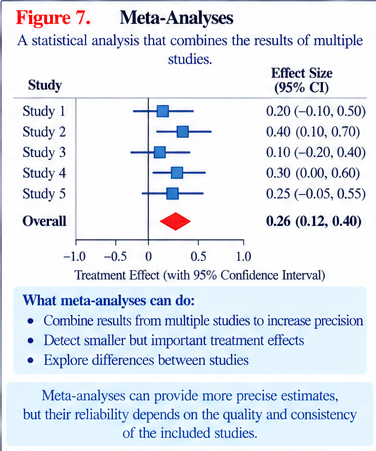
A meta-analysis statistically combines effect estimates from multiple studies to produce a pooled estimate when studies are sufficiently compatible. Pooling can improve precision and explore heterogeneity, but the pooled number is meaningful only if the included evidence addresses a sufficiently coherent clinical question. [1-8]
Combining studies with materially different cell sources, EV preparations, manufacturing methods, doses, routes, indications, populations, comparators, endpoints, or follow-up can create a precise-looking estimate that lacks clinical meaning. Heterogeneity, risk of bias, publication bias, model choice, and study dependence must therefore be examined rather than hidden by the pooled result. [1-8]
Guidelines
Clinical practice guidelines translate evidence into recommendations by combining systematic evidence assessment with judgments about benefits, harms, certainty, patient values, feasibility, equity, resources, and clinical context. High-quality guidelines disclose methods, conflicts of interest, evidence grading, and how recommendations were formulated. [1-8]
A guideline recommendation is not identical to an evidence estimate. Different guideline panels can reach different recommendations from similar evidence because they weigh values, risks, feasibility, or thresholds differently. Guidelines can also become outdated as evidence changes and should be interpreted according to jurisdiction, population, and date. [1-8]

Clinical takeaway
Evidence hierarchies are most useful when they identify what each design contributes rather than when they are treated as a rigid ladder. Case reports and series generate signals; observational studies provide real-world associations and long-term information; controlled and randomized trials strengthen causal inference; systematic reviews synthesize the full evidence base; meta-analyses can increase precision when pooling is justified; and guidelines convert evidence into recommendations using additional clinical and societal judgments. [1-8]
Question-specific evidence
The best design depends partly on the question. Randomized trials are generally strong for comparative efficacy, but very rare or delayed harms may be detected more effectively through large observational datasets or postmarketing surveillance. Mechanistic questions may require laboratory evidence, and patient preferences may require qualitative or patient-reported research. A single hierarchy cannot rank every form of evidence for every purpose. [1-6]
Quality within each level
Study design and study quality are separate dimensions. A randomized label cannot compensate for severe bias or poor execution, and an observational design should not be dismissed when it provides high-quality evidence for a question randomization cannot reasonably answer. Risk of bias, directness, precision, consistency, and applicability should be assessed within each evidence type. [1-8]
Regenerative-medicine considerations
Regenerative studies are particularly vulnerable to false aggregation. Two reports labeled 'MSC therapy' or 'exosome therapy' may involve biologically different products. Evidence synthesis should verify tissue source, manufacturing, characterization, potency, dose metric, route, indication, population, comparator, and outcome before treating studies as estimates of the same intervention. [3-8]
Bottom-line evidence statement
No study design should be accepted or rejected solely by its position in a hierarchy. The most defensible conclusion comes from integrating design, methodological quality, directness, consistency, precision, product comparability, clinical relevance, and the totality of evidence. Higher-level synthesis is valuable only when it accurately represents the evidence beneath it. [1-8]