Plain-language overview
Medical evidence comes from different kinds of studies. Some describe what happened to one patient, some follow groups of patients in routine care, some directly compare treatments, and some combine the results of many studies. An evidence hierarchy is a useful way to understand what each type of evidence can and cannot tell us. [1-8]
The hierarchy should not be treated as a simple rule that anything higher on a list is automatically correct. A poorly conducted randomized trial can be misleading, and a carefully performed observational study can provide valuable information—especially about uncommon harms, long-term outcomes, or patients who are not usually included in trials. Study design and study quality both matter. [1-8]
Case reports
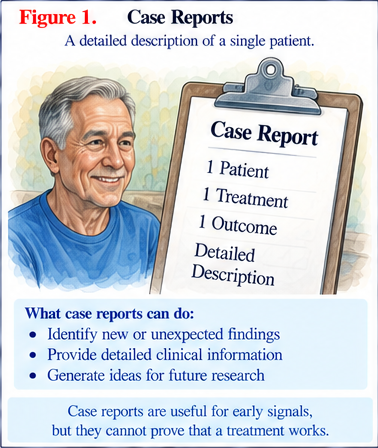
A case report describes what happened to one patient. It can be valuable when a doctor observes an unexpected improvement, unusual complication, new side effect, or other finding that deserves further investigation. [1-8]
A case report cannot prove that a treatment caused the outcome. The patient might have improved naturally, received other treatments, experienced a placebo effect, or simply been an unusual case. Case reports are best viewed as signals that can lead to better studies. [1-8]
Case series
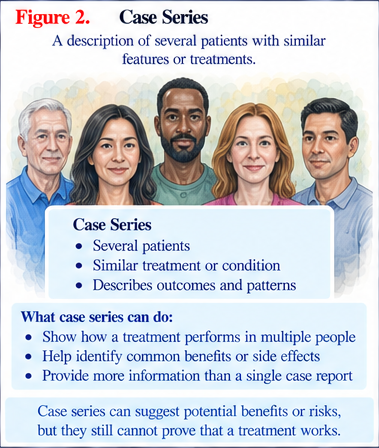
A case series describes several patients with a shared treatment or clinical feature. It can help researchers recognize patterns of response, feasibility, procedural problems, or possible side effects. [1-8]
Because there is usually no appropriate comparison group, a case series cannot reliably show what would have happened without the treatment. Adding more patients makes the description more precise but does not turn the series into a controlled experiment. [1-8]
Observational studies
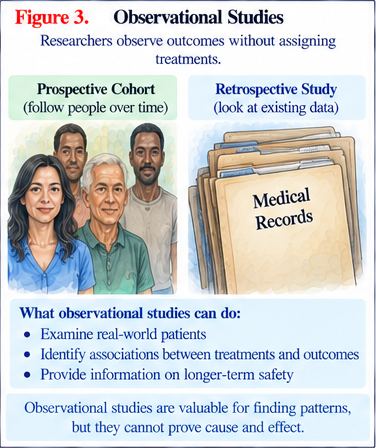
Observational studies examine treatments, exposures, and outcomes without randomly assigning people to treatment. They include cohort studies, case-control studies, registries, health-record studies, and other real-world research. [1-8]
These studies can include large numbers of patients and long follow-up, making them especially useful for uncommon harms and routine clinical practice. Their major limitation is that people who receive different treatments may also differ in important ways. Statistical adjustment can reduce some of these differences, but it cannot guarantee that every important difference has been removed. [1-8]
Controlled trials
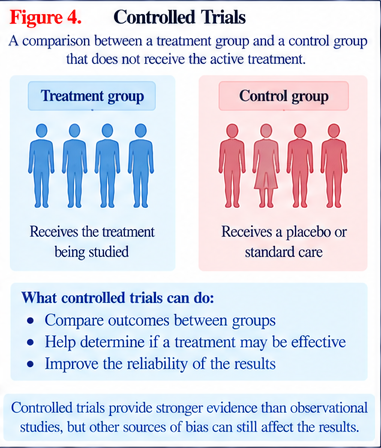
A controlled trial compares people receiving an intervention with a concurrent group receiving placebo, standard care, another active treatment, a sham procedure, or another defined strategy. Having a comparison group makes it easier to estimate what might have happened without the investigational treatment. [1-8]
Not every controlled trial is randomized. If patients or clinicians influence which treatment is received, the groups may differ in ways that affect the result. The quality of the control group, blinding, follow-up, outcome measurement, and analysis all matter. [1-8]
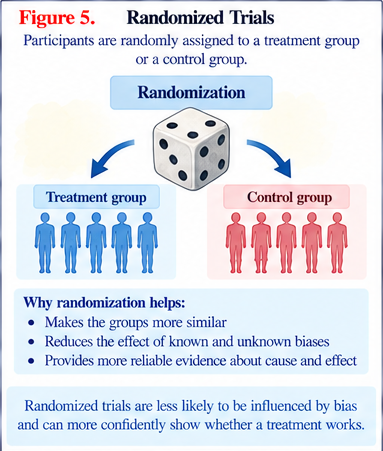
Randomized trials
A randomized trial assigns participants to treatment groups by chance. Proper randomization makes it less likely that one group begins with systematically healthier, sicker, or otherwise different patients and is one of the strongest designs for comparing treatment effects. [1-8]
Randomization does not guarantee that a trial is trustworthy. Poor blinding, loss to follow-up, selective reporting, small sample size, weak endpoints, inconsistent products, or short follow-up can still weaken the result. A randomized trial can also include a narrow group of patients and therefore have limited applicability to others. [1-8]
Systematic reviews
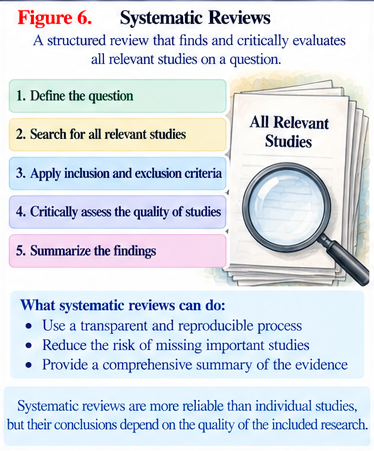
A systematic review asks a focused question and uses planned, reproducible methods to find, evaluate, and summarize all eligible studies. A good review can show where studies agree, where they disagree, and where important evidence is missing. [1-8]
A systematic review is only as reliable as both its methods and the studies it includes. If important studies are missed, weak studies dominate the evidence, or results are selected unfairly, the review can still reach a misleading conclusion. [1-8]
Meta-analyses
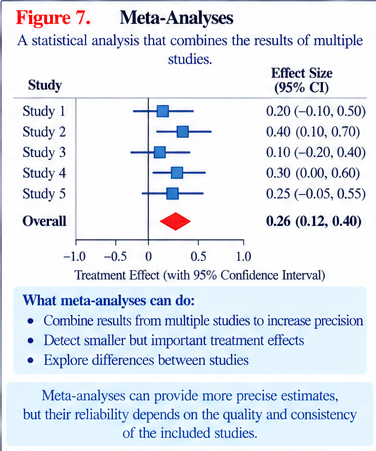
A meta-analysis uses statistical methods to combine results from multiple studies into a pooled estimate. When the studies are sufficiently similar, combining them can improve precision and provide a clearer estimate than any single small study. [1-8]
Pooling studies that are too different can create a precise-looking number that has little clinical meaning. This is particularly important for stem-cell and extracellular-vesicle research, where studies may use different tissue sources, manufacturing methods, doses, routes, diseases, patient groups, and outcomes. [1-8]
Guidelines
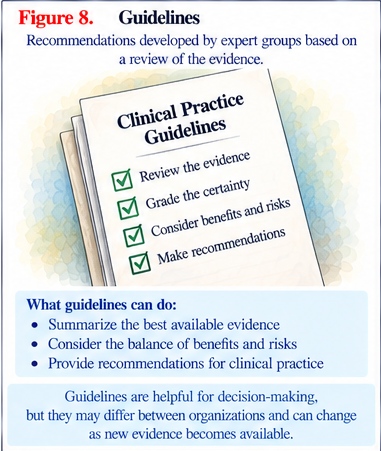
Clinical practice guidelines turn evidence into recommendations for patient care. Guideline panels consider not only study results but also benefits, harms, certainty of evidence, patient values, feasibility, resources, and the clinical setting. [1-8]
A guideline recommendation is not the same thing as a study result. Different panels can reasonably make different recommendations from similar evidence because they weigh risks, benefits, values, or practical issues differently. Guidelines can also become outdated as new evidence appears. [1-8]
How the evidence types fit together
Case reports and case series can identify signals. Observational studies can show patterns in larger and more representative populations. Controlled and randomized trials strengthen treatment comparisons. Systematic reviews bring the evidence together. Meta-analyses can combine compatible results statistically. Guidelines then use the evidence, along with clinical and patient considerations, to make recommendations. [1-8]
The best evidence depends on the question
There is no single study design that is best for every question. Randomized trials are usually strong for comparing treatment effectiveness, but a very rare side effect may be detected more effectively in a large registry or postmarketing database. Different evidence types can therefore complement one another. [1-6]
Why quality still matters
The name of the study design is only the starting point. Researchers must also ask whether the study was well planned, whether important biases were controlled, whether the outcome directly answers the clinical question, how precise the result is, and whether the findings agree with other evidence. [1-8]
Why product identity matters in regenerative medicine
Two studies may both say they used 'stem cells' or 'exosomes' while actually testing substantially different products. Tissue source, manufacturing, purification, storage, potency, dose, route, patient population, and outcome can all differ. Studies should not be combined or treated as equivalent until these differences are examined. [3-8]
Bottom line
Do not judge evidence only by where it sits on a hierarchy. Ask what question the study design can answer, how well the study was conducted, whether the evidence directly applies to the patient and product being considered, how consistent and precise the findings are, and whether higher-level reviews accurately represent the studies underneath them. [1-8]
Questions patients should ask
• What type of study supports this treatment claim?
• Was there a comparison group?
• Were patients randomly assigned when that was appropriate?
• How well was the study conducted?
• Does the study involve the same product, dose, route, and condition being discussed?
• Have the results been reproduced in other studies?
• Does a systematic review include all important evidence, including negative studies?
• If a meta-analysis combines studies, are the treatments and patient groups similar enough to combine meaningfully?
• Is a guideline current, and does it apply to my clinical situation?