Bias is a systematic process that can move an estimate away from the truth. It is different from random error: increasing sample size can improve precision but does not necessarily remove systematic bias. Transparency allows readers, reviewers, clinicians, and patients to identify how a study was planned, conducted, analyzed, funded, and reported. In regenerative medicine, where early trials may be small, procedures may be difficult to blind, products may vary by manufacturing process, and commercial interest may be substantial, rigorous bias control and transparent reporting are essential for interpreting both favorable and unfavorable findings. [1-8]
Selection bias
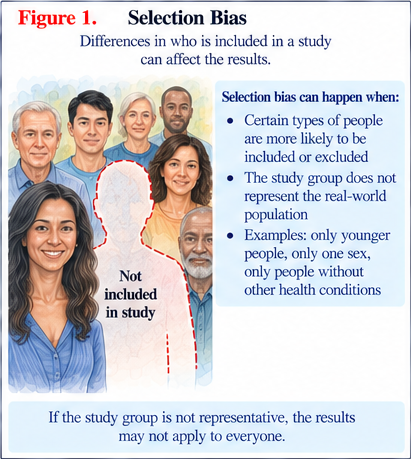
Selection bias occurs when the participants entering a study, or the way they are assigned to comparison groups, creates systematic differences related to prognosis or treatment response. In randomized trials, inadequate sequence generation or allocation concealment can allow investigators to influence assignment. In observational studies, treatment selection may be related to disease severity, access, clinician preference, socioeconomic factors, or other prognostic variables. [1-8]
Randomization with secure allocation concealment reduces selection bias in controlled trials. In nonrandomized studies, careful design and statistical adjustment can reduce measured confounding, but residual and unmeasured confounding may remain. A well-balanced baseline table does not prove that selection bias is absent. [1-8]
Performance bias
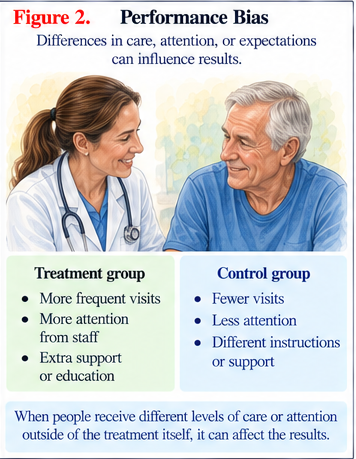
Performance bias arises when participants or clinical teams receive different care, attention, co-interventions, monitoring, rehabilitation, or behavior because treatment assignment is known. Expectations can also alter adherence, symptom reporting, or decisions to seek additional treatment. [1-8]
Blinding can reduce performance bias, but it may be difficult when regenerative interventions require injections, surgery, cell preparation, or distinctive procedures. When blinding is infeasible, protocols should standardize background care, rescue therapy, rehabilitation, follow-up intensity, and other co-interventions as much as possible. [1-8]
Detection bias
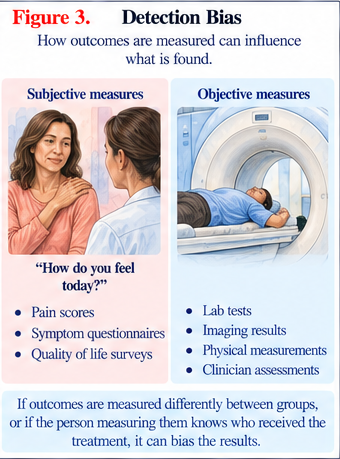
Detection bias occurs when knowledge of treatment assignment influences how outcomes are measured, interpreted, adjudicated, or recorded. It is especially important for outcomes requiring judgment, such as imaging interpretation, physical examination, functional scoring, or decisions about whether an event meets an endpoint definition. [1-8]
Blinded outcome assessment, central imaging review, independent endpoint adjudication, objective measurement methods, standardized training, and prespecified definitions can reduce detection bias. Objective outcomes can still be biased if ascertainment or follow-up differs between groups. [1-8]
Attrition bias
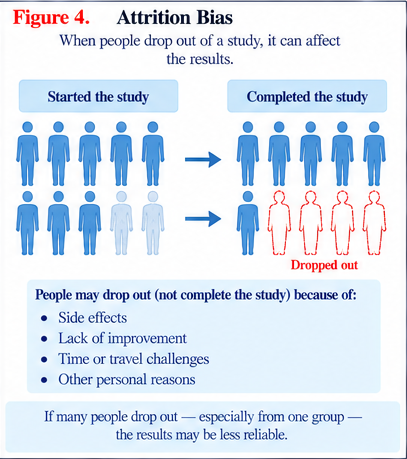
Attrition bias occurs when withdrawal, loss to follow-up, treatment discontinuation, or missing outcomes differ between groups or are related to prognosis or response. The participants who remain under observation may no longer represent the population originally randomized. [1-8]
Trials should report participant flow, reasons for withdrawal, missing outcomes, and analysis methods. Intention-to-treat principles, prevention of avoidable loss to follow-up, appropriate missing-data methods, and sensitivity analyses can reduce or characterize the problem, but no method fully replaces unobserved information. [1-8]
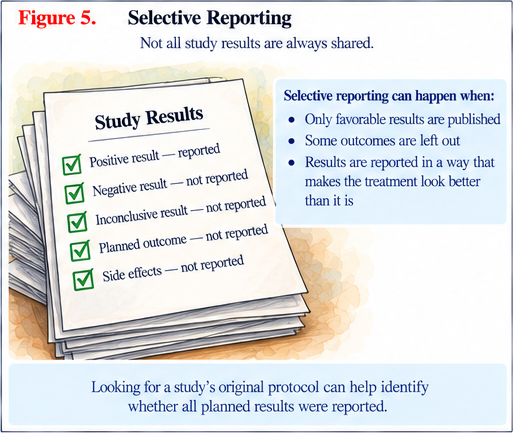
Selective reporting
Selective reporting occurs when outcomes, analyses, time points, subgroups, or adverse events are reported according to the direction or statistical significance of the results. A trial may measure many outcomes but emphasize only those that appear favorable. [1-8]
Prospective registration, publicly available protocols and statistical analysis plans, prespecified primary and secondary outcomes, complete adverse-event reporting, and comparison of publications with registry entries can reveal or reduce selective reporting. Changing an outcome after seeing the data is not automatically invalid, but it must be transparently identified as post hoc rather than presented as prespecified. [1-8]
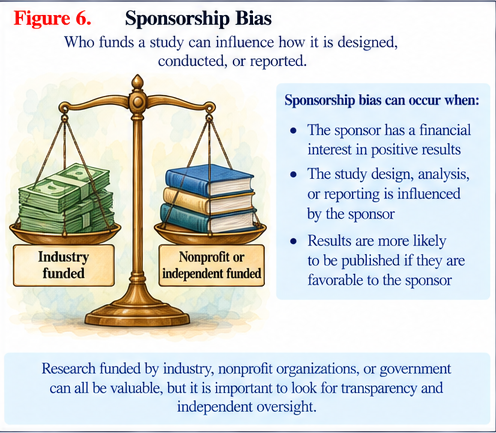
Sponsorship bias
Sponsorship bias refers to systematic differences associated with the interests of a study's funder or sponsor. Funding does not make a study invalid, and industry-sponsored research can be rigorous and clinically important. The concern is whether financial or institutional interests influence design, comparator choice, analysis, interpretation, publication, or access to data. [1-8]
Transparency requires disclosure of funding, relevant financial relationships, sponsor roles, author independence, data access, protocol control, statistical responsibility, and publication rights. Methodological quality should be evaluated directly rather than assuming that either commercial or noncommercial sponsorship guarantees a particular result. [1-8]
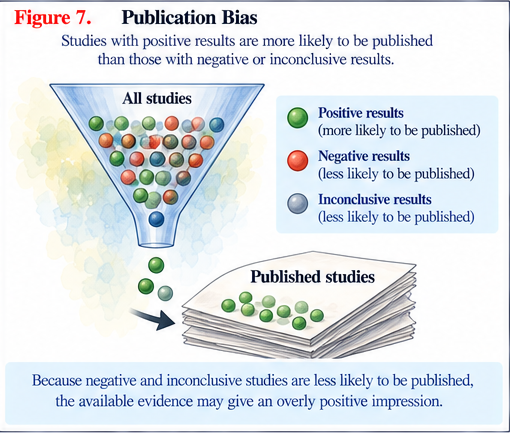
Publication bias
Publication bias occurs when the probability that a study becomes publicly available depends on its results. Positive, statistically significant, or novel findings have historically been more likely to appear in journals, while negative or inconclusive studies may remain unpublished or appear later. [1-8]
This can make an intervention look more effective or better studied than it is. Trial registration, results reporting, regulatory disclosure, preprints, data-sharing initiatives, and systematic searches for unpublished evidence can reduce the distortion. Systematic reviews and meta-analyses remain vulnerable if the underlying evidence base is incomplete. [1-8]
Clinical takeaway
Bias control and transparency are inseparable. Selection bias concerns who enters or receives treatment; performance bias concerns differences in care after assignment; detection bias concerns how outcomes are assessed; attrition bias concerns who remains observed; selective reporting concerns which results are presented; sponsorship bias concerns influence from vested interests; and publication bias concerns which studies become publicly visible. [1-8]
Transparency before the trial
Prospective trial registration, a dated protocol, a prespecified statistical analysis plan, clearly defined outcomes, and documented amendments create an audit trail before results are known. These materials allow later readers to distinguish planned analyses from data-driven decisions and to determine whether important outcomes disappeared or changed. [1-6]
Transparency after the trial
Transparent reporting includes participant flow, protocol deviations, missing data, all prespecified outcomes, adverse events, funding, conflicts of interest, sponsor roles, analytic methods, and limitations. Results should be posted or published regardless of whether they are favorable, negative, mixed, or inconclusive. [1-8]
Regenerative-medicine considerations
Cell and EV studies can be especially vulnerable to hidden heterogeneity if product source, culture, purification, storage, potency, dose, or lot information is incompletely reported. Procedural differences, rehabilitation, background care, and center expertise can also create performance or detection effects. Transparent product and procedure reporting is therefore part of bias assessment, not merely a manufacturing appendix. [3-6]
Bottom-line evidence statement
A study should not be trusted or dismissed solely because of one label such as randomized, blinded, industry-funded, academic, positive, or peer-reviewed. Credibility comes from the total pattern of design safeguards, execution, prespecification, complete reporting, data transparency, consistency with other evidence, and disclosure of interests. Favorable and unfavorable studies deserve the same scrutiny. [1-8]