Plain-language overview
Bias is a systematic problem that can push a study result away from the truth. It is different from ordinary chance variation. A large study can still be biased if patients were selected unfairly, groups received different extra care, outcomes were judged differently, too many participants disappeared from follow-up, or only favorable results were reported. [1-8]
Transparency means giving readers enough information to see how a study was planned, performed, analyzed, funded, and reported. This is especially important in regenerative medicine, where early studies may be small, treatments can be difficult to blind, products may vary in how they are manufactured, and both academic and commercial interests may be involved. [1-8]
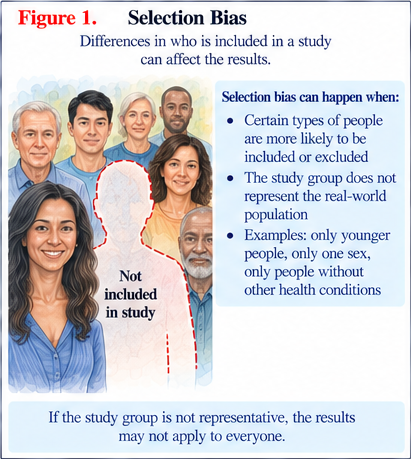
Selection bias
Selection bias occurs when the people entering a study, or the way they are placed into treatment groups, creates systematic differences that can affect the result. For example, one group might begin with healthier patients or patients more likely to improve. [1-8]
Random assignment and concealed treatment allocation can reduce this problem in randomized trials. In nonrandomized studies, researchers can adjust for measured differences, but important unmeasured differences may remain. [1-8]
Performance bias
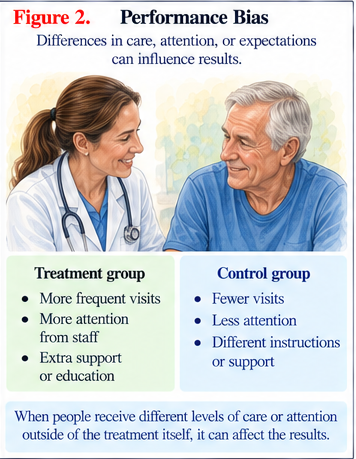
Performance bias occurs when treatment groups receive different attention, additional care, rehabilitation, monitoring, or behavior because patients or clinicians know which treatment was given. [1-8]
Blinding can reduce this problem, but blinding may be difficult when a treatment involves injections, surgery, or visibly different products. When blinding is not possible, researchers should standardize background care and other treatments as much as possible. [1-8]
Detection bias
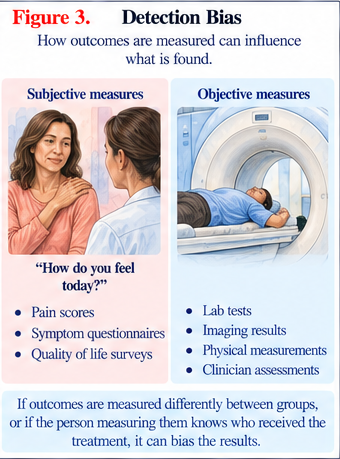
Detection bias occurs when knowledge of treatment assignment influences how an outcome is measured or judged. This is especially important for scans, physical examinations, functional scores, or other outcomes that require human interpretation. [1-8]
Blinded outcome reviewers, central imaging review, standardized definitions, objective measurements, and independent endpoint review can reduce detection bias. [1-8]
Attrition bias
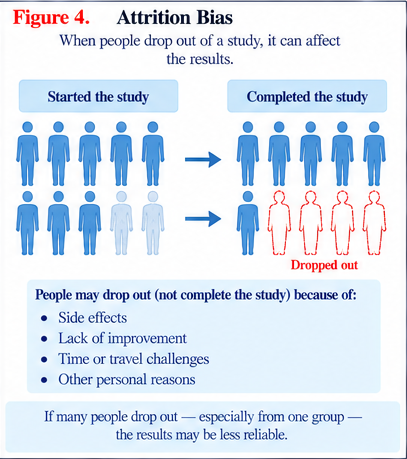
Attrition bias occurs when people leave a study, are lost to follow-up, stop treatment, or have missing outcomes in a way that differs between groups or relates to how well they are doing. [1-8]
Researchers should report how many participants were lost, why they left, and how missing information was handled. Statistical methods can reduce some problems, but they cannot fully replace information that was never collected. [1-8]
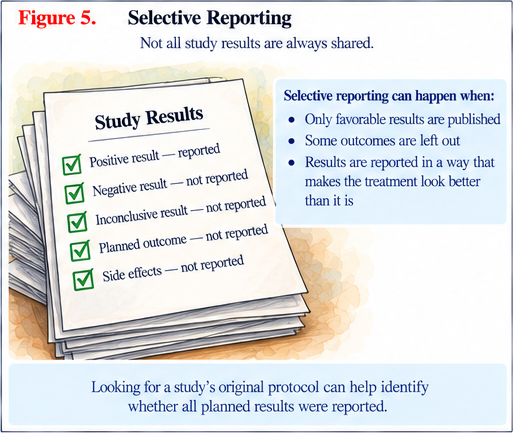
Selective reporting
Selective reporting occurs when researchers emphasize outcomes, time points, subgroups, or analyses because the results look favorable while giving less attention to results that were neutral or unfavorable. [1-8]
Registering a trial in advance and publishing the protocol and analysis plan can help readers compare what researchers originally intended to measure with what was eventually reported. Analyses added after seeing the data can still be useful, but they should be clearly identified as post hoc or exploratory. [1-8]
Sponsorship bias
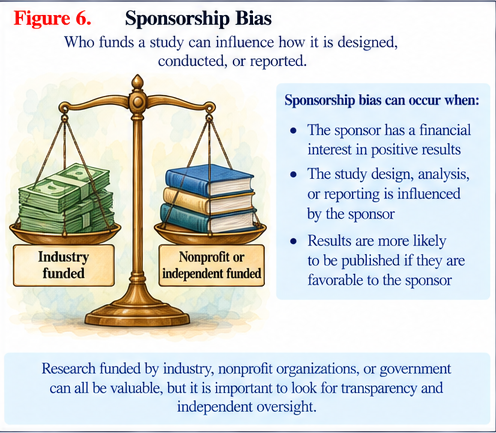
Sponsorship bias refers to possible systematic influence related to the interests of the organization funding or sponsoring a study. Industry funding does not automatically make a study unreliable, and academic or nonprofit funding does not automatically make a study unbiased. [1-8]
The important questions are whether funding and conflicts are disclosed, what role the sponsor had in study design and analysis, whether investigators had access to the data, and whether authors were free to publish unfavorable as well as favorable findings. [1-8]
Publication bias
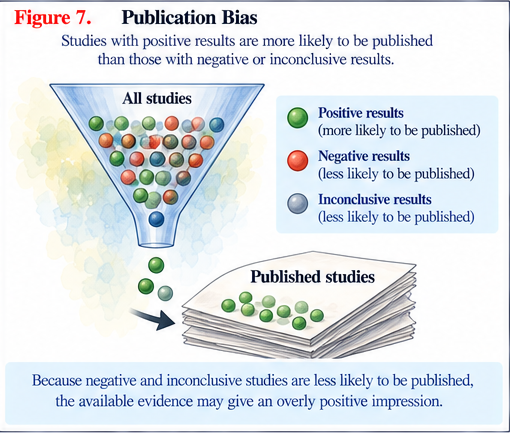
Publication bias occurs when studies with positive, statistically significant, or exciting findings are more likely to become publicly available than studies with negative or inconclusive results. [1-8]
If unsuccessful studies remain hidden, the published literature can make a treatment look more effective than the complete evidence would show. Trial registries, results reporting, regulatory records, and searches for unpublished studies can help reveal this problem. [1-8]
How the forms of bias fit together
Selection bias concerns who enters or receives treatment. Performance bias concerns differences in care after treatment assignment. Detection bias concerns how outcomes are judged. Attrition bias concerns who remains in the study. Selective reporting concerns which results are presented. Sponsorship bias concerns influence from vested interests. Publication bias concerns which entire studies become visible. [1-8]
Transparency before a trial begins
A trustworthy study leaves a record of what researchers planned before they knew the results. Trial registration, a dated protocol, clearly defined outcomes, and a statistical analysis plan make it easier to distinguish planned analyses from decisions made after seeing the data. [1-6]
Transparency after the trial
After a study is completed, readers should be able to see participant flow, missing data, protocol changes, all important outcomes, adverse events, funding, conflicts of interest, sponsor involvement, statistical methods, and major limitations. Negative and inconclusive studies are as important to the evidence base as positive studies. [1-8]
Why this matters in regenerative medicine
Stem-cell and extracellular-vesicle studies can be difficult to compare when product source, culture, purification, storage, potency, dose, or lot information is incomplete. Differences in procedures, rehabilitation, background care, and center expertise can also affect outcomes. Clear product and procedure reporting is therefore part of judging bias and transparency. [3-6]
Bottom line
Do not accept or reject a study simply because it is randomized, peer-reviewed, industry-funded, academic, positive, or negative. Look at the entire pattern: how patients were selected, how groups were treated, how outcomes were measured, how many participants were lost, whether the planned outcomes were fully reported, who funded the work, and whether unfavorable studies are also visible. [1-8]
Questions patients should ask
• How were participants selected and assigned to treatment groups?
• Could patients or clinicians tell which treatment was given?
• Were the people measuring outcomes blinded when possible?
• How many participants were lost to follow-up, and why?
• Were the main outcomes registered before the study began?
• Were unfavorable and neutral results reported as clearly as favorable results?
• Who funded the study, and what role did the sponsor have?
• Are there completed studies of this treatment whose results have not been published or posted?