Statistical interpretation determines how much uncertainty surrounds a clinical-trial result and whether the observed data support the conclusion being claimed. Statistical significance is not synonymous with clinical importance, and a nonsignificant result is not automatically evidence that two treatments are equivalent. Sample size, power, confidence intervals, multiplicity, missing data, subgroup analyses, and the analysis population must be interpreted together with study design, endpoint validity, effect size, and clinical context. These principles apply equally to positive, negative, mixed, and inconclusive regenerative-medicine trials. [1-6]
Sample size
Sample size is the number of participants or observations included in a study. It should be planned from the primary question using assumptions about the expected effect, variability or event rate, significance level, desired power, allocation ratio, anticipated dropout, and the statistical method. [1-8]
A study that is too small may produce imprecise estimates and fail to detect a clinically important effect. A very large study can detect a very small difference that has little clinical importance. Sample size therefore affects precision and detectability, not the intrinsic clinical value of an effect. [1-8]

Statistical power
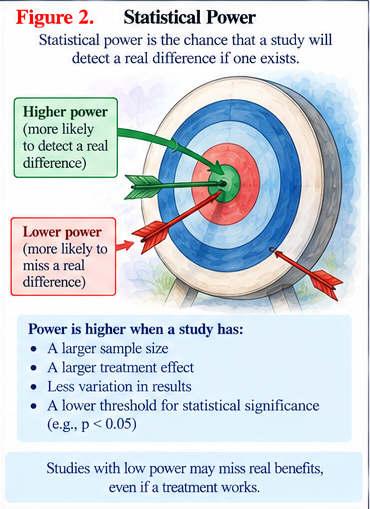
Statistical power is the probability that a study will detect a specified effect when that effect truly exists under the assumptions used for planning. Power is commonly set before a confirmatory trial, often at 80% or 90%, but the value is meaningful only in relation to the assumed effect size, variability, event rate, sample size, and analysis. [1-8]
Low power increases the chance of a false-negative result for the targeted effect. However, post hoc 'observed power' calculated from the trial result generally adds little beyond the estimate and its confidence interval. A nonsignificant underpowered trial should be described as inconclusive when clinically important effects remain compatible with the data. [1-8]
Confidence intervals
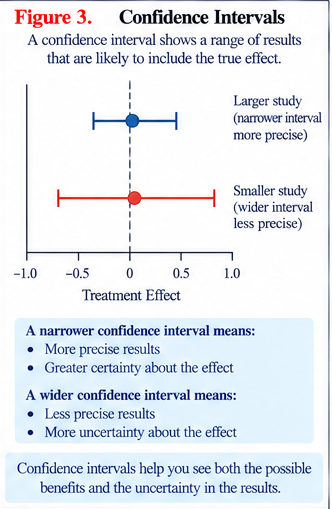
A confidence interval gives a range of values compatible with the observed data under the statistical model and sampling procedure. It conveys both the estimated effect and its precision and is usually more informative than a p value alone. [1-8]
Interpretation should compare the interval with clinically relevant thresholds. An interval may exclude no effect yet contain only trivial benefits; it may cross the null while excluding any important benefit; or it may be so wide that substantial benefit and substantial harm are both plausible. These situations should not be collapsed into a binary significant/nonsignificant label. [1-8]
Multiple comparisons
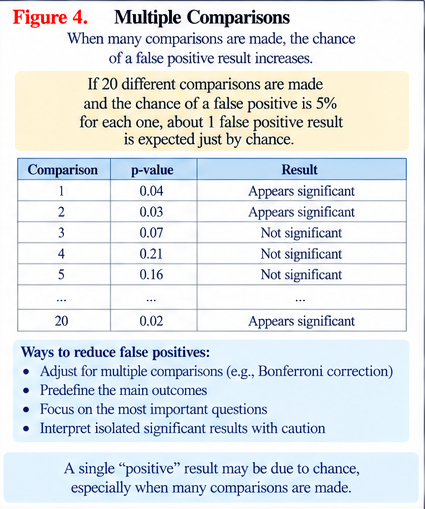
Multiple comparisons arise when a study tests many endpoints, doses, time points, subgroups, or statistical hypotheses. As the number of tests increases, the chance of obtaining at least one apparently significant result by chance also increases. [1-8]
Confirmatory trials should prespecify an endpoint hierarchy or multiplicity-control strategy when multiple claims are intended. Methods can include hierarchical testing, Bonferroni-type adjustments, gatekeeping procedures, or other valid approaches. Unadjusted exploratory analyses can be useful for hypothesis generation but should not be presented as if they were prespecified confirmatory evidence. [1-8]
Missing data
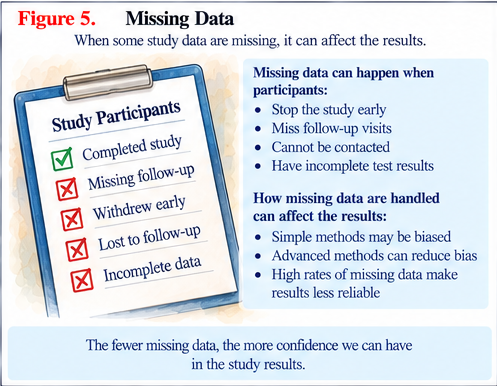
Missing data occur when planned measurements are unavailable—for example because of withdrawal, loss to follow-up, missed visits, death, treatment discontinuation, or incomplete questionnaires. The effect of missing data depends on why the information is missing and whether missingness differs between treatment groups or relates to outcome. [1-8]
Simply analyzing only participants with complete data can introduce bias. Trials should minimize missingness, document reasons, prespecify analytic methods, and perform sensitivity analyses that test how conclusions change under plausible assumptions. No statistical method can fully recover information that was never observed. [1-8]
Subgroup analysis
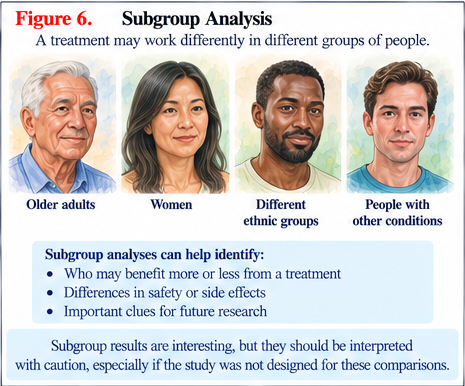
Subgroup analysis examines whether treatment effects differ across defined participant groups, such as disease severity, age, sex, biomarker status, or prior treatment. Such analyses can identify genuine effect modification and help refine future clinical use. [1-8]
They are also highly vulnerable to false-positive and unstable findings, especially when many subgroups are examined or sample sizes are small. Credible subgroup claims are strengthened by prespecification, biological or clinical rationale, adequate sample size, formal interaction testing, consistency, and replication. A significant result in one subgroup and a nonsignificant result in another does not itself prove that the treatment effects differ. [1-8]
Intention-to-treat analysis
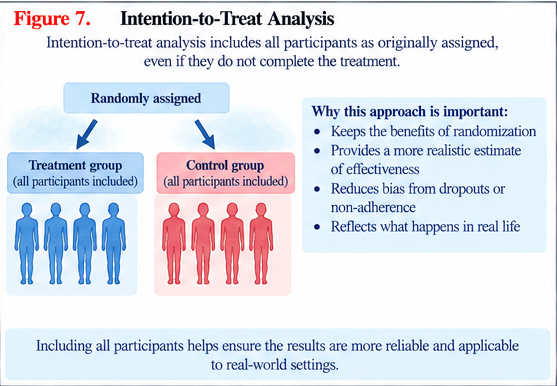
Intention-to-treat (ITT) analysis generally evaluates participants according to the groups to which they were randomized, regardless of treatment adherence, crossover, or some post-randomization events. This preserves important benefits of randomization and estimates the effect of assignment to a treatment strategy under the trial conditions. [1-8]
ITT does not eliminate missing-data problems, protocol deviations, or ambiguity about the clinical question. Per-protocol, as-treated, or estimand-based analyses may address different questions and can be informative when prespecified. The analysis population and estimand should match the treatment effect the trial intends to estimate. [1-8]
Clinical takeaway
Statistical interpretation should focus on effect size and uncertainty rather than a binary p-value threshold. Sample size and power affect what a trial can reliably detect; confidence intervals show precision; multiplicity protects against chance findings; missing-data methods address incomplete observations; subgroup analyses require strong safeguards; and intention-to-treat analysis preserves the randomized comparison for an assignment-based treatment effect. [1-8]
Statistical significance versus clinical importance
A statistically significant result can be too small to matter clinically, while a nonsignificant result can remain compatible with an important benefit or harm if the confidence interval is wide. Clinical interpretation should therefore consider absolute and relative effect size, confidence intervals, prespecified clinically meaningful thresholds, adverse effects, durability, and patient priorities. [1-4]
Positive, negative, and inconclusive trials
A positive trial should be scrutinized for multiplicity, selective emphasis, effect size, precision, and robustness. A negative trial should be examined to determine whether it actually excludes a clinically important effect. An inconclusive trial may reflect insufficient precision, missing data, design limitations, or conflicting outcomes. None of these categories should be assigned solely from whether p is above or below 0.05. [1-6]
Regenerative-medicine considerations
Small early-phase cell and EV trials often generate multiple biological, imaging, functional, and patient-reported outcomes. This can be scientifically appropriate for exploration but increases multiplicity and uncertainty. Heterogeneous products, small samples, center effects, variable background care, and incomplete long-term follow-up can further widen uncertainty. Exploratory signals should therefore be distinguished from prespecified confirmatory evidence. [3-6]
Bottom-line evidence statement
Statistics quantify evidence and uncertainty; they do not replace clinical reasoning. The defensible conclusion from a trial depends on the prespecified question, study design, effect estimate, confidence interval, multiplicity, missingness, subgroup credibility, analysis population, and clinical importance. Positive and negative findings should be subjected to the same statistical standards. [1-8]