Clinical outcomes determine what a trial actually demonstrates. A study can show biological activity without showing that patients feel better, function better, avoid major clinical events, or live longer. Conversely, a clinically meaningful benefit may occur without a validated biomarker explaining it. For mesenchymal stromal cell (MSC), extracellular-vesicle (EV), and related regenerative studies, outcome interpretation must therefore separate safety, biological markers, imaging, function, patient-reported experience, quality of life, survival, and the magnitude of change that matters clinically. [1-6]
Safety endpoints
Safety endpoints measure adverse consequences of an intervention. Depending on product and route, they may include infusion or injection reactions, infection, thrombosis, immune events, organ toxicity, procedure complications, ectopic tissue effects, unwanted proliferation, malignancy-related concerns, hospitalization, serious adverse events, and death. [1-8]
Safety interpretation depends on denominator, severity, attribution, timing, follow-up duration, comparator, and ascertainment. 'No treatment-related serious adverse events observed' is not equivalent to 'the treatment is safe,' particularly in small or short trials that cannot detect uncommon or delayed harms. [1-8]

Biomarkers
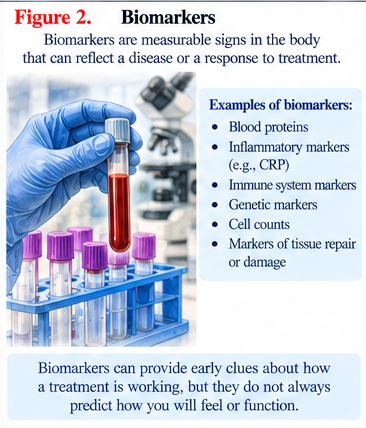
A biomarker is a measured biological characteristic that can indicate normal biology, disease, exposure, response, susceptibility, prognosis, or other biological processes. Examples include circulating proteins, cytokines, cell counts, molecular signatures, physiological measurements, and tissue markers. [1-8]
Biomarkers can support mechanism, target engagement, patient selection, prognosis, or early response. They should not be treated automatically as clinical benefit. A surrogate endpoint requires stronger validation: change in the surrogate must reliably predict change in a clinically meaningful outcome in the relevant context. [1-8]
Imaging
Imaging endpoints use modalities such as MRI, CT, ultrasound, radiography, PET, echocardiography, or specialized quantitative imaging to measure anatomy, tissue characteristics, perfusion, inflammation, structure, or function. [1-8]
Imaging can provide objective and anatomically specific information, but statistical change on an image may not translate into better symptoms or function. Acquisition protocols, scanner differences, segmentation, reader blinding, central interpretation, reproducibility, and prespecified thresholds are important to credibility. [1-8]

Functional outcomes
Functional outcomes measure what a patient can do. Depending on the condition, examples include walking distance, gait speed, strength, range of motion, exercise capacity, activities of daily living, neurologic performance, pulmonary function, or validated performance batteries. [1-8]
Function is often closer to patient-important benefit than a biomarker, but it can still be affected by learning, motivation, rehabilitation, assistive devices, evaluator behavior, and baseline severity. Standardized procedures, blinded assessment when feasible, and clinically interpretable effect sizes are important. [1-8]

Patient-reported outcomes
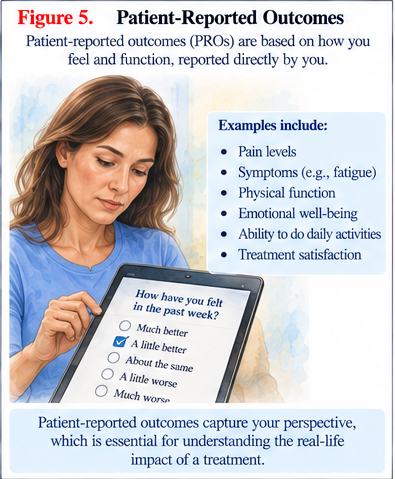
Patient-reported outcomes (PROs) are reports of symptoms, function, or health status provided directly by patients without interpretation by clinicians or observers. Validated PRO instruments can measure pain, fatigue, physical function, sleep, emotional well-being, treatment burden, and other experiences that only the patient can report directly. [1-8]
PROs are not inherently subjective in the sense of being scientifically weak; they can be rigorously developed and validated. Their interpretation depends on instrument validity, language and cultural adaptation, missing data, blinding, recall period, baseline values, and whether the observed change is meaningful to patients. [1-8]
Quality of life
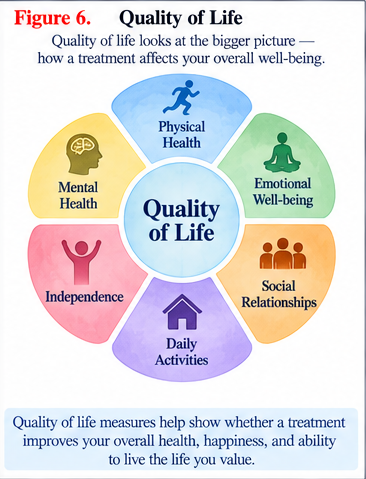
Quality of life is a broad construct reflecting how health affects physical, psychological, social, and sometimes role-related well-being. Health-related quality of life instruments may be generic, allowing comparison across conditions, or disease-specific, providing greater sensitivity to a particular illness. [1-8]
Quality-of-life improvement can be a major clinical benefit even when it does not alter survival. It should be measured with validated instruments and interpreted in relation to baseline status, comparator, missing data, multiplicity, durability, and the magnitude of change. [1-8]
Survival
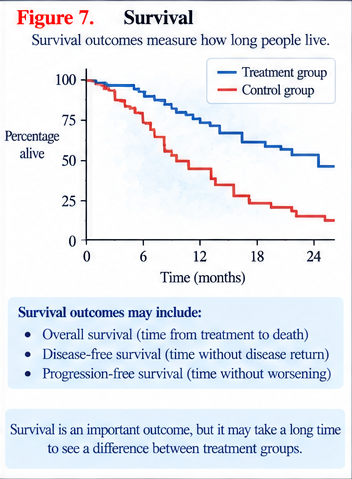
Survival endpoints measure time to death or related time-to-event outcomes. Overall survival is often considered a direct clinical endpoint because it is unambiguous and important to patients. Disease-specific survival, progression-free survival, event-free survival, and other time-to-event outcomes answer different questions. [1-8]
Survival analyses require attention to censoring, follow-up completeness, competing risks, crossover, subsequent therapy, proportional-hazards assumptions, and absolute as well as relative effects. A statistically significant hazard ratio may correspond to a small or large absolute clinical difference depending on baseline risk and follow-up. [1-8]
Clinically meaningful differences
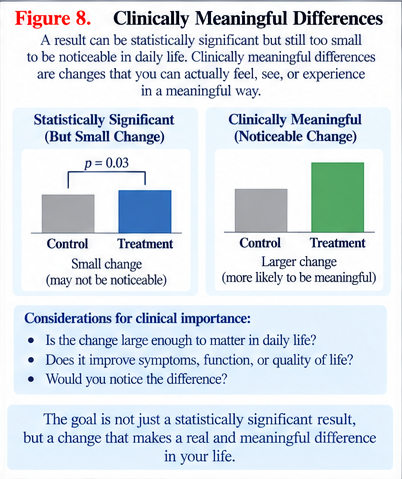
A clinically meaningful difference is a change large enough to matter to patients, clinicians, or decision-makers rather than merely reaching a statistical threshold. Statistical significance is influenced by sample size; with enough participants, a very small effect can be statistically significant without being important. [1-8]
Interpretation should consider absolute effect size, confidence intervals, baseline risk, durability, harms, patient preferences, and validated thresholds such as a minimal clinically important difference when appropriate. Such thresholds are context-specific and should not be transferred automatically between instruments, populations, or diseases. [1-8]
Clinical takeaway
Different outcomes answer different questions. Safety endpoints identify harm; biomarkers and imaging characterize biology and structure; functional outcomes measure performance; patient-reported outcomes and quality of life capture the patient's experience; survival measures time-to-event clinical outcomes; and clinically meaningful differences determine whether the magnitude of benefit is important rather than merely statistically detectable. [1-8]
Primary, secondary, and exploratory outcomes
A trial should prespecify which outcome is primary, which are secondary, and which are exploratory. The primary endpoint usually anchors the main efficacy conclusion and sample-size calculation. Secondary endpoints can provide important complementary evidence but require attention to multiplicity. Exploratory endpoints generate hypotheses and should not be promoted to confirmatory status after results are known. [1-4]
Composite outcomes
Composite endpoints combine more than one event into a single outcome, such as death, hospitalization, or another major event. They can increase event rates and statistical efficiency, but interpretation becomes difficult when components differ greatly in clinical importance or when the overall result is driven mainly by a less important component. Component results should therefore be reported separately. [1,2,6]
Outcome timing and durability
The same outcome measured at different times can produce different conclusions. Early symptom improvement may fade; structural change may take longer to appear; delayed harms may emerge after apparent short-term safety. Trials should prespecify clinically relevant time points and provide follow-up long enough to assess durability and important delayed risks. [1-6]
Bottom-line evidence statement
A clinical trial is only as informative as its outcomes. Mechanistic, imaging, functional, patient-reported, quality-of-life, and survival findings should be described at the level actually measured. Strong evidence requires valid instruments, prespecified endpoints, appropriate analysis, adequate follow-up, and an effect size whose clinical importance is considered separately from statistical significance. [1-8]