Plain-language overview
The outcome of a clinical trial is the thing researchers measure to decide what happened. Some outcomes measure harm, some measure biological changes, some show what a patient can do, and some tell us how a patient feels or whether the patient lives longer. These outcomes are not interchangeable. [1-8]
A stem-cell or extracellular-vesicle study may show a change in a laboratory test or scan without proving that the patient feels better or functions better. The reverse can also happen: a patient may experience meaningful improvement even when no single biomarker explains it. The most useful interpretation is therefore to describe exactly what was measured and how important the change was. [1-8]
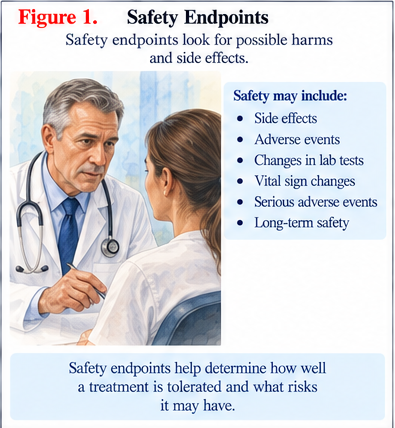
Safety endpoints
Safety endpoints are measurements of possible harm. Depending on the treatment and route, researchers may look for infusion or injection reactions, infection, blood clots, immune reactions, organ injury, procedure complications, hospitalization, serious adverse events, or death. [1-8]
A study reporting no serious treatment-related events is reassuring, but it does not prove that a treatment has no important risks. Small trials and short follow-up may miss uncommon or delayed problems. [1-8]
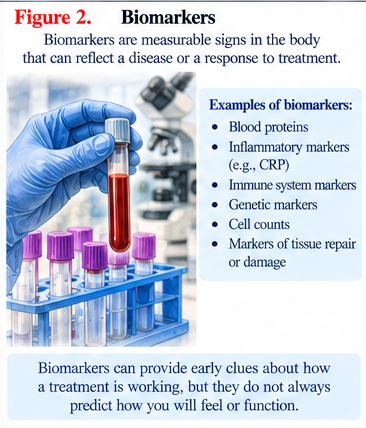
Biomarkers
A biomarker is a measurable biological characteristic, such as a blood protein, inflammatory marker, cell count, molecular signature, or physiological measurement. Biomarkers can help researchers understand mechanism, patient selection, prognosis, or biological response. [1-8]
A biomarker change is not automatically the same as a clinical benefit. A surrogate endpoint requires stronger evidence showing that change in that marker reliably predicts a meaningful clinical outcome. [1-8]
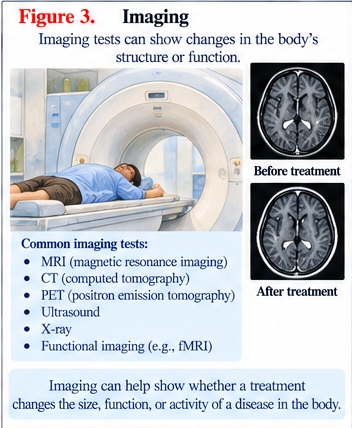
Imaging
Imaging outcomes use tests such as MRI, CT, ultrasound, X-ray, PET, or echocardiography to measure anatomy, structure, blood flow, inflammation, or function. [1-8]
Imaging can provide valuable objective information, but a change on a scan may not always mean that symptoms or daily function improve. Standardized scanning methods and blinded interpretation can make imaging results more reliable. [1-8]
Functional outcomes
Functional outcomes measure what a person can actually do. Examples include walking distance, gait speed, muscle strength, range of motion, exercise capacity, activities of daily living, pulmonary function, or neurologic performance. [1-8]
These outcomes are often close to what matters in daily life, but they can still be affected by motivation, practice, rehabilitation, assistive devices, or differences in testing. Standardized procedures are important. [1-8]

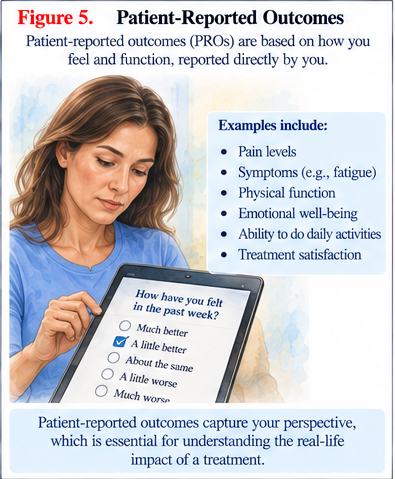
Patient-reported outcomes
Patient-reported outcomes are measures reported directly by patients, such as pain, fatigue, physical function, sleep, mood, or treatment burden. They can capture parts of health that laboratory tests and scans cannot measure directly. [1-8]
These outcomes can be scientifically rigorous when the questionnaire or scale has been properly developed and validated. Interpretation depends on the quality of the instrument, missing responses, recall period, blinding, and whether the amount of change is meaningful to patients. [1-8]
Quality of life
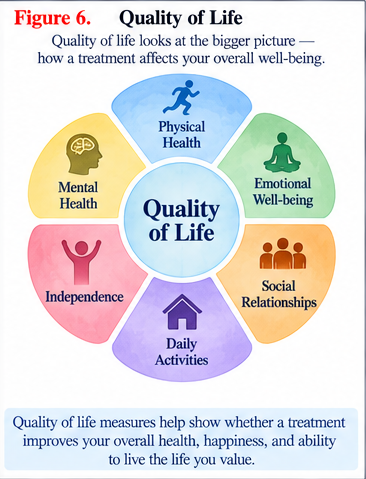
Quality of life describes how health affects physical, emotional, social, and day-to-day well-being. Some questionnaires are general and can be used across many conditions; others are designed for a particular disease. [1-8]
Improved quality of life can be an important benefit even if survival does not change. Researchers should still ask whether the change was large enough to matter, how long it lasted, and whether missing responses could have affected the result. [1-8]
Survival
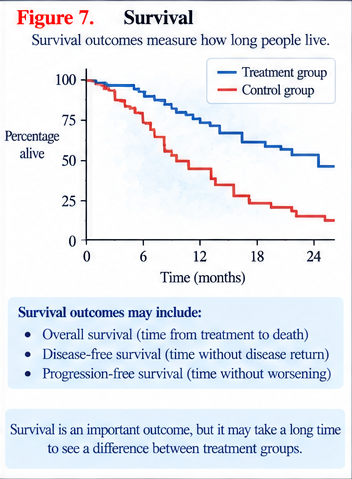
Survival outcomes measure how long patients live or how long it takes before a defined event occurs. Overall survival measures time until death from any cause. Other time-to-event outcomes may measure progression, hospitalization, or another important clinical event. [1-8]
Survival results need careful interpretation. Researchers consider how long patients were followed, whether some participants were lost to follow-up, whether patients crossed over to other treatments, and both the relative and absolute size of the effect. [1-8]
Clinically meaningful differences
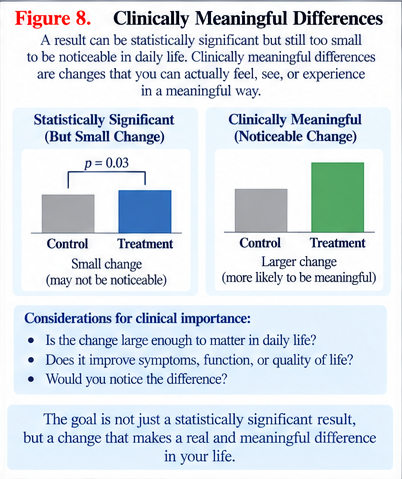
A clinically meaningful difference is a change large enough to matter in real life, not merely large enough to be statistically detectable. A very small difference can become statistically significant in a large study without being important to patients. [1-8]
Researchers should therefore consider the actual size of the benefit, uncertainty around that estimate, how long the benefit lasts, side effects, patient preferences, and whether there is a validated threshold for meaningful change in that specific condition. [1-8]
How the outcomes fit together
Safety endpoints tell us about harm. Biomarkers and imaging tell us about biology and structure. Functional outcomes show what a patient can do. Patient-reported outcomes and quality-of-life measures show how the patient experiences health and treatment. Survival measures time to important events. None of these should be substituted for another without justification. [1-8]
Primary, secondary, and exploratory outcomes
Trials usually identify one main or primary endpoint before the study begins. Secondary endpoints provide additional planned information, and exploratory endpoints are often used to generate new ideas. A trial should not quietly promote an exploratory result to become the main conclusion simply because the original primary outcome was disappointing. [1-4]
Why timing matters
An outcome measured at one month can tell a different story from the same outcome measured at one year. Early improvement may fade, delayed benefit may take time to appear, and some harms may not emerge until much later. Follow-up should therefore be long enough to answer the actual clinical question. [1-6]
Bottom line
When reading a study, ask what the investigators measured and whether that outcome matters to patients. A laboratory or imaging change can be important without proving clinical benefit. A statistically significant result can be real without being clinically important. Strong evidence requires valid measures, prespecified endpoints, adequate follow-up, and an effect large enough to matter in the clinical context. [1-8]
Questions patients should ask
• What was the study's main outcome?
• Was the outcome a safety measure, biomarker, scan, functional test, symptom score, quality-of-life measure, or survival outcome?
• Was the main outcome chosen before the study started?
• Was the improvement large enough to matter clinically?
• How long did the benefit last?
• Were important side effects or delayed risks measured for long enough?
• Did the study show a patient benefit, or only a laboratory or imaging change?