A clinical trial does not study a disease in the abstract; it studies a defined group of people. The characteristics of that study population determine both internal validity and the extent to which results can be applied beyond the enrolled participants. Eligibility criteria, disease severity, prior treatment, comorbidities, age, sex, race and ethnicity, and the clinical setting can alter baseline risk, treatment response, adverse events, adherence, and outcome measurement. For mesenchymal stromal cell (MSC), extracellular-vesicle (EV), and other regenerative products, these population factors interact with product identity, dose, route, and manufacturing and therefore cannot be treated as secondary details. [1-6]
Eligibility criteria
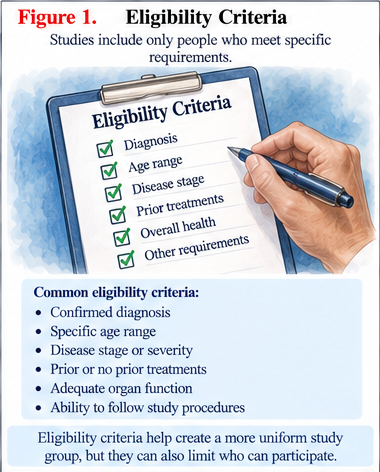
Eligibility criteria define who may enter a trial. Inclusion criteria identify required characteristics; exclusion criteria identify circumstances that prevent enrollment. Appropriate criteria protect participants, create a population capable of answering the study question, and reduce avoidable clinical heterogeneity. [1-8]
Overly restrictive criteria can produce a highly selected population that differs from patients seen in routine practice. Conversely, criteria that are too broad may combine biologically distinct conditions or risk groups and make a treatment effect difficult to interpret. The correct balance depends on development stage, safety knowledge, mechanism, indication, and trial objective. [1-8]
Disease severity
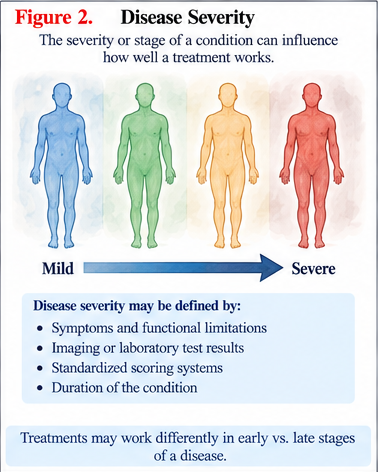
Disease severity can influence both absolute treatment benefit and the ability to detect change. Patients with mild disease may have little room for measurable improvement; patients with advanced irreversible disease may have too little recoverable function for a regenerative intervention to show benefit even if the underlying mechanism is active. [1-8]
Severity should therefore be defined with validated clinical measures when possible and reported by treatment group. A result in early disease cannot automatically be extrapolated to advanced disease, and failure in end-stage disease does not establish lack of activity in earlier, potentially reversible stages. [1-8]
Prior treatment
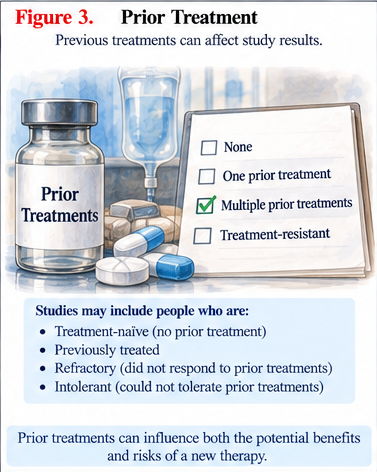
Prior treatment can modify disease biology, prognosis, immune status, tissue structure, and responsiveness to an investigational product. Washout requirements, treatment resistance, prior surgery, rehabilitation, immunosuppression, chemotherapy, radiation, or previous biologic therapy may all affect outcomes. [1-8]
Trials should distinguish treatment-naive participants from those with refractory or heavily pretreated disease. A therapy that appears effective after failure of standard care answers a different clinical question from a therapy tested as first-line treatment. Background and rescue treatments should also be standardized or carefully measured. [1-8]
Comorbidities
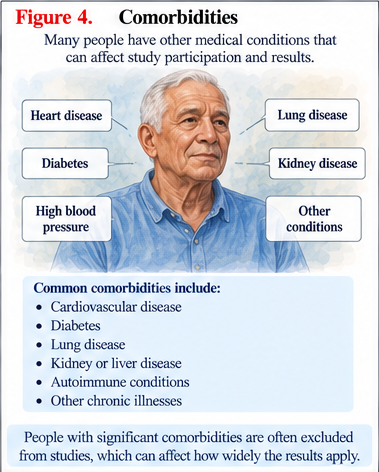
Comorbidities can alter both efficacy and safety. Diabetes, cardiovascular disease, kidney or liver dysfunction, obesity, autoimmune disease, malignancy history, infection risk, smoking, frailty, and polypharmacy may affect inflammation, vascular function, healing, immune response, pharmacology, procedural risk, and competing clinical outcomes. [1-8]
Early trials often exclude substantial comorbidity to reduce risk and interpretability problems. Later development should determine whether findings remain applicable to the more medically complex patients who may ultimately receive the intervention. Exclusion for safety can be justified; exclusion without scientific rationale can unnecessarily narrow applicability. [1-8]
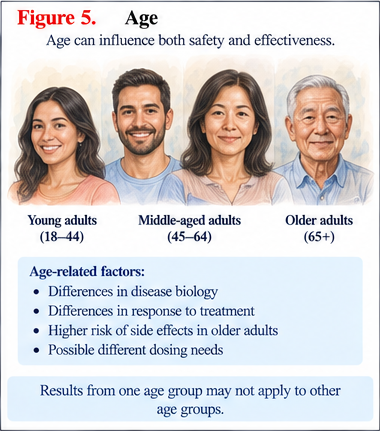
Age
Age can modify disease phenotype, immune function, regenerative capacity, vascular biology, frailty, organ reserve, adverse-event risk, and competing mortality. Pediatric participants also introduce developmental, assent, consent, dosing, and long-term surveillance considerations that differ from adult studies. [1-8]
Chronological age should not automatically substitute for biological or clinical risk. When age is likely to modify treatment effect or safety, trials should prespecify appropriate age ranges, stratification, subgroup analyses, or dedicated studies rather than extrapolating across substantially different populations without evidence. [1-8]
Sex
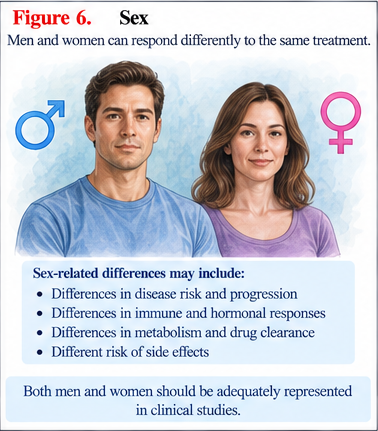
Sex-related biological differences can affect disease prevalence, immune responses, hormones, body composition, vascular biology, pharmacology, reproductive considerations, and clinical outcomes. Enrollment that substantially underrepresents one sex may limit confidence that benefits and risks apply similarly. [1-8]
Sex should be reported, and treatment-effect heterogeneity should be examined when biologically and statistically justified. Subgroup findings require caution because small samples and multiple comparisons can generate unstable apparent differences. Absence of a statistically significant interaction is not proof that effects are identical. [1-8]
Race and ethnicity
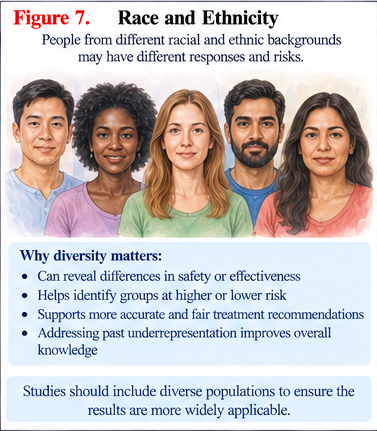
Race and ethnicity are social and demographic classifications rather than simple biological proxies. They can correlate with ancestry, environmental exposures, structural inequities, access to care, comorbidities, socioeconomic conditions, language, and treatment patterns. These factors may influence enrollment, baseline risk, follow-up, and observed outcomes. [1-8]
Representative enrollment improves the relevance of evidence across the population expected to use a therapy. Interpretation should avoid attributing differences automatically to innate biology when social, environmental, clinical, or ancestry-related factors may be responsible. Recruitment, retention, and reporting practices should be designed to identify rather than conceal these sources of variation. [1-8]
Generalizability
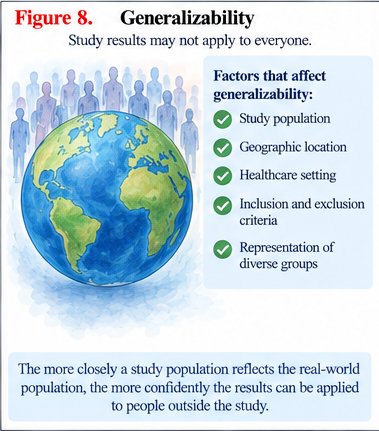
Generalizability, or external validity, asks whether a trial's findings are likely to apply to patients, clinicians, settings, and treatment conditions beyond the study itself. It depends on who was enrolled, who was excluded, where care occurred, how specialized the investigators were, what background care was provided, and whether the clinical product matches the studied product. [1-8]
A trial can have excellent internal validity yet limited generalizability. This is not necessarily a defect: early trials often need narrow populations. The problem arises when conclusions are stated more broadly than the evidence supports. Applicability should expand only as evidence accumulates across populations and settings. [1-8]
Clinical takeaway
The study population is part of the intervention question. A result should be interpreted as applying first to participants who resemble those actually enrolled. Eligibility criteria and disease severity define the clinical target; prior treatment and comorbidities modify prognosis and response; age, sex, race and ethnicity may influence biology, risk, access, and representation; and generalizability determines how far the conclusion can reasonably travel beyond the trial. [1-8]
Effect modification and subgroup analysis
A treatment effect may differ across clinically meaningful subgroups, but subgroup claims require prespecified hypotheses, adequate sample size, formal interaction testing, and biological or clinical plausibility. Comparing statistical significance within separate subgroups is not equivalent to demonstrating a difference between subgroups. Exploratory subgroup findings should generally be treated as hypothesis-generating unless replicated. [1,2,6]
Representation and recruitment
Representative enrollment is both a scientific and an access issue. Barriers can arise from geography, language, transportation, referral patterns, insurance, trial burden, distrust, restrictive criteria, or site selection. Strategies to improve representation should preserve scientific validity while reducing unnecessary barriers and should be planned before recruitment rather than added only after enrollment problems appear. [3-5,7]
Safety
Population selection is a major safety control, especially early in development. Excluding participants at disproportionate risk may be appropriate when safety is uncertain. As evidence grows, continued exclusion of common comorbidities or demographic groups should have a defensible scientific rationale so that safety and effectiveness can ultimately be characterized in the people likely to receive the product. [1,3-5]
Bottom-line evidence statement
Clinical evidence is never population-free. A favorable trial establishes evidence for the population, product, indication, dose, route, comparator, endpoint, and follow-up actually studied. Extrapolation to different ages, disease stages, comorbidity burdens, prior-treatment histories, demographic groups, or practice settings should be proportional to the directness and consistency of the available evidence. [1-8]