Plain-language overview
A clinical trial does not study every person with a disease. It studies a specific group of participants chosen according to rules set before enrollment begins. Who enters the trial matters because age, disease severity, previous treatment, other medical conditions, and many demographic and social factors can influence both benefits and risks. [1-8]
When reading a study about stem cells, extracellular vesicles, or another regenerative treatment, one of the most important questions is therefore: How similar were the study participants to the patient for whom the result is being considered? A strong result in one carefully selected population may not apply equally to people who differ substantially from those enrolled. [1-8]
Eligibility criteria
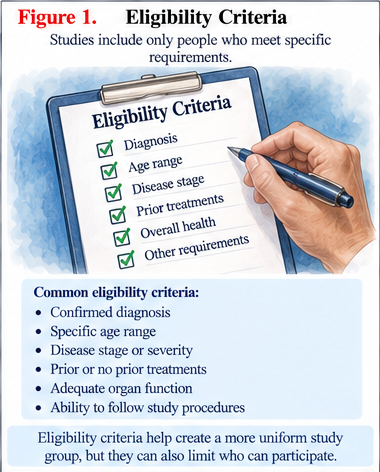
Eligibility criteria are the rules that determine who can and cannot enter a trial. Inclusion criteria describe characteristics participants must have. Exclusion criteria identify circumstances that prevent enrollment. [1-8]
These rules can protect participants and help researchers answer a clear question. But if the rules are too restrictive, the study may include people who are healthier or less complicated than patients seen in everyday practice. If the rules are too broad, the study may combine people whose diseases or risks are too different to interpret clearly. [1-8]
Disease severity
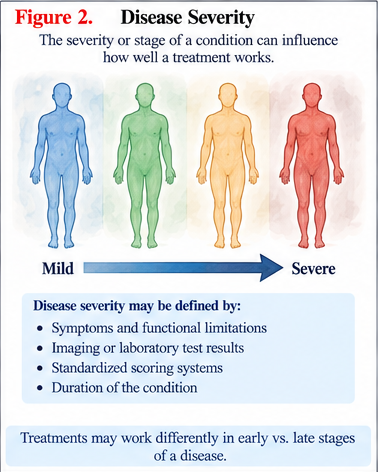
Disease severity can affect how much improvement is possible and how much risk a patient faces. A person with mild disease may have little room for measurable improvement, while a person with very advanced or irreversible disease may have too little recoverable function for a treatment to show benefit. [1-8]
A result in early disease should not automatically be applied to advanced disease. Likewise, failure in end-stage disease does not prove that a treatment would have no effect earlier in the disease process. [1-8]
Prior treatment
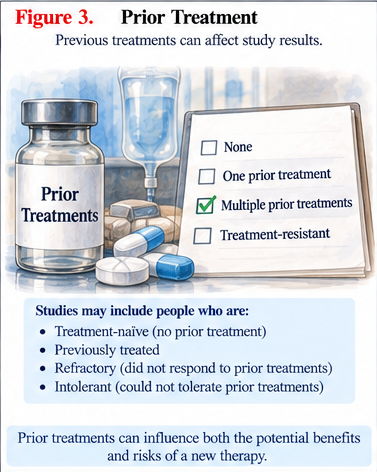
Previous treatment can change the disease, immune system, tissue structure, prognosis, and response to a new therapy. Surgery, rehabilitation, chemotherapy, radiation, immunosuppression, or earlier biologic treatment may all matter. [1-8]
A study of people who have never received previous treatment answers a different question from a study of people whose disease has not responded to several standard treatments. Background treatments and rescue treatments also need to be considered when interpreting the result. [1-8]
Comorbidities
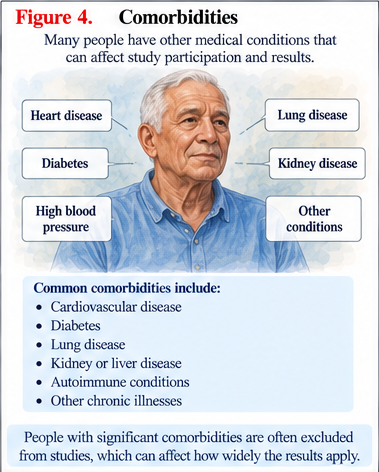
Comorbidities are medical conditions that occur in addition to the main condition being studied. Diabetes, cardiovascular disease, kidney or liver problems, obesity, autoimmune disease, infection risk, cancer history, smoking, frailty, and the use of many medications can affect both safety and treatment response. [1-8]
Early trials may exclude medically complex patients because safety is uncertain. That can be appropriate. As evidence develops, however, researchers need to learn whether the treatment remains safe and effective in the more complicated patients who may eventually receive it in routine care. [1-8]
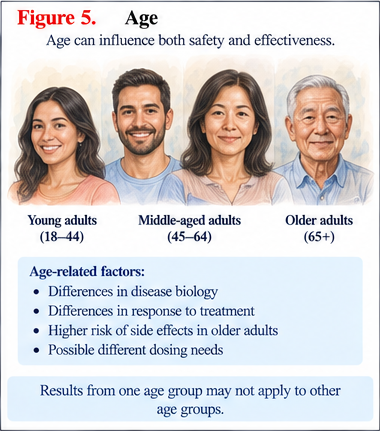
Age
Age can influence immune function, healing, blood vessels, organ reserve, frailty, disease pattern, and risk of adverse events. Children also have developmental, dosing, consent, assent, and long-term follow-up issues that differ from adult studies. [1-8]
Chronological age alone does not describe every patient's biological or clinical risk. When age may change treatment response or safety, researchers should study appropriate age groups rather than assuming that results automatically apply across childhood, middle age, and older adulthood. [1-8]
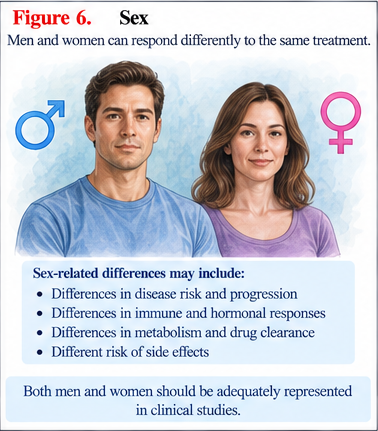
Sex
Biological sex can influence disease patterns, immune responses, hormones, body composition, vascular biology, reproductive considerations, and some treatment effects. If one sex is poorly represented in a trial, there may be less certainty about how well the results apply to that group. [1-8]
Researchers can examine whether treatment effects differ by sex, but small subgroup analyses can be misleading. An apparent difference may occur by chance, and a lack of statistical significance does not prove that the effects are identical. [1-8]
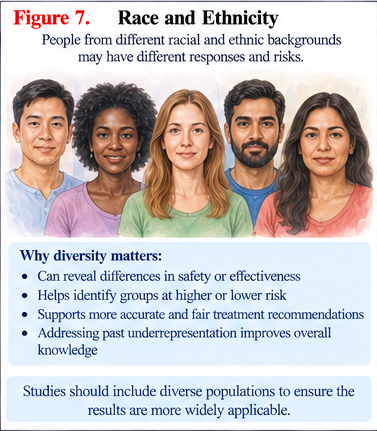
Race and ethnicity
Race and ethnicity can be associated with ancestry, environment, access to care, socioeconomic conditions, language, exposure to structural inequities, comorbidities, and treatment patterns. They should not automatically be treated as simple biological explanations for differences in health outcomes. [1-8]
Clinical trials are more useful when enrollment reflects the population expected to use the treatment. Researchers should also examine the social, clinical, environmental, and ancestry-related factors that may explain differences rather than assuming that a racial or ethnic label itself is the cause. [1-8]
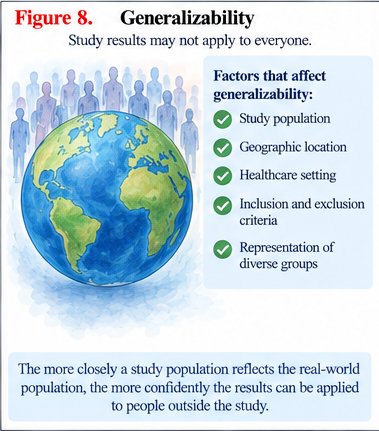
Generalizability
Generalizability asks whether the results of a study are likely to apply to people and settings beyond the trial itself. It depends on who was enrolled, who was excluded, where the study was performed, how specialized the clinical team was, what other care patients received, and whether the product used outside the trial is actually the same product that was studied. [1-8]
A study can be very well designed and still have limited generalizability. Early trials often need narrow populations for safety and clarity. The problem occurs when conclusions are stated more broadly than the evidence supports. [1-8]
How population differences affect interpretation
The safest starting point is to apply a study result to patients who resemble the people actually enrolled. The farther a patient differs in disease stage, prior treatment, age, medical complexity, demographic characteristics, or clinical setting, the more careful the extrapolation should be. [1-8]
Subgroup findings
Researchers sometimes examine whether treatment effects differ within subgroups, such as younger versus older participants or people with different disease severity. These analyses can be useful, but small subgroups and many statistical comparisons can produce apparent differences by chance. Strong subgroup conclusions usually require a prespecified question, enough participants, an appropriate statistical interaction test, and confirmation in other evidence. [1,2,6]
Representation and access
Some groups may be underrepresented in trials because of geography, language, transportation, referral patterns, insurance, trial burden, distrust, restrictive eligibility rules, or where research sites are located. Improving representation can make evidence more useful and can improve access to research, but enrollment strategies still need to preserve participant safety and scientific validity. [3,4,7]
Safety
Population selection is an important safety tool, particularly in early trials. Excluding people at unusually high risk may be justified when little is known about a new intervention. As evidence grows, researchers should determine whether those exclusions remain necessary and whether safety has been adequately studied in the people most likely to receive the treatment. [1,3-5]
Bottom line
A positive clinical trial does not mean that every patient with the same diagnosis should expect the same result. Evidence applies most directly to the kind of people actually studied. When considering a regenerative treatment, compare the patient's disease severity, previous treatment, other medical conditions, age, and other relevant characteristics with the population in the strongest available trial. [1-8]
Questions patients should ask
• Who was allowed to enter the study, and who was excluded?
• How severe was the disease in the participants?
• Had participants already tried standard treatments?
• Did participants have other medical conditions similar to mine?
• Were people my age adequately represented?
• Were both sexes adequately represented when relevant?
• Did the study include a population that reflects the people likely to use the treatment?
• How similar am I to the patients in the strongest trial?