Trial design determines how confidently observed differences can be attributed to an intervention rather than to baseline imbalance, expectations, co-interventions, outcome assessment, chance, center effects, or selective analysis. No single design feature makes a study valid by itself. Randomization, allocation concealment, blinding, an appropriate comparator, prespecified outcomes, adequate follow-up, and rigorous analysis work together. For cell, extracellular-vesicle (EV), and procedure-based regenerative studies, design can be particularly difficult because products may require visible preparation, specialized administration, invasive delivery, or center-specific expertise. [1-6]
Randomization
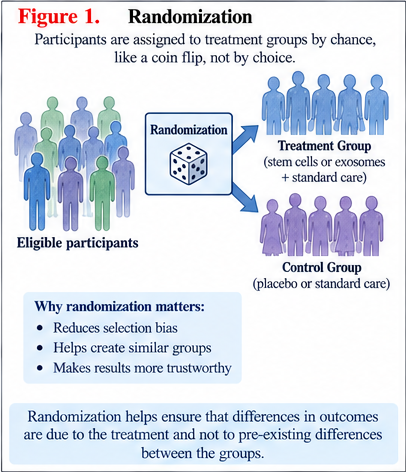
Randomization assigns participants to study groups by a chance process. Its purpose is not merely to make groups look similar; it protects against systematic selection of who receives which intervention and, with adequate sample size, tends to balance both measured and unmeasured prognostic factors. [1-8]
Randomization can be simple, blocked, stratified, response-adaptive, cluster-based, or use other valid schemes. The method should be generated independently of investigator preference and described clearly enough to evaluate. Random assignment does not repair problems that occur after assignment, such as differential dropout, unblinding, crossover, or selective outcome reporting. [1-8]
Allocation concealment
Allocation concealment prevents investigators or recruiters from knowing the next treatment assignment before a participant is irreversibly enrolled. It protects the randomization process from conscious or unconscious manipulation. [1-8]
Allocation concealment is different from blinding. Concealment acts before and during assignment; blinding generally acts after assignment. Centralized randomization, secure electronic systems, or properly controlled pharmacy procedures can provide concealment. Predictable sequences, open lists, or inadequately protected envelopes can undermine it. [1-8]

Blinding
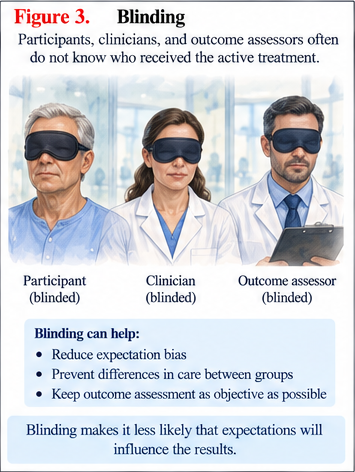
Blinding keeps participants, treating personnel, outcome assessors, data analysts, or some combination of these groups unaware of treatment assignment. Its purpose is to reduce differences in expectations, behavior, co-interventions, outcome assessment, and analysis that can distort treatment estimates. [1-8]
Complete blinding is not always feasible in regenerative medicine, especially when procedures, product appearance, route, or treatment logistics differ. When blinding cannot be achieved, the limitation should be explicit and alternative protections should be strengthened—for example, blinded endpoint adjudication, objective outcomes, standardized co-interventions, and prespecified analysis. [1-8]
Placebo controls
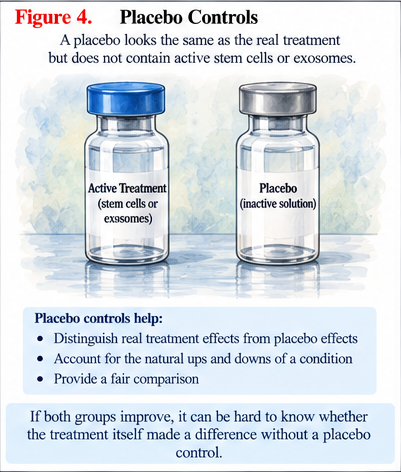
A placebo control attempts to isolate the effect of the active intervention from expectations, attention, natural history, regression to the mean, and other nonspecific effects. A credible placebo should resemble the study intervention sufficiently to preserve blinding without introducing unnecessary risk. [1-8]
Placebo-controlled trials are not always ethically or practically appropriate. Participants should not be denied proven effective therapy when doing so would expose them to unacceptable harm. In many settings the appropriate comparison is active treatment, placebo added to standard care, or another design that preserves necessary background therapy. [1-8]
Active controls
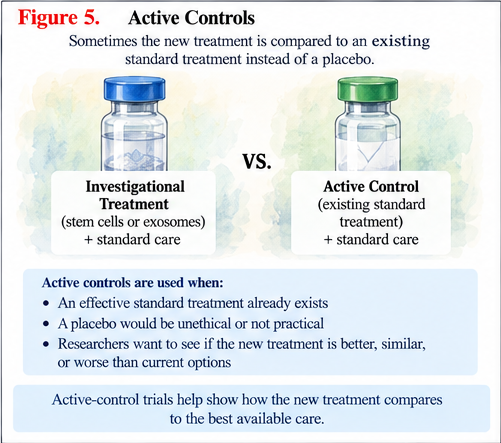
An active-control trial compares the investigational intervention with an established treatment rather than with an inert placebo. This can answer clinically important questions about comparative efficacy, safety, tolerability, convenience, or durability. [1-8]
Active-control interpretation depends on the question and design. Superiority trials ask whether one treatment is better. Noninferiority trials ask whether the new treatment is not unacceptably worse than the comparator by a prespecified margin; poorly chosen margins, weak assay sensitivity, or poor adherence can make a noninferiority result misleading. [1-8]
Sham procedures
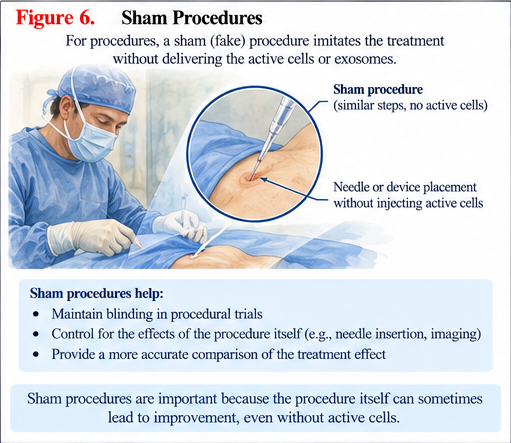
A sham procedure mimics important aspects of an invasive intervention without delivering the putative therapeutic component. In trials involving injections, surgery, catheterization, or device-like procedures, sham controls can help separate the biological effect of the intervention from procedural and expectancy effects. [1-8]
Sham procedures raise ethical issues because they can expose participants to discomfort, sedation, infection, bleeding, or other risks without direct therapeutic intent. Their use requires a strong scientific rationale, risk minimization, informed consent, independent ethical review, and careful consideration of whether less risky methods can answer the question. [1-8]
Multicenter trials
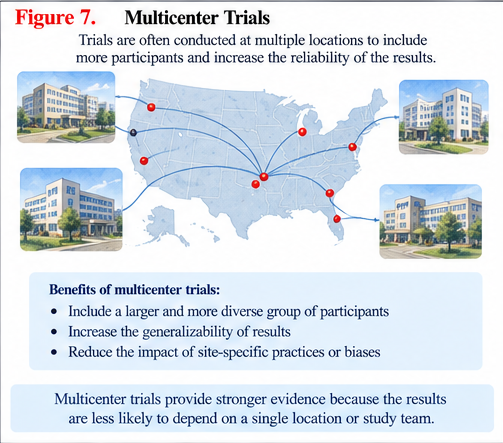
Multicenter trials enroll participants at more than one clinical site. They can increase recruitment, improve demographic and clinical diversity, test whether results are reproducible across teams and settings, and reduce the risk that an apparent effect reflects the practices of a single center. [1-8]
They also introduce heterogeneity. Sites may differ in patient selection, procedural skill, rehabilitation, imaging, endpoint assessment, product handling, storage, timing, and supportive care. Central training, standardized protocols, manufacturing controls, monitoring, endpoint adjudication, and prespecified handling of center effects are therefore essential. [1-8]
Clinical takeaway
Randomization protects against systematic treatment assignment; allocation concealment protects the randomization before assignment; blinding reduces post-assignment expectation and assessment bias; placebo, active, and sham controls answer different causal questions; and multicenter design tests whether findings survive across sites. These methods are complementary rather than interchangeable. [1-8]
Regenerative-medicine design considerations
Cell and EV trials may add design problems not present in conventional drug trials. Product preparation can reveal assignment; invasive routes can make sham procedures relevant; manufacturing may vary across lots or centers; background rehabilitation or other care can influence functional outcomes; and specialized centers may generate results that do not generalize to routine practice. The design should anticipate these sources of bias rather than treating them as post hoc explanations. [3-6]
Endpoint and analysis integrity
A strong design prespecifies the primary endpoint, timing, analysis population, handling of missing data, multiplicity, subgroup analyses, and clinically meaningful effect. Intention-to-treat analysis generally preserves the advantages of randomization by analyzing participants according to assigned groups, while complementary estimands or per-protocol analyses may address different questions when prespecified appropriately. [1,2,7]
Ethics
Methodological rigor and ethics are not competing goals. A poorly designed trial can expose participants to risk without generating reliable knowledge. Conversely, a scientifically necessary control may still be unethical if its risks are disproportionate or if proven therapy is inappropriately withheld. Ethical design requires scientific necessity, risk minimization, informed consent, independent review, and a defensible comparator. [1,2,8]
Bottom-line evidence statement
Trial design determines how much causal weight a clinical result can carry. A favorable outcome from an uncontrolled, unblinded, single-center study may be important as an early signal but cannot provide the same evidentiary confidence as a well-conducted randomized controlled multicenter trial. The correct interpretation depends on the exact design, comparator, execution, endpoint, analysis, and clinical context. [1-8]