Plain-language overview
Clinical-trial design determines how confidently we can say that a treatment—not chance, expectations, differences between patients, extra care, or biased measurement—caused an observed result. No single design feature makes a trial trustworthy by itself. Randomization, careful treatment assignment, blinding when possible, an appropriate comparison group, clear outcomes, adequate follow-up, and a prespecified analysis plan work together. [1-8]
Regenerative-medicine trials can be especially difficult to design because cell or extracellular-vesicle products may look different from controls, require injections or procedures, involve specialized centers, or be combined with rehabilitation and other care that can also affect outcomes. [3-6]
Randomization
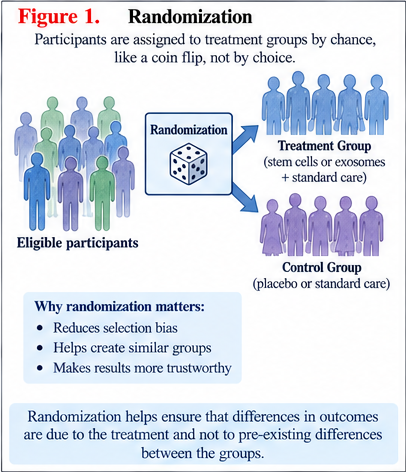
Randomization assigns participants to study groups by chance. This helps prevent doctors or researchers from choosing which patients receive which treatment and tends to balance important differences between groups. [1-8]
Randomization does not guarantee that every trial will be fair or accurate. Problems can still occur after assignment, including dropout, crossover, loss of blinding, unequal additional treatment, or selective reporting. [1-8]
Allocation concealment
Allocation concealment means that the person enrolling a participant cannot know in advance which treatment will be assigned next. This prevents conscious or unconscious decisions about who gets placed into which group. [1-8]
It is different from blinding. Allocation concealment protects the assignment process before treatment is known; blinding generally protects the study after treatment has been assigned. [1-8]

Blinding
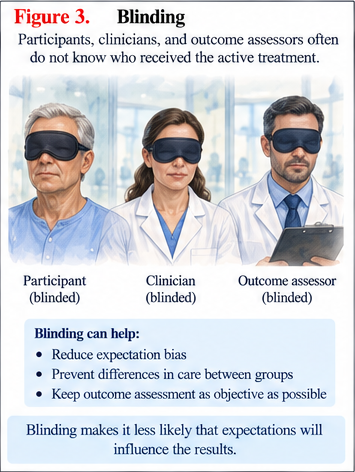
Blinding means that participants, clinicians, outcome assessors, data analysts, or some combination of these people do not know which treatment a participant received. This can reduce the effects of expectations and biased assessment. [1-8]
Complete blinding is not always possible. An injection, surgery, or visibly different product may reveal the assignment. When that happens, researchers can strengthen other protections, such as using blinded outcome reviewers, objective measurements, standardized additional care, and a prespecified analysis. [1-8]
Placebo controls
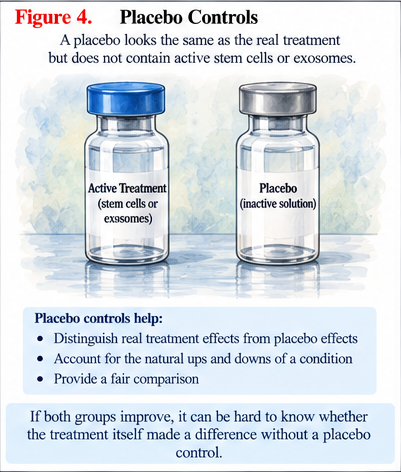
A placebo is designed to resemble the study treatment without containing its proposed active component. A placebo-controlled trial can help separate the treatment's biological effect from expectations, attention, natural changes over time, and other nonspecific effects. [1-8]
Placebos are not appropriate in every situation. Researchers should not withhold proven effective treatment when doing so would expose participants to unacceptable harm. Sometimes placebo is added to standard care rather than replacing it. [1-8]
Active controls
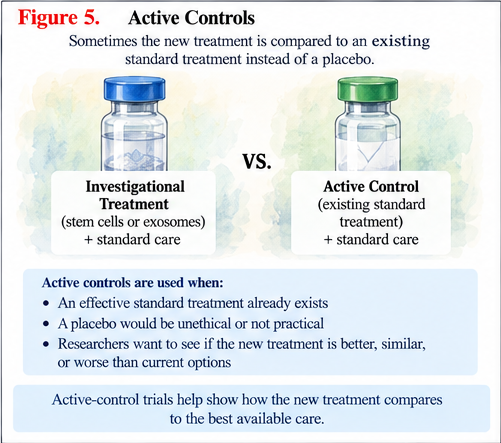
An active-control trial compares the new treatment with an established treatment instead of an inactive placebo. This can answer a practical question: Is the new treatment better, similarly effective, safer, easier to use, or more durable than what patients already receive? [1-8]
Some active-control trials are designed for superiority; others test noninferiority. A noninferiority trial does not try to prove that treatments are identical. It asks whether the new treatment is not worse than the established treatment by more than a prespecified acceptable amount. [1-8]
Sham procedures
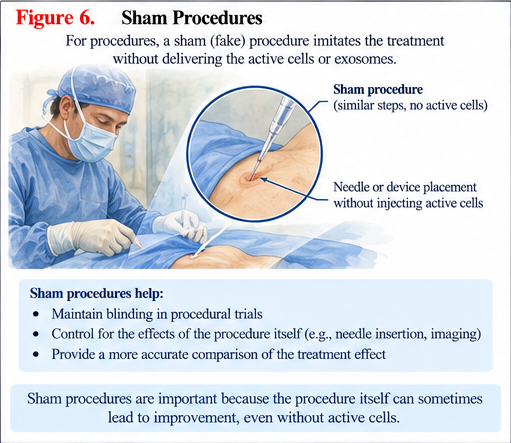
A sham procedure imitates important parts of an invasive treatment without delivering the proposed therapeutic component. In trials involving injections, surgery, catheters, or similar procedures, a sham can help separate the effect of the treatment itself from the effects of undergoing a procedure and expecting improvement. [1-8]
Sham procedures can create real risks such as pain, sedation, bleeding, or infection without offering the intended treatment. They should be used only when scientifically necessary, risks are minimized, participants understand what may happen, and independent ethical review supports the design. [1-8]
Multicenter trials
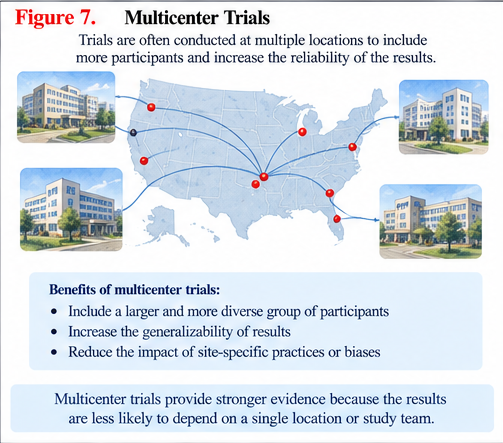
A multicenter trial is conducted at more than one clinical site. This can increase enrollment, include a wider variety of patients, and test whether a result can be reproduced by different clinical teams rather than only at one expert center. [1-8]
Different sites can also create variation in patient selection, procedures, rehabilitation, product handling, imaging, and outcome measurement. Good multicenter trials use standardized protocols, training, monitoring, and consistent product and endpoint procedures. [1-8]
How the design pieces fit together
Randomization helps create comparable groups. Allocation concealment protects the assignment process. Blinding reduces expectation and measurement bias. Placebo, active, and sham controls answer different comparison questions. Multicenter trials test whether findings hold across more than one site. These protections work together; one does not substitute for all the others. [1-8]
Why trial design matters in regenerative medicine
Cell and extracellular-vesicle studies may involve products that are difficult to mask, invasive delivery, specialized handling, rehabilitation, or center-specific expertise. These features do not make rigorous trials impossible, but they must be anticipated when the study is designed. Otherwise an apparent treatment effect may partly reflect the procedure, the center, expectations, or differences in background care. [3-6]
Ethics
Good ethics and good science reinforce each other. A poorly designed trial can expose people to risk without producing reliable knowledge. At the same time, a scientifically attractive control can still be unethical if it exposes participants to disproportionate risk or unnecessarily withholds effective treatment. Independent ethical review, informed consent, scientific necessity, and risk minimization are essential. [1,2,8]
Bottom line
When reading a clinical study, do not ask only whether the result was positive. Ask how patients were assigned, whether assignment was concealed, who was blinded, what the comparison group received, whether the primary outcome was decided in advance, whether follow-up was complete, and whether the result was large enough to matter clinically. Trial design determines how much confidence a result deserves. [1-8]
Questions patients should ask
• Was the trial randomized?
• Could the people enrolling patients predict the next treatment assignment?
• Who was blinded to treatment assignment?
• What did the control group receive: placebo, standard treatment, another active treatment, or a sham procedure?
• Was the main outcome chosen before the study began?
• Was the trial conducted at one center or several?
• How many participants dropped out or crossed over to another treatment?
• Was the observed difference large enough to matter clinically?