Preclinical evidence is the body of experimental work generated before, and often alongside, clinical testing. It can establish biological plausibility, characterize a product, explore mechanism, compare dose and route, identify safety concerns, and determine whether a candidate intervention is sufficiently credible to justify human investigation. For mesenchymal stromal cells (MSCs), extracellular vesicles (EVs), and related products, preclinical evidence is essential but unusually sensitive to product identity, manufacturing, model selection, assay design, and reproducibility. No preclinical model by itself establishes clinical efficacy. [1-6]
In-vitro models
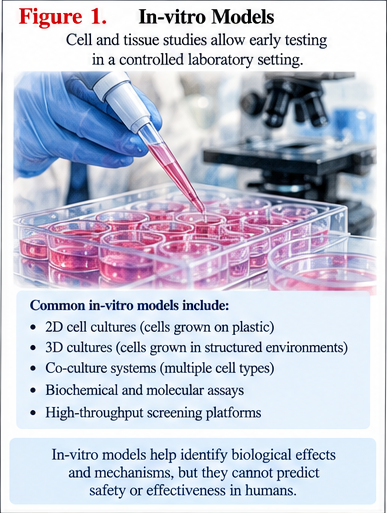
In-vitro models study cells, tissues, or molecular systems outside an intact organism. They are useful for controlled mechanistic experiments, potency development, dose-response work, target engagement, toxicity screening, and comparison of manufacturing conditions. [1-8]
Their strength is experimental control; their weakness is biological simplification. Cell lines, primary cells, co-cultures, and engineered systems may not reproduce circulation, immune interactions, metabolism, tissue architecture, comorbidities, aging, or the competing pathways present in human disease. An in-vitro effect should therefore be described as evidence of activity under the tested conditions, not as proof of therapeutic benefit. [1-8]
Organoids
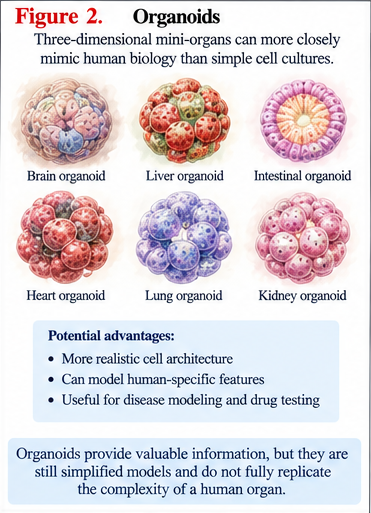
Organoids are three-dimensional cellular systems designed to reproduce selected structural and functional features of an organ or tissue. They can improve on simple monolayer culture by modeling cell-cell interactions, tissue organization, patient-specific biology, and some disease phenotypes. [1-8]
Organoids remain models rather than miniature complete patients. They may lack mature vasculature, full immune and nervous-system interactions, systemic metabolism, endocrine signaling, mechanical forces, and long-term disease evolution. Their translational value depends on how faithfully the specific organoid reproduces the biological question being asked. [1-8]
Small-animal models
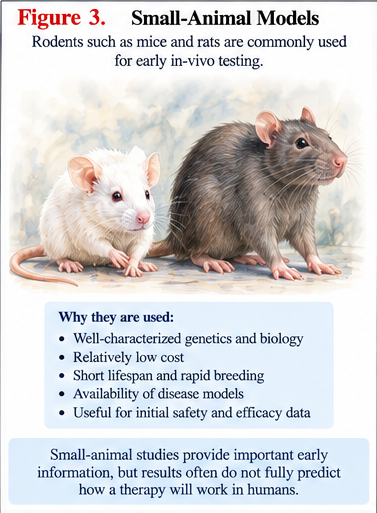
Rodent and other small-animal models are widely used because they permit whole-organism study of biodistribution, persistence, dose, route, immune response, disease mechanisms, functional outcomes, and safety at manageable cost and scale. [1-8]
Small animals can also mislead. Species differences, artificially induced disease, young healthy laboratory animals, altered immune systems, and outcome measures that do not match clinical disease can exaggerate or obscure therapeutic effects. Positive results are most persuasive when replicated, dose-responsive, mechanistically coherent, and obtained in models that resemble the intended human population. [1-8]
Large-animal models
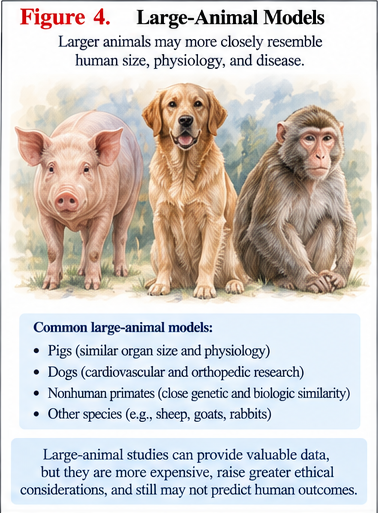
Large-animal models may provide anatomy, organ size, physiology, procedural conditions, imaging, device compatibility, dosing scale, or biomechanics that more closely approximate humans. They can be particularly useful for local delivery, cardiovascular, orthopedic, neurologic, pulmonary, and surgical applications. [1-8]
They are not automatically superior. Large-animal studies are expensive, often smaller, may have limited statistical power, and can still use disease models that differ from human pathology. Their value depends on whether the species and model answer a translational question that simpler systems cannot answer adequately. [1-8]
Disease-model validity
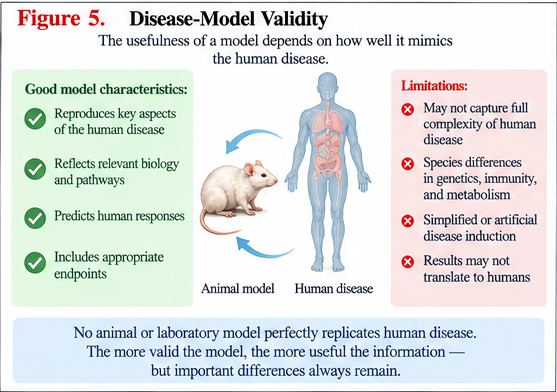
Disease-model validity asks whether the experimental model meaningfully represents the human condition for the purpose of the study. Relevant dimensions include mechanism, anatomy, immune state, age, sex, disease severity, chronicity, comorbidity, prior treatment, and the clinical endpoint the model is intended to predict. [1-8]
A model does not need to reproduce every feature of human disease to be useful, but investigators should state what it models well and what it does not. Choosing a model because it reliably produces a large treatment effect can create false confidence if the model omits the biology responsible for treatment resistance in patients. [1-8]
Reproducibility
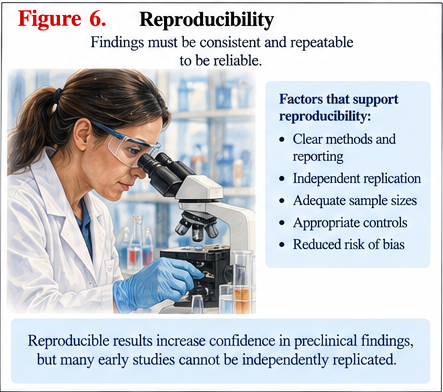
Reproducibility asks whether an experimental finding can be obtained again when the study is repeated. Internal replication tests stability within a laboratory; independent replication tests whether the finding survives different investigators, facilities, materials, and analytical choices. [1-8]
For MSC and EV studies, reproducibility depends heavily on donor and tissue source, passage, culture conditions, isolation and purification, storage, dose metrics, characterization, potency, assay conditions, randomization, blinding, sample size, exclusions, and statistical analysis. Transparent reporting is therefore part of the evidence itself, not an administrative detail. [1-8]
Translation failures
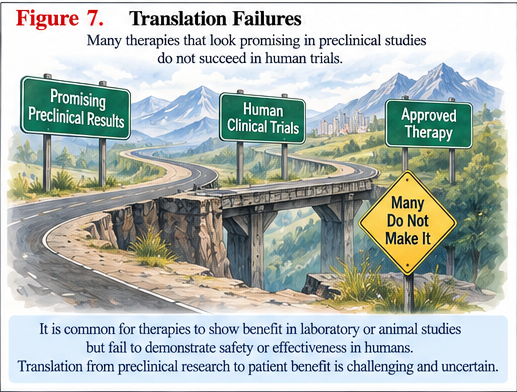
Translation failure occurs when promising preclinical findings do not produce the expected clinical benefit or acceptable safety profile in humans. This is common across biomedical research and should not be treated as evidence that preclinical science is useless; it shows that preclinical evidence is conditional. [1-8]
Failures can arise from poor model validity, exaggerated effect sizes, publication bias, inadequate replication, species differences, incorrect dose or route, product changes during scale-up, weak potency assays, heterogeneous patients, inadequate target engagement, endpoint mismatch, or a mechanism that is real but insufficient to change clinical outcomes. Studying failures is therefore an essential part of improving translation. [1-8]
Clinical takeaway
Preclinical evidence should answer specific translational questions rather than function as a generic claim that a therapy 'works.' In-vitro systems and organoids can define mechanism and product activity; small- and large-animal models can address whole-organism behavior, dose, route, and safety; disease-model validity determines what those findings can reasonably predict; reproducibility determines whether the signal is robust; and translation failures reveal where assumptions break down. [1-8]
Product identity and manufacturing
A preclinical study is only as relevant as the product tested. For MSCs and EVs, tissue source, donor characteristics, passage, culture medium, purification, concentration, storage, release criteria, potency, and dose metric may alter biological behavior. Preclinical evidence generated with one product cannot be transferred automatically to a materially different clinical product. [2,3,5]
Bias control
Randomization, allocation procedures, blinded outcome assessment, prespecified inclusion and exclusion criteria, sample-size justification, complete reporting, and appropriate statistical analysis reduce avoidable bias in preclinical studies. Selective publication of positive experiments can inflate apparent efficacy and weaken the reliability of the translational evidence base. [4,6-8]
Safety
Preclinical safety findings can identify hazards and guide starting dose, route, monitoring, and eligibility for human trials. They cannot identify every human risk. Species-specific biology, limited sample size, follow-up duration, and differences between experimental and clinical products can leave important uncertainty. [1,4,5]
Bottom-line evidence statement
Strong preclinical evidence increases confidence that human testing is scientifically justified; it does not establish that patients will benefit. The most informative preclinical program uses complementary models, validates product identity, controls bias, reports negative as well as positive findings, demonstrates reproducibility where feasible, and explicitly defines the limits of translation. [1-8]