Plain-language overview
Preclinical evidence is research performed before, and sometimes alongside, human clinical trials. It helps researchers decide whether a treatment idea makes biological sense, how it might work, what dose or route might be reasonable, and what safety problems should be watched for. Preclinical research is essential, but it cannot by itself prove that a treatment will help patients. [1-8]
This distinction is especially important for stem-cell and extracellular-vesicle research. Results can depend on the exact tissue source, donor, manufacturing method, purification, storage, dose, route, and laboratory model. Two products described with the same broad name may behave differently. [2,3,5]
In-vitro models
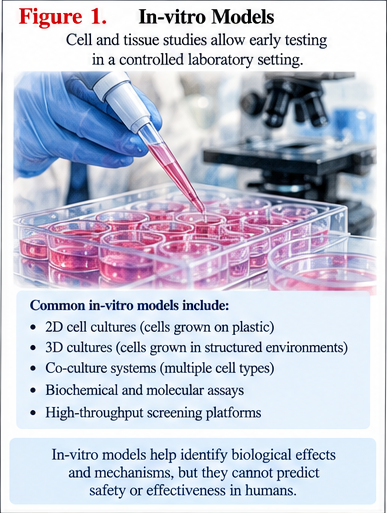
In-vitro models study cells, tissues, or biological processes outside an intact living organism. They allow researchers to control experimental conditions closely and can help identify mechanisms, compare doses, study biological activity, and screen for possible toxicity. [1-8]
The limitation is that a dish or laboratory system cannot reproduce everything happening in a patient. It may lack circulation, a complete immune system, metabolism, tissue architecture, aging, other diseases, medications, and many interacting biological pathways. A positive in-vitro result therefore means the intervention showed activity under those tested conditions—not that it has been proven effective in people. [1-8]
Organoids
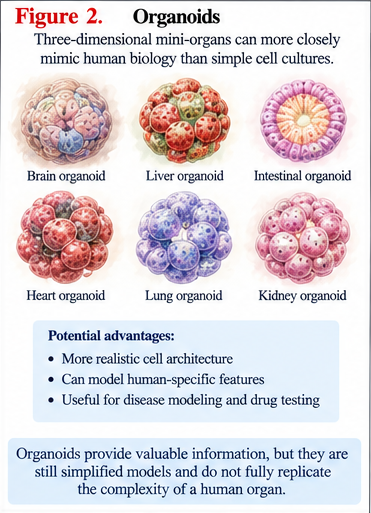
Organoids are three-dimensional cell systems designed to reproduce selected features of a tissue or organ. They can sometimes model tissue organization and cell-to-cell interactions more realistically than ordinary flat cell cultures. [1-8]
They are still simplified models. Many organoids lack mature blood vessels, complete immune and nervous-system interactions, whole-body metabolism, and the long-term changes found in real disease. Their usefulness depends on whether the particular organoid actually represents the biological question being studied. [1-8]
Small-animal models
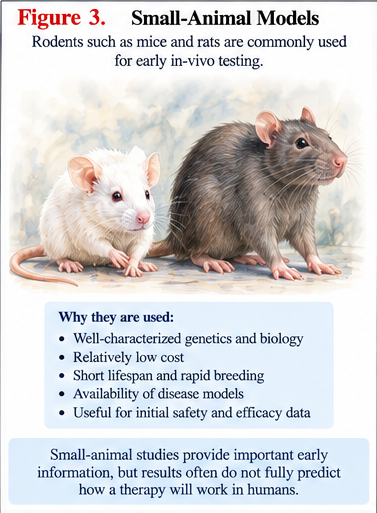
Small-animal models, especially rodents, allow researchers to study a treatment in a whole living organism. Investigators can examine where a product travels, how long it remains, dose, route, immune responses, possible benefits, and possible harms. [1-8]
Animal results do not always predict human results. Species biology differs, and laboratory disease models may be created artificially or studied in young, otherwise healthy animals. A treatment that looks impressive in mice can later have little or no benefit in patients. [1-8]
Large-animal models
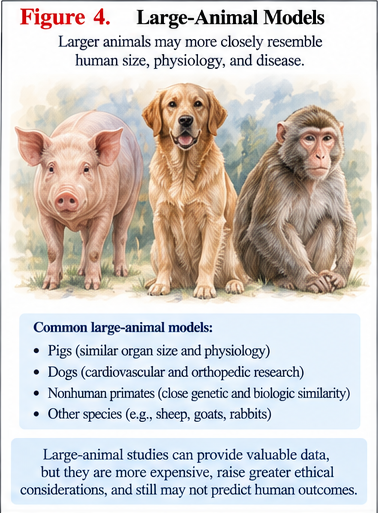
Large animals can sometimes provide anatomy, organ size, physiology, surgical conditions, imaging, or dosing conditions that more closely resemble humans. They may be useful when a treatment involves local injection, surgery, devices, joints, the heart, lungs, or nervous system. [1-8]
Large-animal research is not automatically better evidence. These studies can be small and expensive, and the disease being modeled can still differ substantially from the human condition. The important question is whether the model answers a translational question that simpler models cannot answer adequately. [1-8]
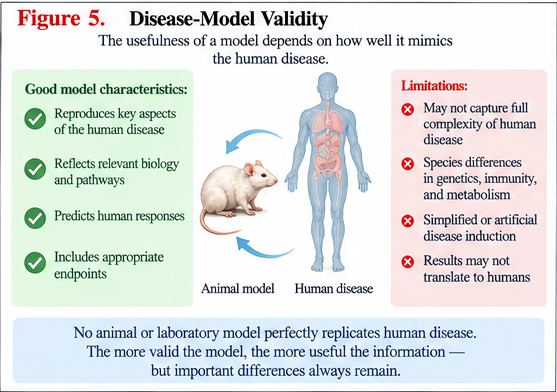
Disease-model validity
Disease-model validity asks how well an experimental model represents the part of human disease that researchers are trying to study. Important differences can include age, sex, immune function, disease severity, duration, other medical conditions, previous treatments, and the outcome being measured. [1-8]
No model needs to copy every feature of human disease to be useful. Researchers should be clear about what the model represents well and what it does not. A model that reliably produces a large treatment effect may still be a poor predictor of patient benefit if it leaves out important causes of treatment resistance. [1-8]
Reproducibility
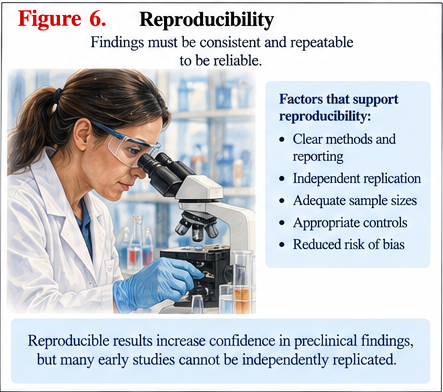
Reproducibility asks whether a scientific result can be obtained again. Repeating a study within the same laboratory is useful; obtaining a similar result in an independent laboratory is even stronger evidence that the finding is robust. [1-8]
For cell and extracellular-vesicle studies, reproducibility can be affected by donor differences, tissue source, cell passage, culture conditions, purification, storage, dose measurement, laboratory methods, sample size, randomization, blinding, exclusions, and statistical analysis. Clear reporting of these details is part of good science. [1-8]
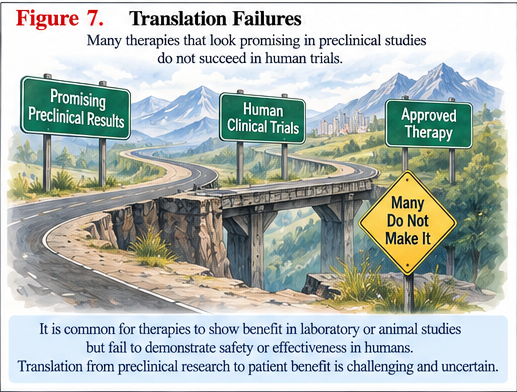
Translation failures
A translation failure occurs when a promising laboratory or animal result does not produce the expected benefit or acceptable safety in people. This happens throughout medicine and does not mean preclinical science has no value. It means that preclinical evidence has limits. [1-8]
Failures can happen because the model did not represent human disease well, the original effect was exaggerated, the finding was not reproducible, animal and human biology differed, the dose or route was wrong, manufacturing changed the product, the patients were more diverse, or the biological mechanism was real but not strong enough to change clinical outcomes. Learning from these failures can improve future research. [1-8]
How to interpret preclinical evidence
The strongest preclinical programs use several complementary models rather than relying on one dramatic experiment. A laboratory result can establish mechanism, an organoid can add tissue complexity, and an animal model can provide whole-organism information. Agreement across different models increases confidence, but human clinical trials are still required to determine whether patients benefit. [1-8]
Why the exact product matters
For stem-cell and extracellular-vesicle therapies, the product used in a laboratory experiment must be compared carefully with the product eventually given to patients. Changes in tissue source, donor selection, cell culture, purification, storage, dose, potency, or other manufacturing steps can change biological behavior. [2,3,5]
Bias and reproducibility
Preclinical studies are more reliable when investigators use appropriate sample sizes, randomization, blinded outcome assessment when possible, prespecified rules, complete reporting, and appropriate statistical analysis. Publishing negative and neutral findings is also important because an evidence base containing mostly positive experiments can give an exaggerated impression of effectiveness. [4,6-8]
Safety
Preclinical safety studies can identify hazards and help choose starting doses, routes, monitoring, and eligibility for human trials. They cannot identify every possible human risk. Differences between species, small study sizes, limited follow-up, and changes between the experimental and clinical product can leave important uncertainty. [1,4,5]
Bottom line
Good preclinical evidence can make human testing scientifically reasonable. It cannot prove that a treatment works in patients. The most convincing preclinical evidence uses appropriate models, tests the actual product carefully, controls avoidable bias, can be reproduced, reports unfavorable as well as favorable results, and states clearly what remains uncertain. [1-8]
Questions patients should ask
• Is the evidence being described from cells in a laboratory, organoids, animals, or actual patients?
• Was the same product used in the preclinical research and in the proposed human treatment?
• Has the result been reproduced by another laboratory or research group?
• Does the disease model resemble the human condition I have?
• Were negative or neutral findings reported as well as positive findings?
• What human clinical evidence exists beyond the preclinical studies?