The translational pathway is the sequence by which a scientific observation is developed into an intervention that can be tested in humans and, if the total evidence supports it, considered for authorization and broader clinical use. It is not a one-way conveyor belt. Programs can advance, pause, return to earlier development work, change manufacturing, alter dose or route, narrow the intended population, or stop entirely. For mesenchymal stromal cells (MSCs), extracellular vesicles (EVs), and other biologic products, exact product identity and manufacturing consistency are inseparable from the evidence. [1-5]
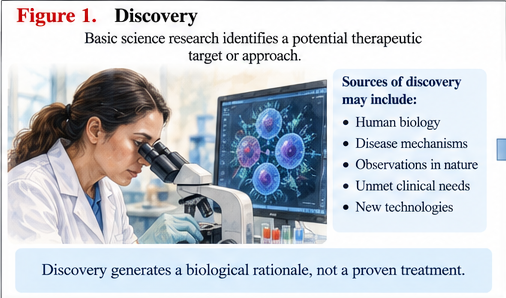
Discovery
Discovery begins with a biological question and a candidate intervention. Investigators may identify a cell population, EV preparation, molecular cargo, tissue source, signaling pathway, or manufacturing feature that could plausibly affect disease biology. Evidence may come from human tissue, cell culture, molecular profiling, mechanistic experiments, or observations from related clinical fields. [1-8]
A biologically interesting signal is not yet evidence of clinical benefit. At this stage the central tasks are to define the candidate product, establish reproducible methods, identify plausible mechanisms, and choose measurements that can support later development. [1-8]
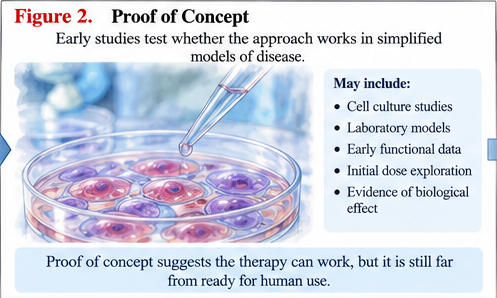
Proof of concept
Proof of concept asks whether the proposed intervention produces the intended biological or functional effect under defined experimental conditions. Strong proof-of-concept work links product characteristics to a prespecified effect and begins to clarify dose-response, mechanism, and potency relationships. [1-8]
Proof of concept remains conditional evidence. An effect in a simplified model may disappear when the product is manufactured at scale, exposed to a more complex biological environment, delivered by another route, or tested in a heterogeneous patient population. [1-8]
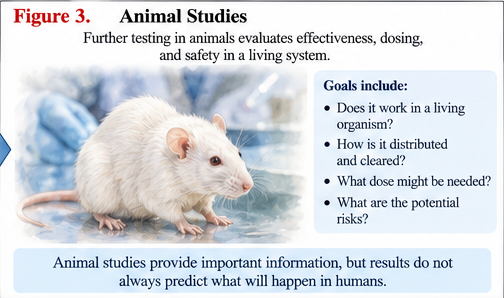
Animal studies
Animal studies can address biodistribution, persistence, dose, route, mechanism, disease-specific efficacy, and adverse effects in an intact organism. They can reveal phenomena that are not visible in cell culture. [1-8]
Translation depends on model validity. Species biology, immune systems, age, comorbidity, disease induction, and outcome measures can differ materially from human disease. Positive animal results may increase confidence in a hypothesis; they do not guarantee human efficacy. [1-8]
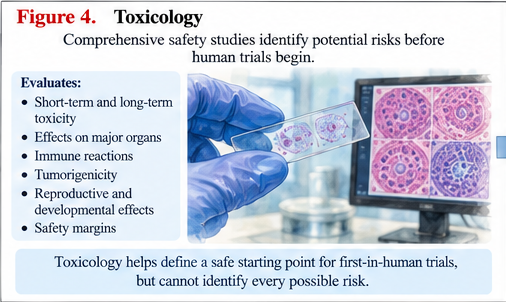
Toxicology
Nonclinical toxicology evaluates potential harms before or alongside human exposure. For cell and EV products this may include local and systemic toxicity, immune effects, thrombosis, biodistribution, persistence, unwanted proliferation, tumor-related concerns, and risks created by impurities or manufacturing variability. [1-8]
The toxicology program should match the exact product, route, dose, schedule, and intended clinical population. Safety data for one cell source or route cannot automatically be transferred to a materially different product. [1-8]
Phase 1
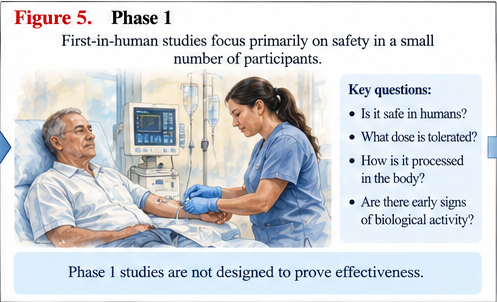
Phase 1 studies are usually the first structured human evaluation of a new investigational product. Their central purpose is commonly safety and tolerability, while also examining feasibility, dose, route, pharmacodynamic or biological signals, and sometimes exploratory efficacy measures. [1-8]
A Phase 1 study can provide important positive information without proving effectiveness. Small samples, selected participants, limited controls, and short follow-up mean that favorable exploratory outcomes should be described as signals rather than confirmatory efficacy. [1-8]
Phase 2
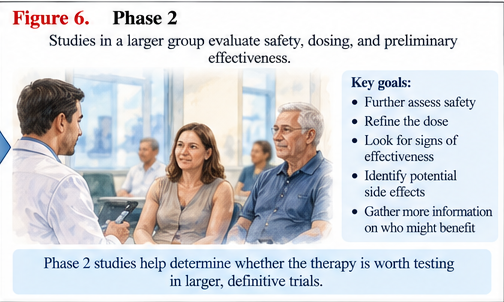
Phase 2 studies refine the clinical hypothesis. They may evaluate dose, schedule, patient selection, endpoint performance, biological activity, and preliminary evidence of efficacy, often using randomized controlled designs. [1-8]
A positive Phase 2 result can materially increase confidence and justify confirmatory testing. Interpretation still depends on the prespecified primary endpoint, effect size, confidence intervals, multiplicity, missing data, product consistency, and whether the observed difference is clinically meaningful. [1-8]
Phase 3
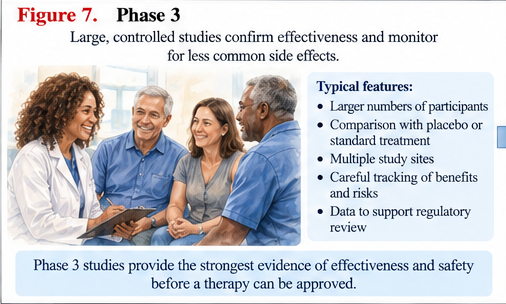
Phase 3 studies are generally larger confirmatory trials designed to determine whether benefits and risks support the proposed clinical use. They should use prespecified populations, comparators, endpoints, statistical plans, and manufacturing controls capable of supporting a regulatory and clinical conclusion. [1-8]
Phase 3 does not guarantee success or approval. A program can fail because efficacy is smaller than expected, safety problems emerge, manufacturing changes undermine comparability, endpoints do not confirm earlier signals, or the overall benefit-risk balance is unfavorable. [1-8]
Regulatory review
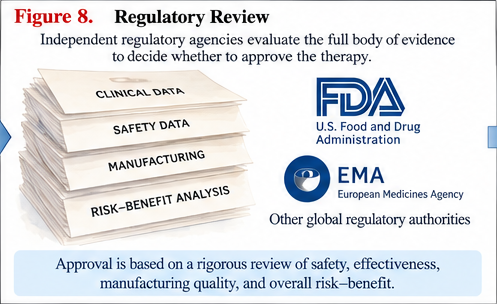
Regulatory review evaluates the total evidence for a specific product and proposed indication. Authorities consider manufacturing and quality data, nonclinical evidence, clinical safety and efficacy, labeling, inspection findings, and the benefit-risk balance. FDA's August 2026 cellular and gene therapy FAQ guidance explicitly spans regulatory, CMC, pharmacology/toxicology, clinical, and clinical-pharmacology issues in development. [1-8]
Regulatory authorization and scientific evidence are related but distinct. An authorized product may still have important uncertainty, and an investigational product may have promising evidence without authorization. Evidence level, development stage, regulatory status, guideline position, and manufacturing quality should remain separate labels. [1-8]
Postmarketing surveillance
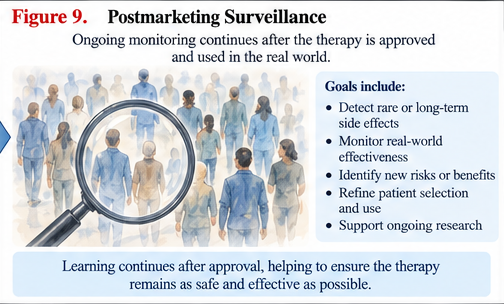
Postmarketing surveillance begins after authorization and wider clinical use. Larger and more diverse populations can reveal uncommon adverse events, delayed harms, effectiveness differences, product-use problems, or safety signals that were not detectable in preauthorization trials. [1-8]
Surveillance can include spontaneous adverse-event reporting, registries, active safety systems, required postmarketing studies, real-world data, inspections, lot investigations, and label changes. FDA's 2025 draft guidance for cell and gene therapies emphasizes postapproval methods because long-lasting effects and small preapproval populations can leave important uncertainty after authorization. [1-8]
Clinical takeaway
Each translational stage answers a different question. Discovery and proof of concept establish plausibility; animal studies and toxicology address whole-organism behavior and preclinical safety; Phase 1 emphasizes initial human safety; Phase 2 refines dose and efficacy hypotheses; Phase 3 seeks confirmation; regulatory review evaluates the total product-specific evidence; and postmarketing surveillance continues benefit-risk assessment in broader use. Evidence should not be promoted from one stage to another without the data required for that stage. [1-8]
Product identity and manufacturing
For MSC and EV development, translation cannot be separated from manufacturing. Tissue source, donor selection, culture conditions, passage, purification, concentration, cryopreservation, release criteria, sterility, identity, purity, potency, stability, and comparability after process changes can materially affect the product. FDA's 2026 CMC guidance specifically describes a lifecycle approach and regulatory flexibility during cellular and gene therapy development; flexibility does not eliminate the need to establish product quality appropriate to the development stage. [3,5]
Evidence interpretation
Failure at a later stage does not prove that an earlier mechanistic observation was false. It may show that the mechanism was insufficient, the model poorly predictive, the dose or route inappropriate, the product changed, or the clinical endpoint did not capture the expected effect. Conversely, a promising early signal should not be treated as established clinical efficacy before adequate confirmatory testing. [1-6]
Safety
Safety evidence accumulates across the entire pathway. Risks may be predicted mechanistically, detected in animals, observed during early human dosing, clarified in larger trials, or emerge only after broad use. For products capable of persistent biological effects, long-term follow-up may be necessary; FDA guidance for some gene therapies explicitly addresses delayed adverse events and extended surveillance. [4,7]
Bottom-line evidence statement
The translational pathway is best understood as a sequence of increasingly demanding tests rather than a guarantee of progress. A therapy may be biologically plausible and clinically promising while remaining investigational. The defensible conclusion at any moment is the conclusion supported by the highest-quality evidence actually reached for that exact product, indication, dose, route, population, comparator, endpoint, and follow-up. [1-8]