Plain-language overview
Before a new treatment becomes part of routine medical care, it usually passes through increasingly demanding tests. Researchers first ask whether the idea makes biological sense, then whether it works in laboratory and animal models, whether it appears safe enough to test in people, whether early human studies are encouraging, and whether larger trials confirm that benefits outweigh risks. Regulators then review the evidence for a specific product and use. Monitoring continues even after authorization.
This pathway is especially important for stem-cell and extracellular-vesicle products because products with similar names may differ in tissue source, manufacturing, dose, purity, potency, route, and biological behavior. A positive result with one product does not automatically apply to another.
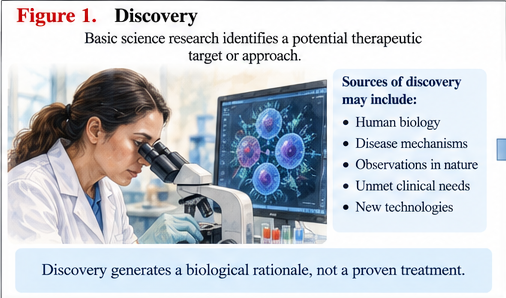
Discovery
Discovery is where a possible treatment idea begins. Researchers may identify a cell type, extracellular-vesicle preparation, biological pathway, molecular signal, or manufacturing feature that could affect a disease. At this stage the evidence can be scientifically interesting without proving that patients will benefit.
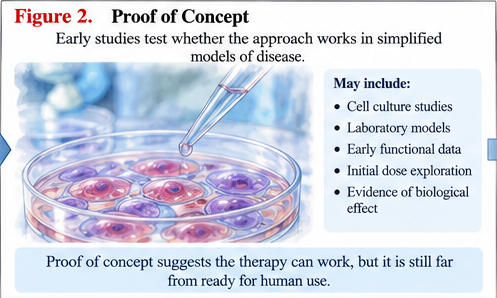
Proof of concept
Proof of concept asks whether the idea can produce the expected effect under defined experimental conditions. A successful result is a reason to continue studying the idea, but real human disease is usually much more complicated than an experimental model.
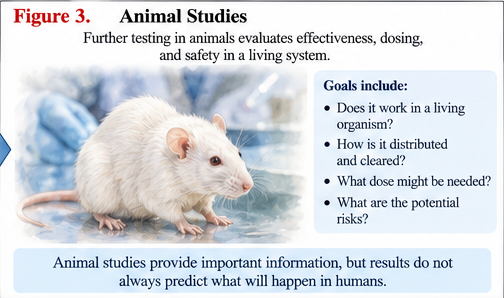
Animal studies
Animal studies let researchers examine dose, route, biodistribution, persistence, potential benefit, and harm in an intact organism. Animals and humans differ, so a treatment can work well in an animal model and later fail in human trials.
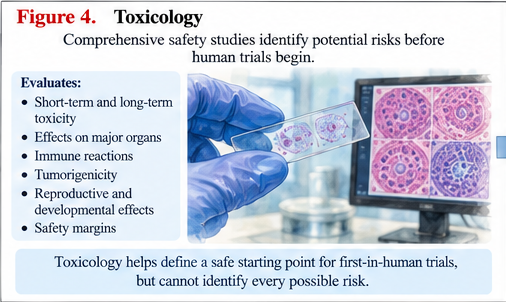
Toxicology
Toxicology studies look specifically for potential harm. Depending on the product, researchers may examine inflammation, immune reactions, clotting, organ injury, unwanted growth, contamination-related risks, and where the product travels in the body.
Phase 1
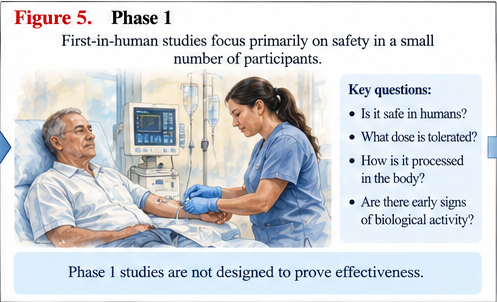
Phase 1 is usually an early human-testing stage. The main question is commonly initial safety and tolerability. Researchers may also study dose, feasibility, biological effects, and exploratory signs of benefit. A favorable Phase 1 result does not by itself prove effectiveness.
Phase 2
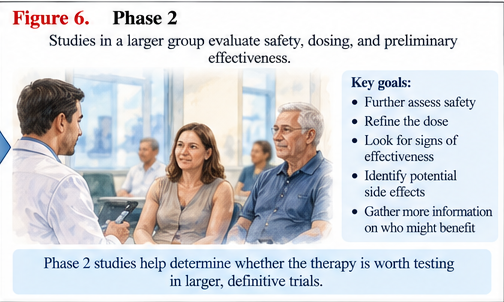
Phase 2 studies examine the treatment hypothesis more closely. Researchers may compare doses, refine which patients are most appropriate, test clinical endpoints, and look for preliminary evidence of meaningful benefit. Positive results still require careful interpretation.
Phase 3
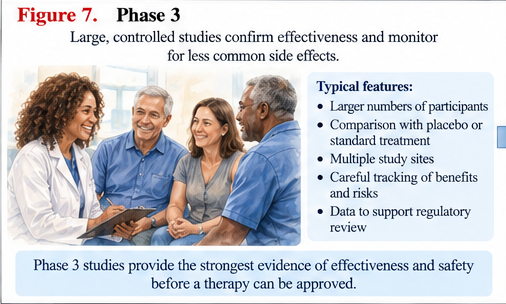
Phase 3 studies are generally larger confirmatory trials designed to determine whether evidence on benefit and harm supports the proposed clinical use. Reaching Phase 3 does not guarantee success or authorization.
Regulatory review
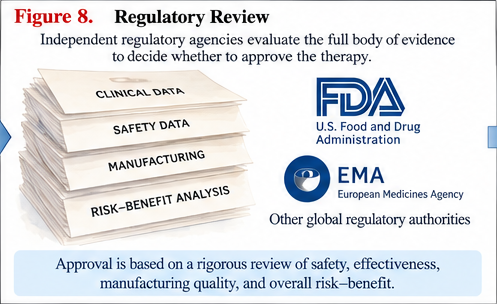
During regulatory review, authorities evaluate evidence for a specific product and proposed use, including manufacturing, preclinical studies, clinical safety and effectiveness, labeling, inspections, and the overall benefit-risk balance. A promising treatment may still be investigational.
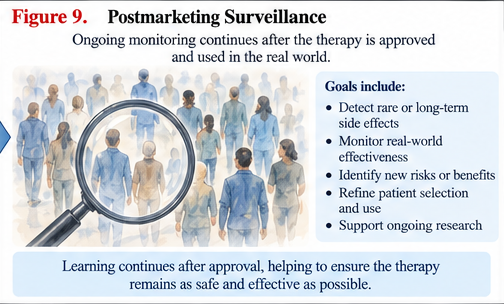
Postmarketing surveillance
Evidence collection does not stop after authorization. Broader use can reveal uncommon or delayed problems and show how a treatment performs in routine practice. Postmarketing surveillance may include adverse-event reports, registries, active safety systems, required studies, real-world data, inspections, and label changes.
How to interpret the pathway
The stages are not a simple ladder that every treatment automatically climbs. A program may return to earlier work, change the product, alter the dose or route, narrow the patient population, or stop because the evidence is not strong enough.
Why manufacturing matters
For cell and extracellular-vesicle therapies, manufacturing is part of the treatment. Tissue source, donor selection, culture, purification, storage, release testing, potency, stability, and process changes can affect what patients actually receive.
Safety
Safety information accumulates throughout development. Some risks may appear in laboratory work, others in animals, early human trials, larger trials, or only after broad use. A short study with no serious adverse events is reassuring within that study but is not proof of complete long-term safety.
Bottom line
The translational pathway is a series of increasingly demanding questions. Early research can be promising without proving clinical benefit. Later trials can confirm, weaken, or overturn earlier expectations. The key is to ask which exact product was tested, how far it has progressed, what the best human evidence shows, and what remains uncertain.
Questions patients should ask
• What exact product is being studied or offered?
• What stage of development has this exact product reached?
• Have human trials been performed for my exact condition?
• What was the main endpoint of the strongest trial?
• Was the study controlled and randomized?
• How long were patients followed?
• Is this exact use authorized or experimental and investigational?