Longevity and anti-aging claims sit at the intersection of geroscience, regenerative medicine, and commercial health marketing. The scientific question is legitimate: whether interventions that modify mechanisms associated with aging can preserve function, delay age-related disease, or extend healthspan. The evidentiary standard, however, must remain exact. A change in a molecular pathway, biomarker, organ-specific symptom, or short-term performance test is not equivalent to demonstrated rejuvenation, slowed organism-wide aging, or longer survival. [1-4]
Biological aging claims
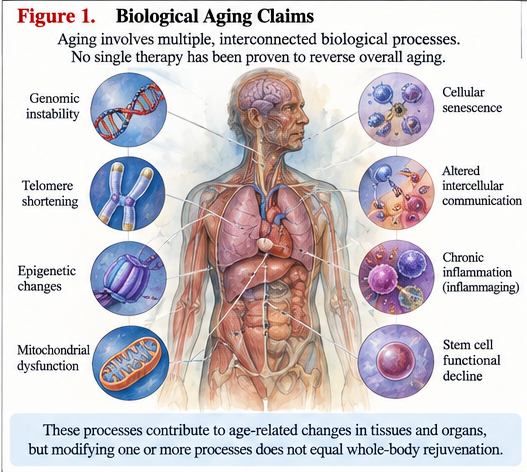
Biological aging is not a single pathway. Contemporary aging biology describes multiple interacting processes, including genomic instability, epigenetic alteration, impaired proteostasis and autophagy, deregulated nutrient sensing, mitochondrial dysfunction, cellular senescence, stem-cell exhaustion, altered intercellular communication, chronic inflammation, and dysbiosis. Mesenchymal stromal cells (MSCs) and extracellular vesicles (EVs) can influence some of these pathways experimentally through immunomodulatory, trophic, vascular, mitochondrial, and intercellular-signaling effects. This establishes mechanistic relevance, not clinical proof of anti-aging efficacy. [1,5,6]
The phrase “biological age” also requires caution. Epigenetic, proteomic, metabolomic, physiological, and digital measures may correlate with age-related risk, function, or mortality, but they are not interchangeable and are not yet validated as stand-alone surrogate endpoints for rejuvenation. Current expert recommendations emphasize standardized collection, benchmarking, and linkage to clinically meaningful outcomes rather than treating any single clock as a definitive efficacy measure. [2-4]
Accordingly, claims should be stated at the level actually measured. A reduction in an inflammatory marker is an inflammatory-marker result. A change in an epigenetic clock is a biomarker result. Neither should be converted into a claim that a person has become biologically younger unless that measure has been validated to predict patient-important aging outcomes and the intervention has demonstrated durable benefit. [2-4]
Frailty
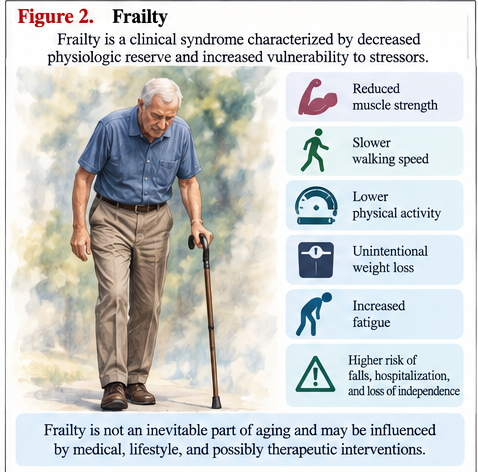
Frailty is a clinically meaningful syndrome of reduced physiologic reserve and increased vulnerability to stressors. Unlike a generic anti-aging label, it can be defined and measured using validated physical-performance, functional, patient-reported, and adverse-event outcomes. [7-9]
Human MSC research in frailty has produced genuine positive signals. In a 2017 randomized, double-blind, placebo-controlled phase II study of 30 frail adults, intravenous allogeneic MSCs produced no therapy-related serious adverse events at one month; the 100-million-cell group improved in the six-minute walk test, Short Physical Performance Battery, forced expiratory volume in one second, and selected inflammatory markers, whereas the 200-million-cell and placebo groups did not show the same pattern. [7]
A separate 2024 randomized, double-blind, placebo-controlled trial of human umbilical-cord-derived MSCs reported a greater improvement in the physical component score of SF-36 than placebo over six months, with additional physical-performance and cytokine outcomes assessed. This is clinically relevant evidence in a defined frailty population and should not be minimized simply because the intervention is investigational. [8]
The limitations are equally important. Frailty trials differ in population, frailty definition, cell source, manufacturing, dose, schedule, background care, endpoint hierarchy, and follow-up. A favorable frailty result does not establish generalized rejuvenation, lifespan extension, or efficacy for unrelated MSC or EV products. [7-9]
Sarcopenia
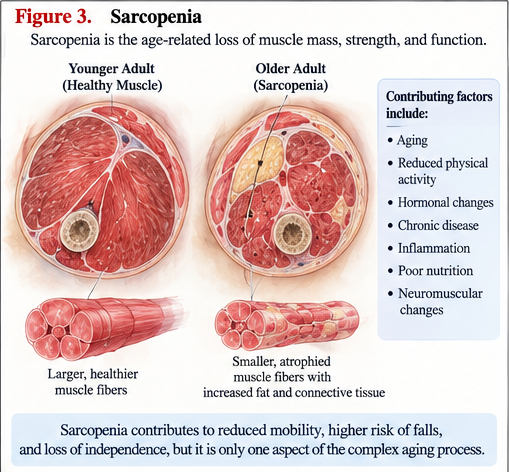
Sarcopenia is a progressive skeletal-muscle disorder characterized primarily by low muscle strength, with low muscle quantity or quality used to confirm the diagnosis and poor physical performance identifying more severe disease. It overlaps with frailty but is not synonymous with frailty. [10]
Preclinical research provides a plausible rationale for regenerative approaches, including effects on inflammatory signaling, vascular support, mitochondrial biology, extracellular matrix, and endogenous muscle progenitor cells. However, evidence from animal or cell models cannot establish human efficacy. [5,6]
A key evidentiary problem is endpoint substitution. Improvement in walking distance or global frailty performance does not prove treatment of sarcopenia unless participants meet accepted sarcopenia criteria and the study directly measures strength, muscle quantity or quality, physical performance, durability, and safety. Human evidence specifically addressing consensus-defined sarcopenia with MSC or EV products remains much less developed than the broader frailty literature. [9,10]
Cognitive aging
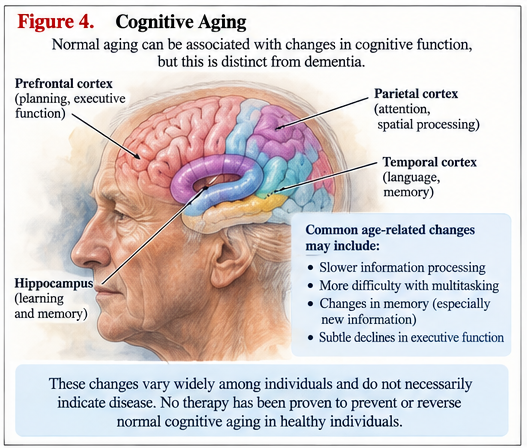
Normal cognitive aging, mild cognitive impairment, Alzheimer disease, vascular cognitive impairment, and other neurodegenerative disorders are distinct clinical entities. Disease-specific regenerative research can inform mechanism and feasibility, but it cannot be relabeled as proof of generalized brain rejuvenation. [11]
Early-phase cell-based studies in neurodegenerative disease have generally focused on safety, feasibility, inflammatory biology, imaging, or exploratory cognitive and functional outcomes. Even when favorable signals are observed, small samples, multiplicity of endpoints, short follow-up, and disease-specific enrollment limit generalization to normal cognitive aging. [11]
A credible cognitive-aging trial would need validated cognitive and functional outcomes, adequate controls, prespecified endpoint hierarchy, attention to practice effects and mood or sleep confounding, and sufficient follow-up to distinguish transient test variation from durable preservation of function. [2-4,11]
Sexual health claims
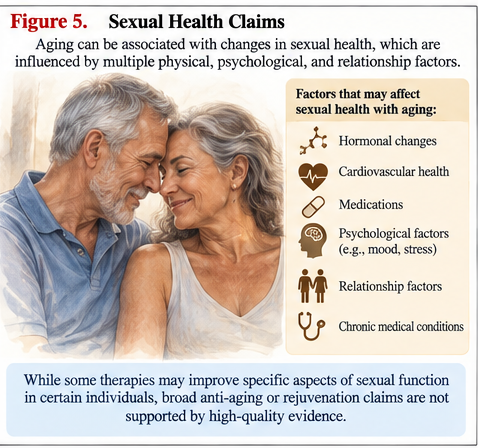
Sexual health is influenced by vascular, neurologic, endocrine, medication-related, psychologic, relational, and age-associated factors. Improvement in one sexual-health domain is therefore not a valid proxy for whole-body rejuvenation. [12]
For erectile dysfunction, regenerative approaches including stem-cell strategies have been studied clinically, but the evidence base remains small and heterogeneous. Contemporary reviews emphasize variability in cell source, dose, route, etiology of erectile dysfunction, concomitant treatments, and follow-up. Short-term improvements in validated erectile-function scores or penile hemodynamics may justify further study, but they do not establish restored youth, improved fertility, generalized sexual rejuvenation, or an anti-aging effect. [12]
Claims in female sexual health require the same discipline. Desire, arousal, pain, genitourinary syndrome of menopause, pelvic-floor dysfunction, endocrine factors, and relational determinants have different mechanisms and endpoints and should not be collapsed into a single rejuvenation claim. [12]
Absence of validated rejuvenation endpoints
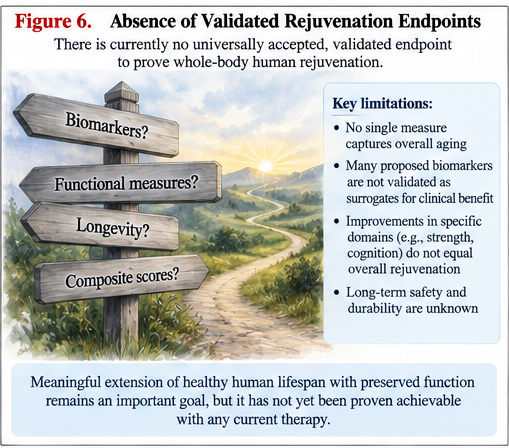
The largest methodological problem in broad anti-aging claims is often the endpoint itself. There is no single validated clinical endpoint that proves a person has been rejuvenated. Geroscience increasingly favors multidimensional outcomes incorporating physical function, cognition, disability, multimorbidity, resilience, patient-reported outcomes, hospitalization, and survival, with biomarkers treated as complementary rather than definitive. [2-4]
A surrogate endpoint is only useful when changes in that measure reliably predict changes in an outcome that matters to patients. Aging biomarkers do not yet meet that standard broadly enough to function as universal surrogate endpoints for rejuvenation. Standardization and validation efforts are active, but that scientific development should not be confused with completed validation. [2-4]
Therefore, a broad rejuvenation claim would require more than a favorable cytokine, methylation clock, imaging result, or exercise test. It would require a prespecified clinical framework, adequate controls, validated multidimensional outcomes, manufacturing consistency, sufficient follow-up for durability and delayed harms, and evidence that benefits extend beyond one disease-specific pathway. [2-4]
Clinical takeaway
The evidence is neither uniformly negative nor sufficient for broad rejuvenation claims. Defined MSC products have generated clinically meaningful signals in selected frailty trials. Mechanistic and early clinical work in other aging-related domains justifies continued study. The defensible conclusion is product- and endpoint-specific: promising in defined areas, investigational in most, and unsupported when broad anti-aging claims exceed the outcomes actually measured. [2-9,11,12]
Biological rationale
Relevant mechanisms include immunomodulation, trophic signaling, vascular support, mitochondrial effects, modulation of cellular senescence and chronic inflammation, extracellular-vesicle cargo transfer, and effects on endogenous progenitor-cell niches. These mechanisms overlap with recognized hallmarks of aging but are neither unique to aging nor sufficient to prove clinical rejuvenation. [1,5,6]
Product identity
Bone-marrow-derived MSCs, umbilical-cord-tissue MSCs, adipose-derived stromal products, native EV preparations, engineered EVs, and other regenerative products are not interchangeable. Donor characteristics, tissue source, culture conditions, passage, cryopreservation, release criteria, potency assays, dose, route, and manufacturing controls are part of therapeutic identity. [5,6]
Trial design
Trials should state whether the objective is disease treatment, frailty improvement, disability prevention, preservation of physical or cognitive function, reduced multimorbidity, or a broader geroscience claim. Eligibility, comparator, product identity, dose, route, endpoint hierarchy, multiplicity control, biomarker role, durability, and delayed safety surveillance should be prespecified. [2-4]
Safety
Potential risks depend on product and route and may include infusion or procedure reactions, infection, thrombosis, immune effects, contamination, ectopic tissue effects, unwanted proliferation, and delayed adverse events. Older adults often have multimorbidity and polypharmacy, making long-term surveillance and careful attribution of adverse events particularly important. [5,6]
Regulatory status
Regulatory status is product-, indication-, route-, jurisdiction-, and date-specific. Approval of a cellular product for one defined disease does not establish approval or efficacy for longevity, frailty, sarcopenia, cognitive aging, sexual rejuvenation, or generalized anti-aging use. Regulatory status and scientific evidence should be reported separately. [5,6]
Standard care
Healthy-aging and frailty management remain anchored in physical activity and resistance exercise, adequate nutrition and protein intake, vaccination, sleep, cardiovascular and metabolic risk reduction, fall prevention, medication review, sensory and mental-health care, and condition-specific treatment. Investigational regenerative approaches should be evaluated against—not substituted for—the appropriate contemporary standard of care. [9,10]
Knowledge gaps
Major gaps include validation of clinically meaningful geroscience endpoints, replication of frailty efficacy signals, trials using consensus-defined sarcopenia criteria, long-term safety, effects on disability and multimorbidity, standardized EV manufacturing and dose metrics, product-specific potency assays, and evidence linking biomarker changes to patient-important outcomes. [2-6,9,10]
Bottom-line evidence statement
Regenerative medicine has credible biological relevance to aging research and has produced favorable human signals in selected frailty studies. That is materially different from validated human rejuvenation. Current evidence does not establish that MSCs, EVs, or related products reverse organism-wide aging or extend lifespan. Conclusions should remain tied to the exact product, population, endpoint, comparator, and duration of follow-up. [2-10]