Plain-language overview
Research on aging asks whether biological changes that occur over time can be modified in ways that help people remain healthier and more functional. Mesenchymal stromal cells and extracellular vesicles are being studied because they can affect inflammation, blood vessels, tissue signaling, and other processes connected with aging. That makes them scientifically interesting. It does not mean they have been proven to make people younger, reverse aging, extend life, or provide general rejuvenation. [1-6]
Biological aging claims
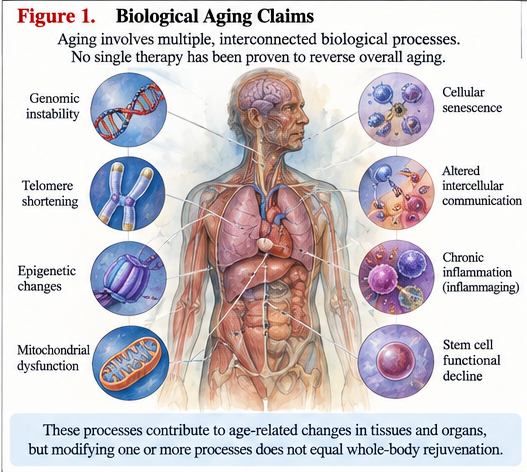
Biological aging involves many interacting changes in cells, tissues, metabolism, immunity, and organ function. A treatment may change one pathway or laboratory measurement without changing how long a person lives, how well the person functions, or whether age-related diseases are delayed. [1-4]
Researchers sometimes use inflammatory markers, DNA-based biological-age clocks, imaging, or other biomarkers. These can be useful research tools, but no single biomarker or biological-age clock is currently accepted as proof that a treatment has slowed or reversed human aging. [2-4]
Frailty
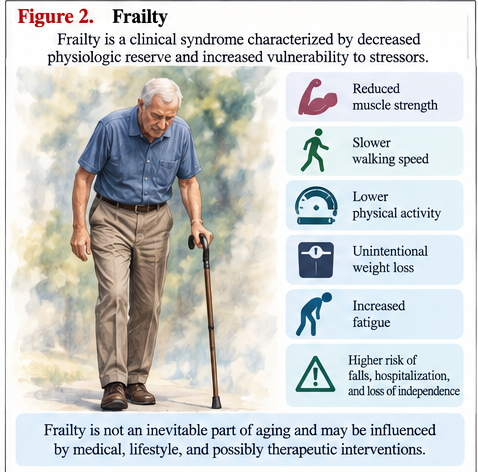
Frailty is a medical syndrome in which an older person has less physiological reserve and becomes more vulnerable to illness, injury, or other stresses. It can be measured with walking tests, strength, physical performance, daily function, and patient-reported outcomes. [7-9]
Human mesenchymal stromal cell research in frailty has produced genuinely encouraging results. Randomized studies have reported improvements in selected physical-function and quality-of-life measures. In one phase II study, the 100-million-cell group improved in the six-minute walk test, Short Physical Performance Battery, lung function, and selected inflammatory measures. A separate randomized trial of umbilical-cord-derived MSCs reported improvement in selected physical-health outcomes. [7,8]
These findings deserve to be taken seriously. They also should not be stretched into a claim that MSC treatment reverses aging. The results apply to particular products, doses, patients, measurements, and follow-up periods. [7-9]
Sarcopenia
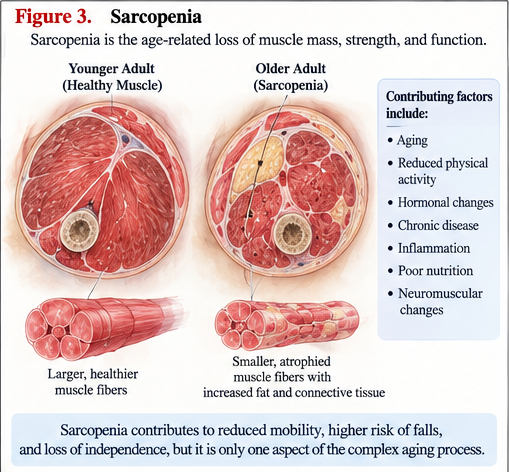
Sarcopenia is a progressive muscle disorder characterized mainly by low muscle strength together with reduced muscle quantity or quality. It overlaps with frailty, but the two are not the same diagnosis. [10]
Laboratory and animal studies give researchers reasons to study regenerative approaches for sarcopenia, including possible effects on inflammation, blood-vessel support, mitochondria, and muscle repair. Those findings do not by themselves prove that the treatment works in people. [5,6]
Human evidence specifically targeting people who meet accepted sarcopenia criteria remains much less developed than the frailty literature. Improvement in walking distance in a frailty study cannot automatically be relabeled as successful treatment of sarcopenia. [9,10]
Cognitive aging
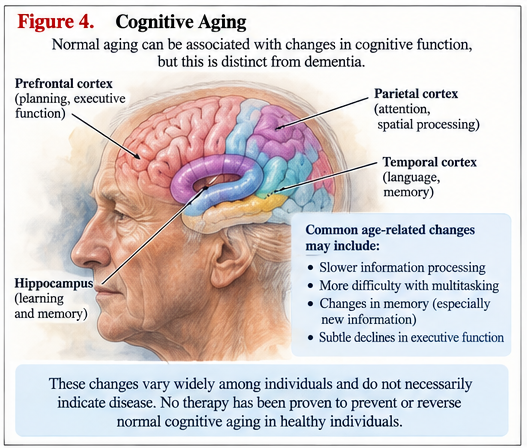
Normal cognitive aging is different from mild cognitive impairment, Alzheimer disease, vascular cognitive impairment, and other neurological disorders. Evidence from one of these conditions should not be described as proof of general brain rejuvenation. [11]
Early cell-based studies in neurodegenerative disease have mainly examined safety, feasibility, inflammation, imaging, and exploratory cognitive or functional outcomes. Favorable signals can justify further research, but small studies and disease-specific enrollment do not establish prevention or reversal of normal cognitive aging. [11]
Sexual health claims
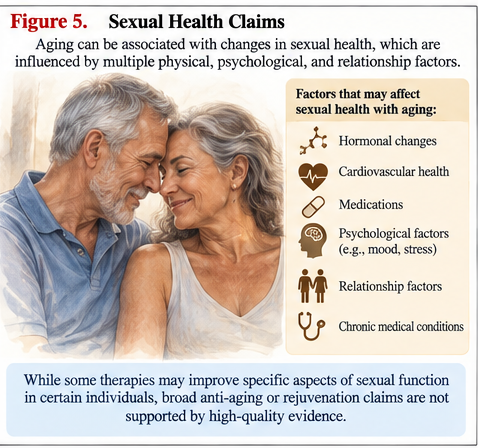
Sexual health can be affected by blood-vessel disease, nerve problems, hormones, medications, psychological factors, relationships, pelvic conditions, chronic illness, and aging. Improvement in one sexual-health problem is therefore not a valid general test of whether the body has been rejuvenated. [12]
For erectile dysfunction, regenerative approaches have produced some encouraging early clinical findings, but the studies remain small and heterogeneous. Improvement in erectile function does not prove restored youth, improved fertility, or a whole-body anti-aging effect. [12]
Absence of validated rejuvenation endpoints
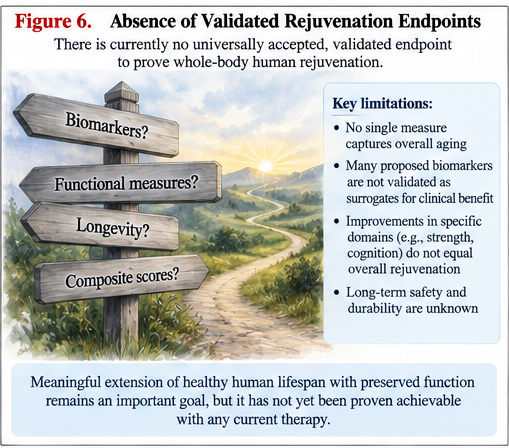
There is currently no single clinical test that proves a person has been rejuvenated. Geroscience researchers increasingly look at combinations of outcomes such as physical function, cognition, disability, multimorbidity, resilience, patient-reported outcomes, hospitalization, and survival. [2-4]
A surrogate endpoint is a substitute measurement intended to predict an outcome that matters to patients. Aging biomarkers have not been validated broadly enough to serve as universal surrogate endpoints for rejuvenation. A favorable biomarker, aging clock, scan, exercise test, or symptom score can be informative without proving that aging itself has been reversed. [2-4]
Why the exact product matters
Stem-cell therapy is not one treatment. Bone-marrow-derived MSCs, umbilical-cord-tissue MSCs, adipose-derived products, extracellular vesicles, and engineered products can differ in source, manufacturing, dose, route, biological activity, and safety. A positive study of one product does not prove that another product works. [5,6]
How anti-aging studies can mislead
A study can appear more impressive than it is when a laboratory marker is presented as if it were a clinical outcome, when only favorable outcomes are emphasized, when there is no appropriate control group, when follow-up is short, or when improvement in one disease is described as whole-body rejuvenation. [2-4]
Safety considerations
Potential risks depend on the exact product and route. They can include infusion or injection reactions, infection, clotting, immune reactions, contamination, unwanted tissue effects, and delayed problems that short studies may miss. Older adults may also have multimorbidity and take several medications. [5,6]
Bottom line
Regenerative medicine is a legitimate area of aging research, and selected human studies—especially in frailty—have produced encouraging clinical signals. Current evidence does not establish that MSCs, extracellular vesicles, or related products generally reverse human aging, restore youth, or extend lifespan. [2-10]
How this review was prepared
This Patient Edition was derived from the explicitly approved 0815 Professional Edition. Positive, negative, mixed, and inconclusive findings were retained according to the quality and directness of the evidence. Mechanistic evidence, clinical evidence, regulatory status, manufacturing quality, and safety were kept as separate questions.
Questions patients should ask
• What exact product is being offered, and how is it manufactured and tested?
• What human trials have studied this exact product for my exact condition?
• Is the claimed benefit a biomarker, symptom, functional outcome, or demonstrated effect on healthspan or survival?
• Was the study randomized and controlled?
• How long were patients followed?
• Is this exact use approved in my jurisdiction or experimental and investigational?