Professional Edition Reproductive ethics therefore requires attention to autonomy, informed consent, proportional risk, offspring interests, justice, and avoidance of unsupported therapeutic claims.
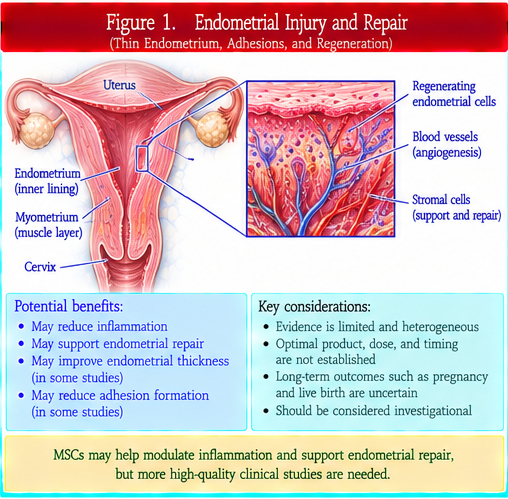
Endometrial injury
Endometrial injury can include intrauterine adhesions, basal-layer damage, inflammation, fibrosis, and impaired endometrial regeneration after surgery, infection, pregnancy-related instrumentation, or other insults. Severe injury can compromise cavity anatomy, endometrial thickness, implantation, and fertility. MSC and extracellular-vesicle research has explored immunomodulation, angiogenesis, antifibrotic signaling, stromal support, and regeneration of endometrial tissue. Human studies are small and heterogeneous, and changes in endometrial thickness or imaging do not establish restoration of normal histology, implantation competence, live birth, or obstetric safety. Standard evaluation should identify the cause and anatomy of injury and preserve established hysteroscopic, hormonal, fertility, and obstetric care.
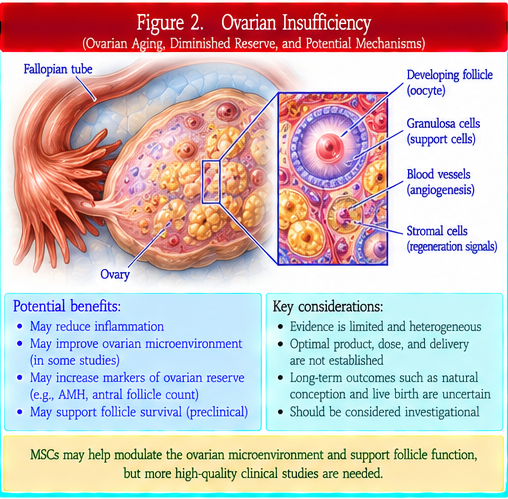
Ovarian insufficiency
Ovarian insufficiency includes diminished or lost ovarian endocrine and reproductive function and must be distinguished from normal reproductive aging and from specific causes such as genetic disease, autoimmunity, gonadotoxic therapy, surgery, or other injury. Primary ovarian insufficiency can involve intermittent residual follicular activity despite reduced ovarian reserve. MSC and EV studies have proposed angiogenic, antiapoptotic, immunomodulatory, mitochondrial, and stromal-support mechanisms, predominantly in preclinical models. Changes in anti-Müllerian hormone, follicle-stimulating hormone, antral follicle count, or menstruation do not establish restoration of a durable oocyte pool, genetically normal gametes, pregnancy, or live birth.
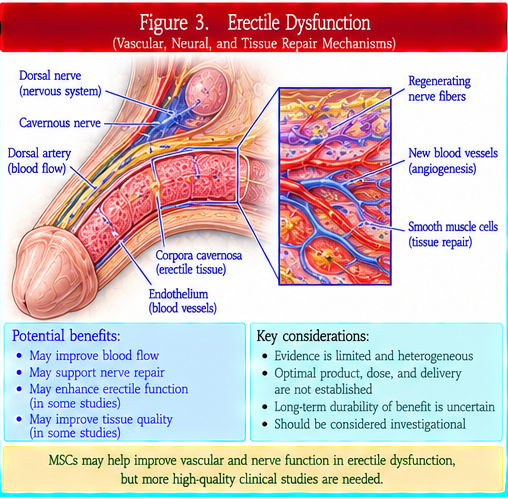
Erectile dysfunction
Erectile dysfunction (ED) is a symptom with vascular, neurologic, endocrine, medication-related, psychogenic, structural, and mixed causes. Regenerative studies have investigated MSCs, EVs, platelet-derived products, and other biologic approaches, often focusing on endothelial function, smooth-muscle support, neural signaling, and fibrosis. Small studies and uncontrolled series cannot establish durable efficacy across etiologically different ED populations. Valid interpretation should distinguish spontaneous erections, validated erectile-function scores, medication responsiveness, penile hemodynamics, adverse events, and durability. Cardiovascular risk assessment and established behavioral, pharmacologic, device, and surgical therapies remain central.
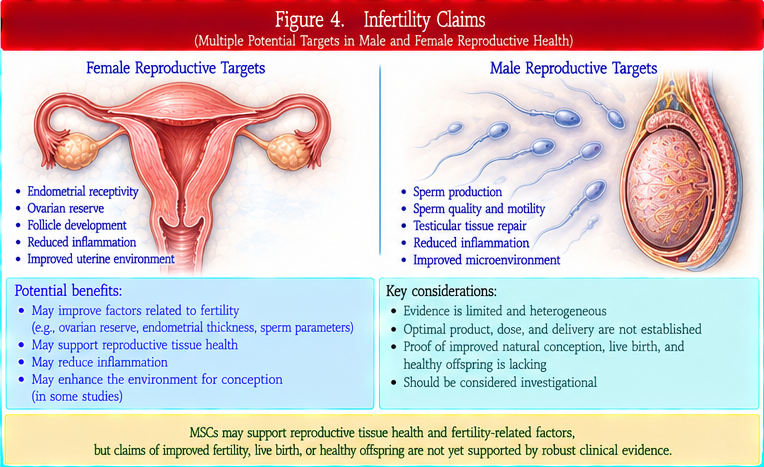
Infertility claims
Infertility claims require exceptional precision because infertility can arise from ovulatory disorders, diminished ovarian reserve, tubal disease, uterine factors, endometriosis, male-factor infertility, genetic conditions, age-related reproductive decline, or unexplained causes. Claims that MSCs or EVs 'restore fertility,' 'rejuvenate ovaries,' improve egg quality, or reverse reproductive aging are not supported merely by mechanistic studies or changes in surrogate biomarkers. Fertility outcomes should distinguish oocyte retrieval, fertilization, embryo development, implantation, clinical pregnancy, miscarriage, live birth, neonatal outcomes, and cumulative success over time. Any intervention must be compared with diagnosis-specific reproductive endocrinology and assisted-reproductive options.
Evidence and ethical limitations
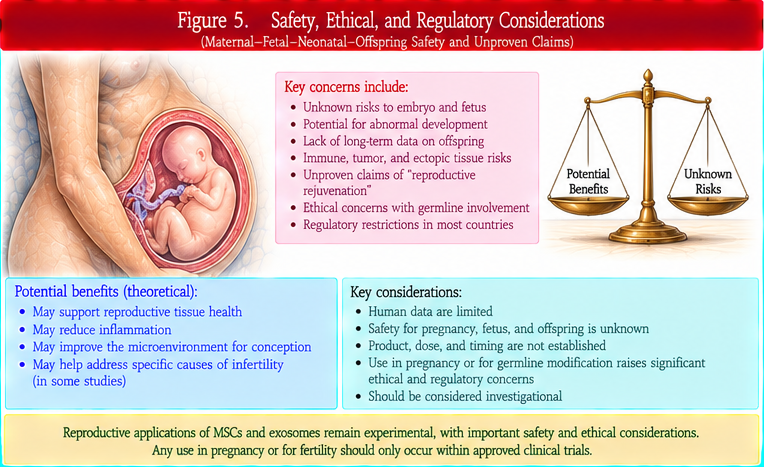
Evidence and ethical limitations are unusually important in reproductive medicine because interventions may affect not only the treated patient but also gametes, embryos, pregnancy, offspring, and future reproductive choices. Key issues include uncertain efficacy, procedure-related risk, gonadal or uterine tissue manipulation, genetic and epigenetic uncertainty, potential effects on embryos or offspring, informed consent, therapeutic misconception, financial exploitation, and long-term follow-up. Pregnancy and live birth are not sufficient safety endpoints if maternal, fetal, neonatal, or developmental outcomes are inadequately characterized. Germline modification, embryo manipulation, donor-derived materials, and investigational cell products raise distinct ethical and regulatory questions and should never be collapsed into a generic 'stem-cell fertility' category.
Clinical takeaway
Reproductive regenerative claims must be tied to the exact diagnosis and therapeutic objective. Endometrial repair, ovarian function, erectile function, fertility, and reproductive safety are distinct endpoints.
Biological rationale
Proposed mechanisms include angiogenesis, immunomodulation, antifibrotic signaling, stromal support, endothelial and neural support, antiapoptotic effects, and paracrine signaling.
Product identity
MSCs, MSC-derived EVs, conditioned media, gonadal or endometrial cell products, platelet-derived preparations, and other reproductive biologics are not interchangeable.
Preclinical evidence
Animal and in-vitro reproductive models support multiple mechanistic hypotheses, but species-specific ovarian reserve, estrous biology, implantation, pregnancy, and developmental outcomes limit direct translation.
Human clinical evidence
Human evidence remains heterogeneous and generally investigational. Surrogate hormonal, imaging, or functional changes must not be substituted for validated reproductive or patient-important outcomes.
Trial design
Studies should define diagnosis, age, ovarian reserve, uterine anatomy, male-factor status, prior fertility treatment, co-interventions, comparator, embryo-transfer strategy where relevant, and cumulative live-birth outcomes.
Dose and administration
Intrauterine, intraovarian, systemic, intracavernosal, scaffold-based, and other local routes have different tissue exposure, invasiveness, procedural risk, and evidentiary requirements.
Safety
Potential concerns include infection, bleeding, vascular or organ injury, immune effects, fibrosis, abnormal tissue growth, anesthesia or procedure complications, and unknown reproductive, pregnancy, fetal, or developmental effects.
Regulatory status
Regulatory status is product-, indication-, route-, jurisdiction-, and date-specific. Fertility-clinic use, trial registration, or patient payment does not establish authorization or efficacy.
Standard care
Hysteroscopic management, diagnosis-specific fertility treatment, assisted reproductive technology, fertility preservation, endocrine treatment, cardiovascular assessment, PDE5 inhibitors, devices, and surgery remain central where indicated.
Knowledge gaps
Major gaps include validated potency assays, true restoration of ovarian reserve, oocyte competence, durable endometrial function, live-birth benefit, offspring safety, long-term developmental surveillance, and ethical governance.
Bottom-line evidence statement
MSC and EV approaches in reproductive medicine remain investigational; surrogate reproductive signals are not proof of restored fertility, reproductive rejuvenation, live-birth benefit, or multigenerational safety.
Additional controlled terminology
An intrauterine adhesion can distort the uterine cavity after endometrial injury. The endometrium is the uterine lining in which implantation occurs. Primary ovarian insufficiency involves impaired ovarian function before the expected age of menopause; ovarian reserve is estimated using measures such as anti-Müllerian hormone, follicle-stimulating hormone, and antral follicle count but none directly measures oocyte quality. An oocyte and sperm are gametes; spermatogenesis produces sperm. Penile hemodynamics and endothelial function are important in vascular erectile function. Assisted reproductive technology includes procedures such as in vitro fertilization and embryo transfer. Clinical pregnancy, live birth, and miscarriage are distinct reproductive outcomes. Fertility preservation may be considered before gonadotoxic therapy. Therapeutic misconception can occur when research is mistaken for proven therapy. Germline modification and possible epigenetic effects raise concerns that may extend beyond the treated individual and require developmental surveillance.