Plain-language overview
Reproductive medicine includes several very different problems and goals. Repairing an injured uterine lining, evaluating ovarian insufficiency, treating erectile dysfunction, treating infertility, and protecting reproductive and offspring safety are not the same therapeutic objective.
Mesenchymal stromal cells (MSCs), extracellular vesicles (EVs), and other biologic products are being studied for possible effects on inflammation, blood vessels, fibrosis, tissue support, and cell signaling. These biological effects do not prove that fertility has been restored or reproductive aging has been reversed.
Evidence must remain tied to the exact diagnosis, product, route, patient population, and outcome. Hormone levels, imaging, or laboratory findings are not substitutes for meaningful reproductive outcomes such as pregnancy, live birth, and safety.
Endometrial injury
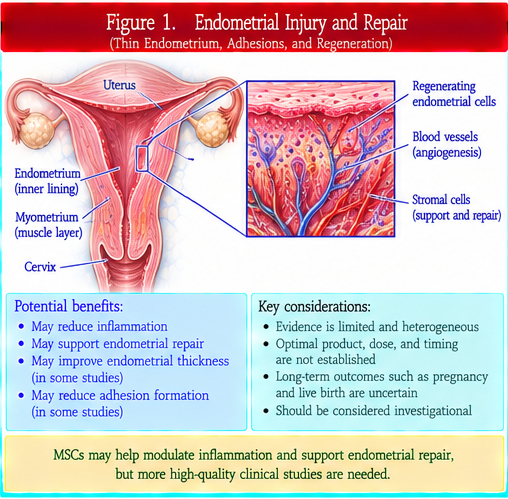
Endometrial injury can occur after surgery, infection, pregnancy-related procedures, or other damage to the uterine lining. An intrauterine adhesion can distort the uterine cavity and interfere with normal endometrial function.
The endometrium is the lining of the uterus where implantation occurs. Severe damage can affect the uterine cavity, endometrial thickness, implantation, and fertility.
MSC and EV research has examined inflammation, blood-vessel growth, fibrosis, and tissue repair. An increase in endometrial thickness does not prove restoration of normal tissue, successful implantation, live birth, or safe pregnancy. Established evaluation and hysteroscopic, hormonal, fertility, and obstetric care remain important.
Ovarian insufficiency
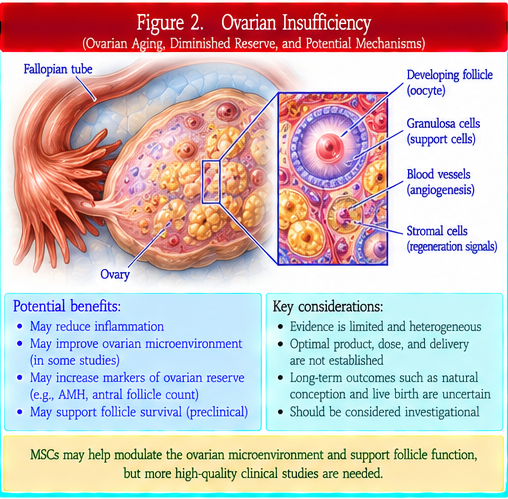
Ovarian insufficiency means reduced or lost ovarian reproductive and hormonal function. Primary ovarian insufficiency occurs before the expected age of menopause and can still include intermittent ovarian activity.
Ovarian reserve describes the remaining reproductive potential of the ovaries. Anti-Müllerian hormone, follicle-stimulating hormone, and antral follicle count are commonly used to estimate aspects of ovarian reserve, but none directly measures oocyte quality.
MSC and EV studies have examined blood-vessel support, inflammation, cell survival, mitochondrial effects, and ovarian tissue signaling. Changes in hormones, follicle counts, or menstrual cycles do not prove restoration of a durable supply of oocytes, genetically normal gametes, pregnancy, or live birth.
Erectile dysfunction
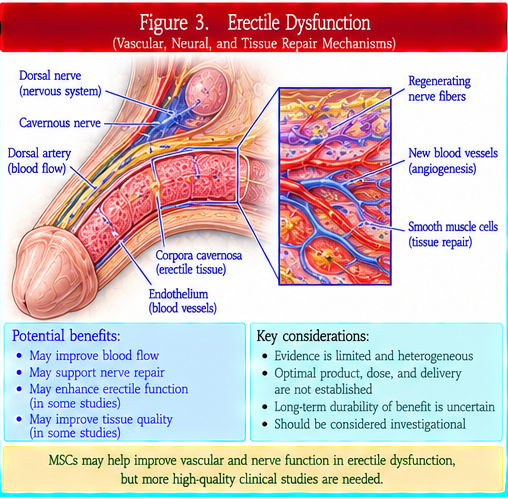
Erectile dysfunction can result from vascular disease, nerve injury, hormonal problems, medications, psychological factors, structural disease, or combinations of these causes.
Penile hemodynamics describes blood flow involved in erection, and endothelial function is important to normal vascular responses.
MSC, EV, and other biologic approaches have been studied for possible vascular, nerve, smooth-muscle, and antifibrotic effects. Small or uncontrolled studies do not prove lasting benefit across different causes of erectile dysfunction. Cardiovascular evaluation and established behavioral, medication, device, and surgical treatments remain central.
Infertility claims
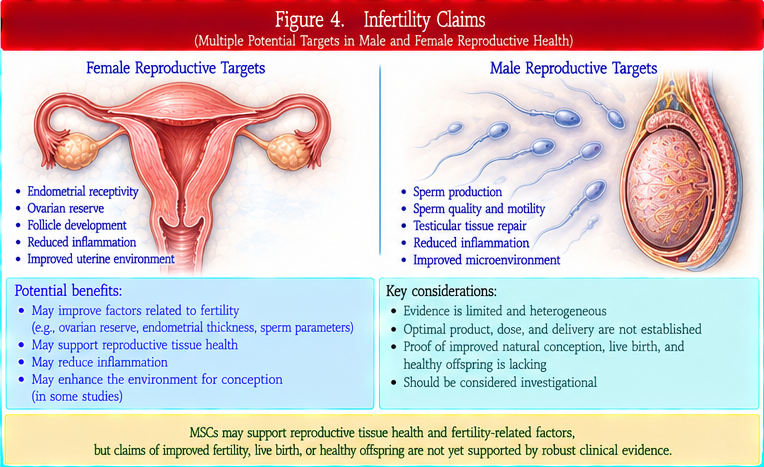
Infertility can result from ovulation problems, reduced ovarian reserve, tubal disease, uterine disease, endometriosis, male-factor infertility, genetic conditions, reproductive aging, or unexplained causes.
An oocyte and sperm are gametes. Spermatogenesis is the process that produces sperm. Assisted reproductive technology includes procedures such as in vitro fertilization and embryo transfer.
Claims that MSCs or EVs can “restore fertility,” “rejuvenate ovaries,” improve egg quality, or reverse reproductive aging require much stronger evidence than laboratory mechanisms or hormone changes. Clinical pregnancy, miscarriage, live birth, neonatal outcomes, and cumulative success are distinct outcomes and should be reported separately.
Evidence and ethical limitations
Reproductive ethics is especially important because an intervention can affect the treated patient, gametes, embryos, pregnancy, offspring, and future reproductive choices.
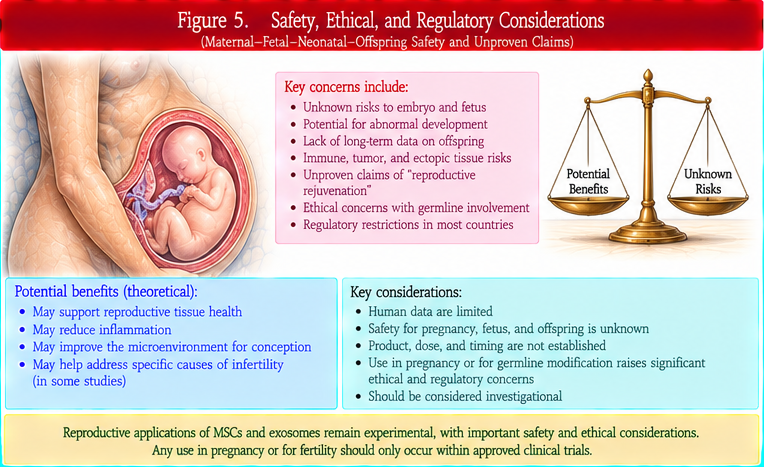
Important concerns include uncertain effectiveness, procedure-related risk, genetic or epigenetic effects, informed consent, financial exploitation, and therapeutic misconception—the mistaken belief that participation in research guarantees proven treatment.
Pregnancy or live birth alone does not establish complete safety if maternal, fetal, neonatal, or long-term developmental outcomes are unknown. Germline modification, embryo manipulation, donor-derived materials, and investigational cell products raise different ethical and regulatory questions. Developmental surveillance may be needed when potential effects could extend to offspring.
Why products and routes differ
MSCs, MSC-derived EVs, conditioned media, platelet-derived products, endometrial or gonadal cell products, and other reproductive biologics are not interchangeable.
Intrauterine, intraovarian, systemic, intracavernosal, scaffold-based, and other local routes create different tissue exposure, invasiveness, and procedural risks.
How reproductive studies can mislead
Hormone levels, endometrial thickness, follicle counts, semen measurements, penile blood-flow tests, and other surrogate outcomes can improve without proving that the final clinical goal has been achieved.
For fertility treatment, pregnancy and live birth matter, but so do miscarriage, maternal complications, neonatal outcomes, and durability. For ovarian treatment, apparent hormonal improvement does not prove restoration of egg quality or reproductive lifespan.
Safety considerations
Potential risks include infection, bleeding, vascular or organ injury, immune effects, fibrosis, abnormal tissue growth, and complications from anesthesia or invasive procedures.
Reproductive interventions can also create uncertainty about pregnancy, fetal development, neonatal health, genetic or epigenetic effects, and longer-term child development. Fertility preservation may be appropriate before gonadotoxic therapy when established options are available.
Questions patients should ask
What exact reproductive diagnosis is being treated? What exact product is being used? What route and dose are proposed? Is the goal endometrial repair, ovarian function, erectile function, or fertility? What controlled human evidence exists? Were live birth and long-term safety measured, or only hormones and imaging? Are pregnancy and offspring outcomes known? What established reproductive or urologic treatments are available?
Bottom line
MSC and EV approaches in reproductive medicine remain investigational and must be evaluated according to the exact diagnosis and therapeutic goal.
Changes in hormones, imaging, tissue appearance, or other surrogate measures are not proof of restored fertility, reproductive rejuvenation, improved live-birth rates, or safety for future offspring.
How this review was prepared
This Patient Edition was derived directly from the explicitly approved 0812 Professional Edition and preserves all five controlling reproductive-medicine Points.