Burns A pressure injury therefore reflects both loading conditions and the tissue's ability to tolerate them.
Radiation injury
Scar remodeling
Alopecia
Cosmetic skin claims The hair follicle is the biological unit whose cycling, miniaturization, inflammation, or destruction differs across these diagnoses.
Diabetic ulcers
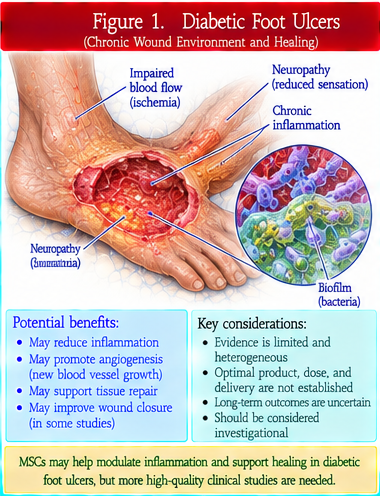
Diabetic ulcers, especially diabetic foot ulcers, arise from interacting neuropathy, repetitive pressure or trauma, peripheral arterial disease, infection risk, impaired immune responses, and abnormal wound-healing biology. MSC and extracellular-vesicle research has explored angiogenic signaling, immunomodulation, fibroblast and keratinocyte activity, extracellular-matrix remodeling, and support of granulation tissue. Human studies vary in product, route, wound severity, perfusion, off-loading, debridement, infection control, and endpoints. Wound closure or area reduction must be distinguished from durable healing, recurrence, limb salvage, amputation, and survival. Investigational biologic therapy cannot replace vascular assessment, pressure off-loading, debridement, infection management, glycemic care, and evidence-based wound treatment.
Pressure injuries
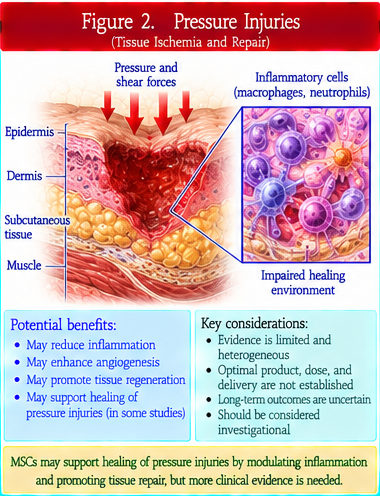
Pressure injuries result from sustained pressure or pressure combined with shear, producing ischemia and tissue deformation over vulnerable areas. Depth and tissue involvement vary substantially by stage. MSC and EV studies have investigated inflammation, angiogenesis, matrix remodeling, and epithelial repair, predominantly in preclinical models. Interpretation requires attention to pressure redistribution, nutrition, moisture, mobility, perfusion, infection, debridement, and wound stage. A laboratory signal or faster closure in an experimental model does not establish prevention of recurrence, reduced hospitalization, or improved function in medically complex patients.
Burns
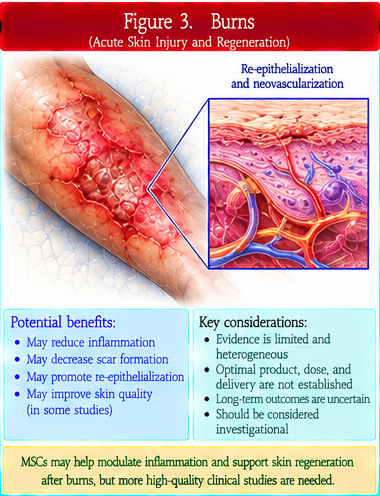
Burn injury produces depth-dependent damage to epidermis, dermis, microvasculature, nerves, and deeper tissues and can trigger major systemic inflammatory and metabolic responses when extensive. Regenerative research includes MSCs, EVs, keratinocytes, fibroblasts, skin substitutes, engineered matrices, and other cellular approaches. Proposed MSC/EV mechanisms include immunomodulation, angiogenesis, epithelialization, and modulation of fibrosis. These approaches are not interchangeable with established burn excision, grafting, resuscitation, infection control, rehabilitation, and scar management. Clinically meaningful outcomes include time to epithelialization, graft take, infection, contracture, function, pain, scarring, and long-term quality of life.
Radiation injury
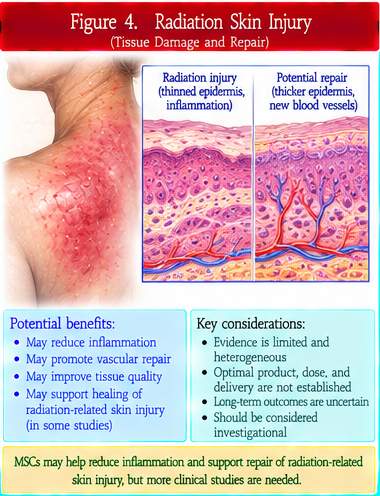
Radiation injury to skin and soft tissue can involve acute inflammation, vascular damage, impaired stem/progenitor-cell function, chronic hypoxia, fibrosis, ulceration, and poor healing. Injury may evolve over months or years and can coexist with prior surgery, infection, recurrent malignancy, or tissue necrosis. MSC and EV research has examined vascular support, immunomodulation, antifibrotic signaling, and tissue repair. Any regenerative intervention in previously irradiated tissue requires careful exclusion of active or recurrent cancer and attention to oncologic safety. Improvement in wound appearance does not establish reversal of deep fibrosis or restoration of normal tissue architecture.
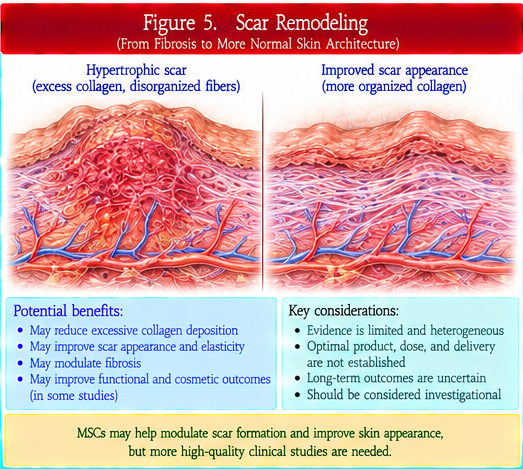
Scar remodeling
Scar remodeling is the prolonged reorganization of collagen, extracellular matrix, vascularity, pigmentation, and mechanical properties after injury. Hypertrophic scars and keloids differ biologically from mature normotrophic scars. MSC and EV studies have explored fibroblast behavior, myofibroblast differentiation, inflammatory signaling, collagen organization, and matrix remodeling. Reduced scar thickness or altered collagen in preclinical studies does not establish durable improvement in symptoms, contracture, function, pigmentation, or recurrence. Established scar therapies remain dependent on scar type, location, maturity, and patient goals.
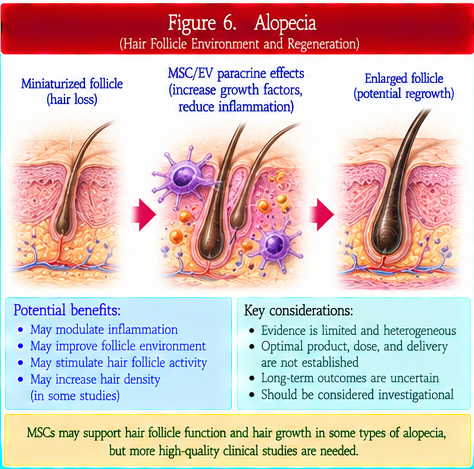
Alopecia
Alopecia is a symptom category rather than a single disease. Androgenetic alopecia, alopecia areata, scarring alopecia, telogen effluvium, and treatment-related hair loss have different mechanisms. MSC, EV, conditioned-media, and related regenerative approaches have been promoted for hair growth, but product definitions, dosing, delivery, study design, and endpoints are inconsistent. Hair count, shaft diameter, photographic assessment, patient-reported benefit, and durability should be distinguished. Evidence from one alopecia phenotype cannot be generalized to another, and underlying endocrine, autoimmune, nutritional, medication-related, or inflammatory causes require appropriate diagnosis.
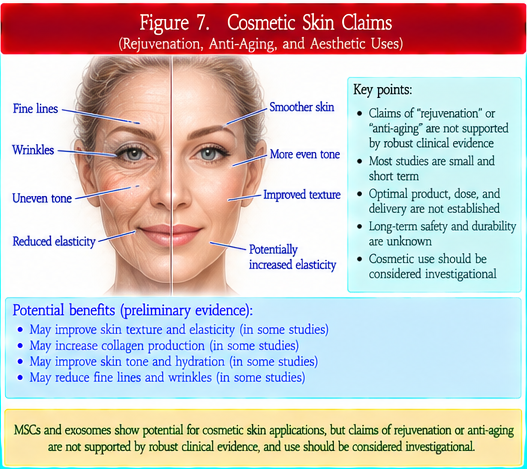
Cosmetic skin claims
Cosmetic skin claims include proposed improvements in wrinkles, pigmentation, texture, elasticity, hydration, photoaging, and generalized 'rejuvenation.' MSC-derived conditioned media and EV-containing products are increasingly marketed in this space, but composition, purity, dose, stability, delivery, and clinical evidence vary widely. Mechanistic findings involving collagen, fibroblasts, inflammation, or oxidative stress do not establish visible or durable rejuvenation. Cosmetic endpoints are vulnerable to lighting, photography, expectation, concurrent procedures, and short follow-up. Claims should identify the exact product and route and distinguish topical cosmetics, microneedling-associated delivery, injection, and regulated biologic interventions.
Clinical takeaway
Dermatology and wound care span acute wounds, chronic wounds, fibrosis, hair disorders, and cosmetic claims. Evidence must remain attached to the exact diagnosis, wound context, product, route, co-interventions, and clinically meaningful endpoint.
Biological rationale
Proposed mechanisms include immunomodulation, angiogenesis, epithelialization, fibroblast and keratinocyte signaling, extracellular-matrix remodeling, antifibrotic effects, and modulation of hair-follicle biology.
Product identity
MSCs from different tissues, EV preparations, conditioned media, keratinocyte or fibroblast products, skin substitutes, matrices, and cosmetic formulations are distinct interventions.
Preclinical evidence
Cell culture and animal wound models support multiple repair mechanisms, but wound geometry, perfusion, infection, diabetes, radiation exposure, scar biology, and hair cycling differ from human clinical disease.
Human clinical evidence
Human evidence is heterogeneous. Some wound and skin-cell technologies have indication-specific development, while broad MSC/EV claims across ulcers, burns, scars, alopecia, and cosmetic rejuvenation remain investigational.
Trial design
Trials should define wound etiology, depth or stage, perfusion, infection, off-loading, debridement, background care, scar phenotype, alopecia diagnosis, cosmetic co-interventions, and durable outcomes.
Dose and administration
Topical, intradermal, periwound, intralesional, scaffold-based, microneedling-assisted, and systemic delivery create different exposure, retention, procedural risk, and regulatory considerations.
Safety
Potential concerns include infection, inflammatory or immune reactions, abnormal scarring, vascular or injection complications, contamination, poorly characterized products, and oncologic uncertainty in previously irradiated or cancer-affected tissue.
Regulatory status
Regulatory status is product-, indication-, route-, jurisdiction-, and date-specific. Cosmetic marketing, clinic use, or labeling as an exosome or stem-cell product does not establish biologic authorization or efficacy.
Standard care
Off-loading, vascular assessment, debridement, infection management, burn surgery and grafting, pressure redistribution, established scar therapy, diagnosis-specific alopecia care, and evidence-based dermatologic procedures remain central.
Knowledge gaps
Major gaps include validated potency assays, dose and route, wound and patient selection, interaction with standard wound care, long-term recurrence, scar quality, hair-growth durability, product characterization, and long-term safety.
Bottom-line evidence statement
Dermatologic MSC and EV approaches remain indication- and product-specific; accelerated repair signals or cosmetic biomarker changes are not proof of durable healing, hair restoration, or rejuvenation.
Additional controlled terminology
Neuropathy and repetitive pressure contribute to many diabetic ulcers, making off-loading essential; debridement removes devitalized tissue, while granulation tissue and epithelialization are components of healing. A keratinocyte forms much of the epidermis, and a fibroblast produces and remodels extracellular matrix. A skin substitute may provide cellular, matrix, or combined wound support. Graft take describes successful adherence and survival of transplanted skin, while contracture can impair movement after deep burns. Radiation fibrosis and chronic hypoxia can impair healing after radiotherapy. A hypertrophic scar remains within the original wound boundaries, whereas a keloid extends beyond them; myofibroblast activity contributes to contraction and fibrosis. Androgenetic alopecia, alopecia areata, scarring alopecia, and telogen effluvium are distinct hair-loss disorders involving different hair-follicle biology. Photoaging reflects chronic light-associated skin change. Microneedling creates controlled microchannels and is sometimes combined with topical or biologic products, but combination use changes both exposure and evidence requirements.