Plain-language overview
Dermatology and wound care include very different problems: chronic diabetic wounds, pressure injuries, burns, radiation damage, scars, hair-loss disorders, and cosmetic skin concerns. A treatment studied for one of these problems should not be assumed to work for another.
Mesenchymal stromal cells (MSCs), extracellular vesicles (EVs), conditioned media, and other cellular or tissue-based products are being studied for effects on inflammation, blood-vessel signaling, skin-cell activity, wound repair, scarring, and hair-follicle biology.
These biological effects are reasons for research, not proof of durable healing, hair restoration, or skin rejuvenation. Established wound, vascular, burn, dermatologic, and hair-loss care remains essential.
Diabetic ulcers
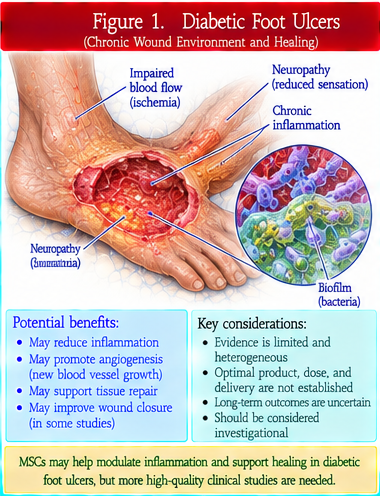
Diabetic ulcers, especially diabetic foot ulcers, usually develop through several interacting problems. Neuropathy can reduce protective sensation, repeated pressure can injure tissue, poor circulation can limit healing, and infection can complicate the wound.
Off-loading reduces pressure on the wound. Debridement removes dead or unhealthy tissue. Granulation tissue and epithelialization are important parts of wound healing.
MSC and EV research has examined inflammation, blood-vessel growth, fibroblast and keratinocyte activity, and extracellular matrix remodeling. A smaller wound is not automatically a permanently healed wound. Durable closure, recurrence, infection, limb salvage, amputation, and survival are more important clinical outcomes.
Pressure injuries
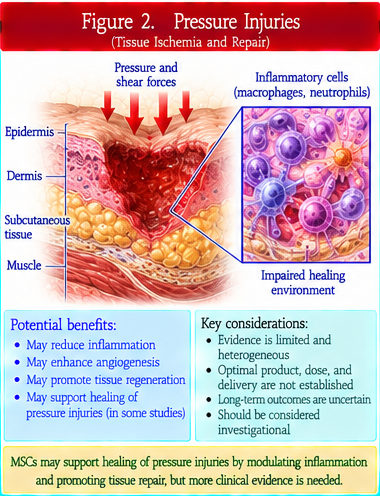
A pressure injury develops when sustained pressure, often combined with shear, damages tissue. Risk depends on pressure exposure as well as the tissue’s ability to tolerate that stress.
Treatment requires attention to pressure redistribution, mobility, moisture, nutrition, circulation, infection, wound depth, and debridement when appropriate.
MSC and EV research has examined inflammation, angiogenesis, matrix remodeling, and epithelial repair. Faster closure in an animal model does not prove fewer recurrences, fewer hospitalizations, or better function in patients.
Burns
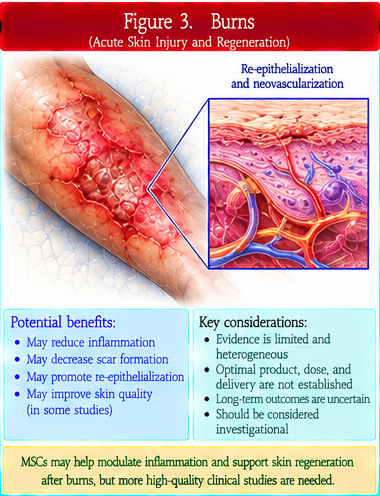
A burn injury can damage the epidermis, deeper skin, blood vessels, nerves, and sometimes tissues beneath the skin. Large burns can also cause major whole-body inflammatory and metabolic effects.
Regenerative research includes MSCs, EVs, keratinocytes, fibroblasts, a skin substitute, engineered matrices, and other approaches. These products are not interchangeable.
Established burn care can include resuscitation, removal of damaged tissue, infection control, grafting, rehabilitation, and scar management. Important outcomes include epithelialization, graft take, infection, contracture, pain, function, scarring, and long-term quality of life.
Radiation injury
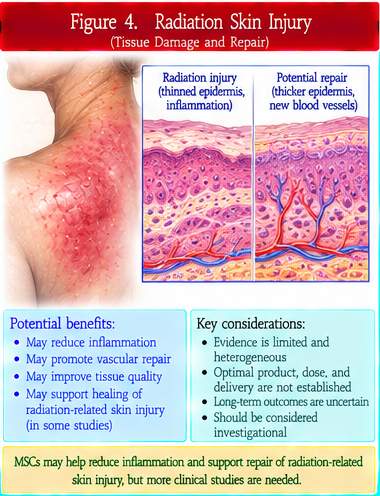
Radiation injury to skin and soft tissue can develop during treatment or appear months to years later. It may involve inflammation, blood-vessel damage, chronic hypoxia, poor healing, tissue breakdown, and radiation fibrosis.
MSC and EV research has examined vascular support, inflammation, fibrosis, and tissue-repair signaling.
Previously irradiated tissue can also be affected by prior surgery, infection, tissue necrosis, or recurrent cancer. Active or recurrent cancer must be considered carefully before any regenerative intervention. Better wound appearance does not prove that deep fibrosis or normal tissue architecture has been restored.
Scar remodeling
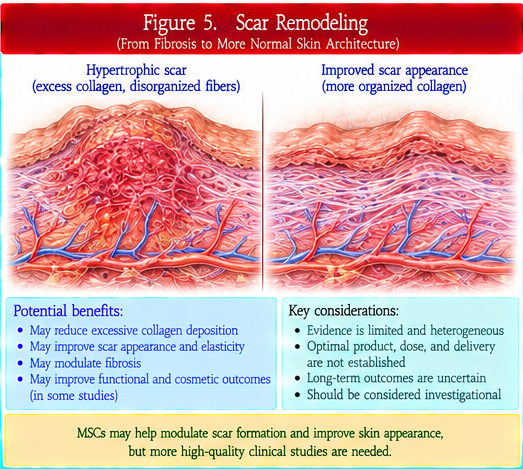
Scar remodeling is the long process by which collagen, extracellular matrix, blood vessels, pigmentation, and mechanical properties change after an injury.
A hypertrophic scar remains within the original wound boundaries, while a keloid grows beyond them. Myofibroblast activity contributes to wound contraction and fibrosis.
MSC and EV research has examined inflammation, fibroblast behavior, collagen organization, and matrix remodeling. A thinner scar or altered collagen in a study does not automatically mean durable improvement in pain, itching, contracture, function, appearance, or recurrence.
Alopecia
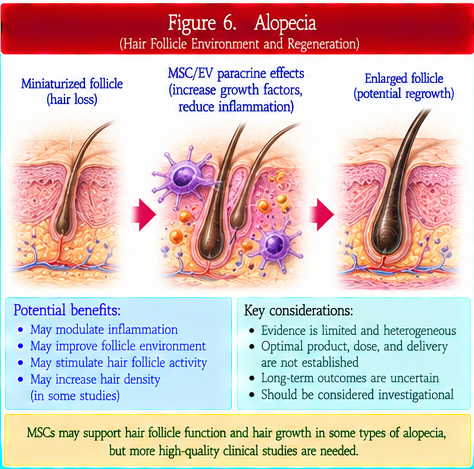
Alopecia means hair loss, but it is not one disease. Androgenetic alopecia, alopecia areata, scarring alopecia, and telogen effluvium have different causes and treatments.
The hair follicle is the biological structure that produces hair. Its cycling, miniaturization, inflammation, or destruction differs among hair-loss disorders.
MSC, EV, conditioned-media, and related products are marketed for hair growth, but products, doses, delivery methods, and studies vary widely. Hair counts, hair-shaft thickness, photographs, patient satisfaction, and durability should be evaluated separately.
Cosmetic skin claims
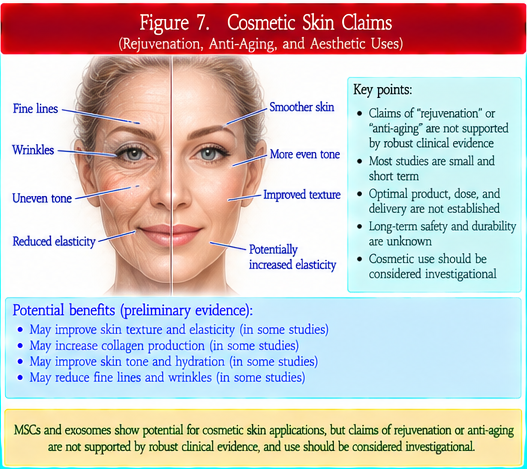
Cosmetic skin claims can include proposed improvement in wrinkles, pigmentation, texture, elasticity, hydration, photoaging, or generalized “rejuvenation.”
MSC-derived conditioned media and EV-containing products are increasingly marketed for these purposes, but their composition, purity, dose, stability, delivery, and clinical evidence vary.
Microneedling creates controlled microchannels in the skin and is sometimes combined with topical or biologic products. Combining procedures changes both exposure and risk. Laboratory findings involving collagen, fibroblasts, inflammation, or oxidative stress do not prove visible or lasting rejuvenation.
Why products and routes differ
MSCs from different tissues, EV preparations, conditioned media, keratinocyte or fibroblast products, skin substitutes, engineered matrices, and cosmetic formulations are different interventions.
Topical, intradermal, periwound, intralesional, scaffold-based, microneedling-assisted, and systemic delivery also create different tissue exposure, retention, procedural risk, and regulatory questions.
How dermatology and wound studies can mislead
Wound area, laboratory markers, collagen measurements, photographs, hair counts, or short-term cosmetic ratings can be useful research outcomes without proving lasting clinical benefit.
Strong studies should account for wound cause and stage, circulation, infection, off-loading, debridement, background wound care, scar type, exact alopecia diagnosis, cosmetic co-interventions, and adequate follow-up.
Safety considerations
Potential risks include infection, inflammatory or immune reactions, abnormal scarring, injection or vascular complications, contamination, and uncertainty from poorly characterized products.
Previously irradiated or cancer-affected tissue requires additional oncologic caution. Cosmetic use does not eliminate the need for product-quality and safety evaluation.
Questions patients should ask
What exact wound, scar, hair-loss disorder, or cosmetic problem is being treated? What exact product is being used? Is it an MSC product, EV preparation, conditioned medium, skin substitute, or cosmetic formulation? What route is used? What established care is being given at the same time? Did controlled human studies show durable healing or meaningful improvement? What infection, recurrence, scarring, and long-term safety data exist?
Bottom line
Dermatologic MSC and EV research is active, but evidence is highly dependent on the exact diagnosis, product, route, and accompanying care.
Accelerated repair signals, changes in collagen, hair measurements, or cosmetic biomarkers are not proof of durable wound healing, hair restoration, or rejuvenation.
How this review was prepared
This Patient Edition was derived directly from the explicitly approved 0811 Professional Edition and preserves all seven controlling dermatology and wound-care Points.