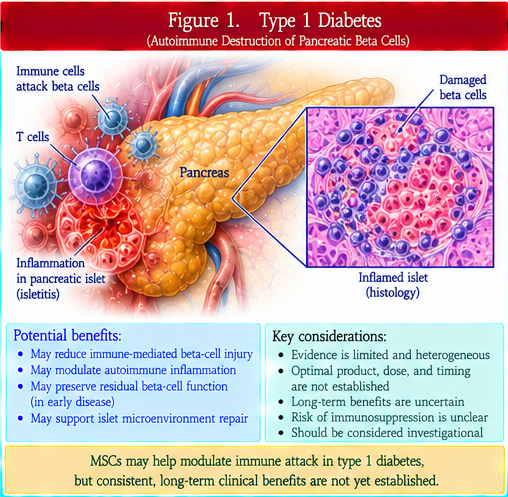
Type 1 diabetes (T1D) is an autoimmune disease in which immune-mediated destruction of pancreatic beta cells produces absolute insulin deficiency. MSC and extracellular-vesicle research has focused on immunomodulation, preservation of residual beta-cell function, inflammatory control, and support of immune tolerance. MSC therapy should not be conflated with beta-cell replacement. Clinically meaningful outcomes include stimulated C-peptide, exogenous insulin requirement, glycated hemoglobin, time in range, severe hypoglycemia, diabetic ketoacidosis, safety, and durability. Exogenous insulin remains essential unless a validated replacement strategy establishes sufficient endogenous insulin production.
Type 2 diabetes complications
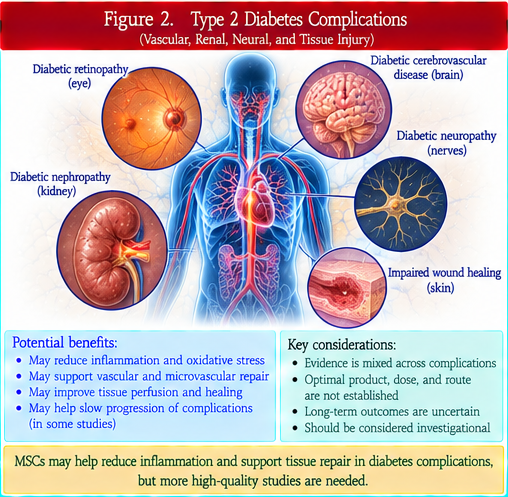
Type 2 diabetes complications arise from chronic metabolic, vascular, inflammatory, and tissue-specific injury and include kidney disease, neuropathy, retinopathy, cardiovascular disease, impaired wound healing, and other organ damage. MSC and EV research has proposed anti-inflammatory, vascular, trophic, and tissue-repair effects, but evidence in one complication cannot be generalized to another. Improvements in glucose, inflammatory biomarkers, perfusion, or tissue imaging do not establish prevention of microvascular or macrovascular events. Contemporary diabetes care requires glycemic management plus aggressive cardiovascular, renal, blood-pressure, lipid, weight, and complication-specific treatment.
Islet-cell replacement
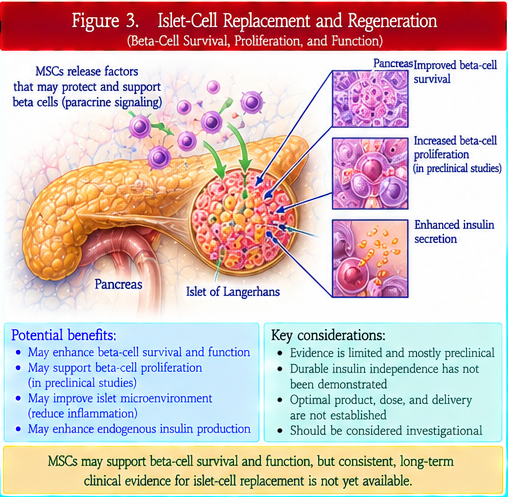
Islet-cell replacement aims to restore physiologically responsive insulin secretion by replacing functional beta-cell mass. Donor-islet transplantation and stem-cell-derived islet or pancreatic-cell products are biologically distinct from MSC therapy. Current development includes approaches using immunosuppression, encapsulation, immune-evasive engineering, and differentiated pluripotent-cell products. Interpretation requires evidence of engraftment, glucose-responsive insulin secretion, reduction or elimination of exogenous insulin, avoidance of severe hypoglycemia, durability, and product-specific safety. Risks can include alloimmunity, autoimmunity, immunosuppression toxicity, procedural complications, and product-specific concerns such as unwanted cell growth.
Obesity-associated inflammation
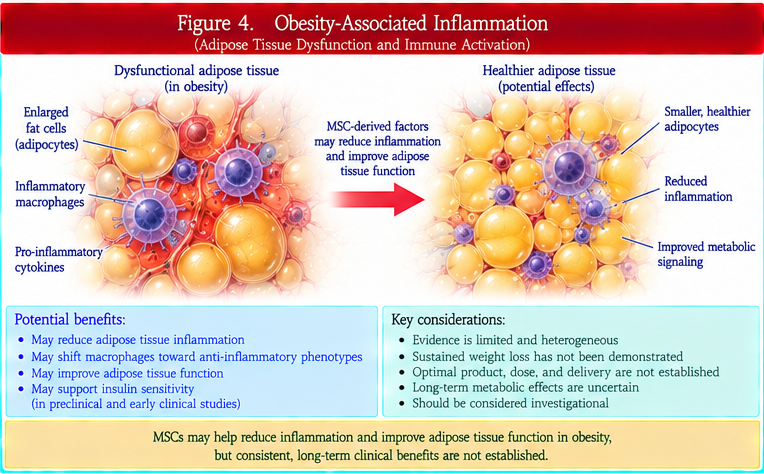
Obesity-associated inflammation reflects chronic low-grade immune and metabolic signaling arising from adipose-tissue expansion, adipocyte stress, macrophage recruitment, altered adipokines, insulin resistance, ectopic fat, and systemic metabolic dysfunction. MSC and EV studies have explored immunometabolic effects, adipose-tissue signaling, mitochondrial pathways, and insulin sensitivity, predominantly in preclinical models. Reductions in inflammatory markers or improved experimental insulin signaling do not establish clinically meaningful weight loss, prevention of diabetes, reduced cardiovascular events, or improved survival. Evidence-based obesity treatment should remain distinct from investigational regenerative claims.
Metabolic syndrome
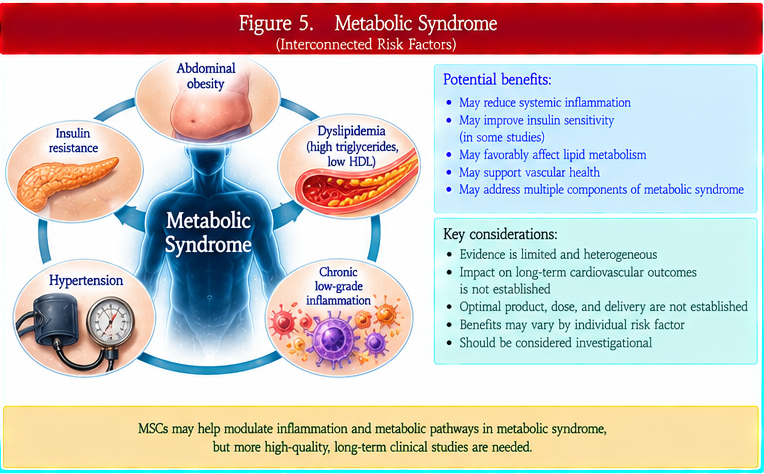
Metabolic syndrome is a clinical clustering of cardiometabolic risk factors that commonly includes central adiposity, insulin resistance or dysglycemia, hypertension, elevated triglycerides, and reduced HDL cholesterol. It is a risk construct rather than a single tissue-regeneration target. MSC and EV research may examine inflammatory, endothelial, adipose, hepatic, or insulin-signaling pathways, but heterogeneous mechanisms make class-wide conclusions especially weak. Clinical benefit should be demonstrated through validated metabolic and cardiovascular outcomes rather than biomarker normalization alone. Lifestyle intervention and evidence-based treatment of obesity, diabetes, blood pressure, lipids, and cardiovascular risk remain central.
Clinical takeaway
Endocrine and metabolic indications differ fundamentally in mechanism and therapeutic goal. Immune modulation, complication repair, beta-cell replacement, obesity biology, and cardiometabolic risk reduction must not be conflated.
Biological rationale
Proposed mechanisms include immunomodulation, beta-cell support, trophic and vascular signaling, immunometabolic effects, adipose-tissue modulation, and EV-mediated intercellular communication.
Product identity
MSCs, MSC-derived EVs, donor islets, stem-cell-derived islet products, pancreatic progenitors, encapsulated products, and immune-engineered cell products are distinct interventions.
Preclinical evidence
Animal and in-vitro models support multiple endocrine and metabolic hypotheses, but model-specific diabetes, obesity, and immune biology may not reproduce heterogeneous human disease.
Human clinical evidence
Human development is uneven. Islet-replacement programs represent a distinct cell-replacement field, whereas MSC/EV applications across diabetes complications, obesity-associated inflammation, and metabolic syndrome remain investigational.
Trial design
Trials should define diabetes type and duration, residual beta-cell function, background glucose-lowering therapy, obesity phenotype, organ complications, cardiovascular risk, and clinically meaningful endpoints.
Dose and administration
Systemic MSC administration, local tissue delivery, portal-vein islet infusion, and implanted or encapsulated islet-cell products have fundamentally different exposure and procedural profiles.
Safety
Potential concerns include infection, immune reactions, thrombo-inflammatory effects, procedure-related complications, hypoglycemia during treatment transitions, immunosuppression toxicity, alloimmunity, and product-specific proliferative risks.
Regulatory status
Authorization is product-, indication-, route-, jurisdiction-, and date-specific. A cell-replacement authorization or trial status cannot be generalized to MSCs or EVs.
Standard care
Insulin for T1D, evidence-based glucose-lowering therapy, cardiovascular and renal risk reduction, obesity treatment, lipid and blood-pressure management, and complication-specific care remain central.
Knowledge gaps
Major gaps include durable immune tolerance, long-term beta-cell survival, scalable manufacturing, potency assays, immune protection without toxic immunosuppression, responder phenotypes, and long-term safety.
Bottom-line evidence statement
Endocrine and metabolic cell therapies must be separated by therapeutic objective; MSC/EV immunomodulation is not beta-cell replacement, and mechanistic metabolic signals are not proof of durable clinical benefit.
Additional controlled terminology
A beta cell produces insulin, while C-peptide is released with endogenous insulin and can help assess beta-cell function. Glycated hemoglobin and time in range describe different dimensions of glycemic control; severe hypoglycemia and diabetic ketoacidosis are clinically important acute outcomes. Insulin resistance contributes to type 2 diabetes and metabolic disease. Microvascular complication and macrovascular complication distinguish small-vessel and large-vessel consequences. Islet transplantation and a stem-cell-derived islet are cell-replacement strategies; a pluripotent stem cell can be differentiated toward pancreatic lineages. Encapsulation and immune-evasive engineering seek to protect transplanted cells, while alloimmunity and recurrent autoimmunity remain challenges. An adipocyte secretes adipokines; ectopic fat, central adiposity, and dysglycemia contribute to cardiometabolic risk. Triglyceride and HDL cholesterol are common metabolic-risk measures.