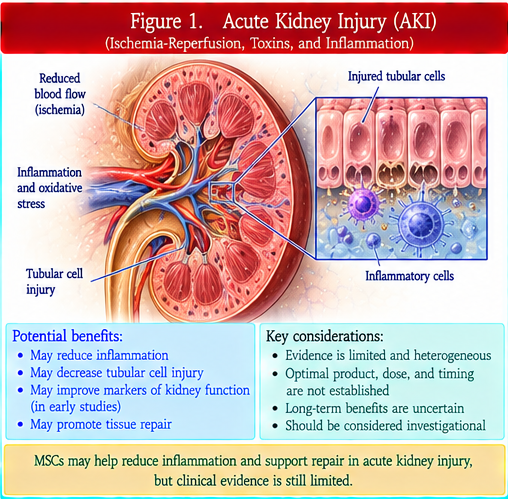
Acute kidney injury (AKI) is an abrupt decline in kidney function caused by heterogeneous insults including ischemia, sepsis, nephrotoxins, obstruction, inflammation, and major surgery. Tubular epithelial injury, endothelial dysfunction, microvascular disturbance, inflammation, and maladaptive repair can contribute. MSC and extracellular-vesicle research has focused on paracrine cytoprotection, immunomodulation, microvascular support, and modulation of tubular repair rather than replacement of entire nephrons. Preclinical signals are substantial, but human studies remain limited and heterogeneous. Changes in serum creatinine or short-term biomarkers do not by themselves establish reduced dialysis, faster durable recovery, prevention of chronic kidney disease, or improved survival.
Chronic kidney disease
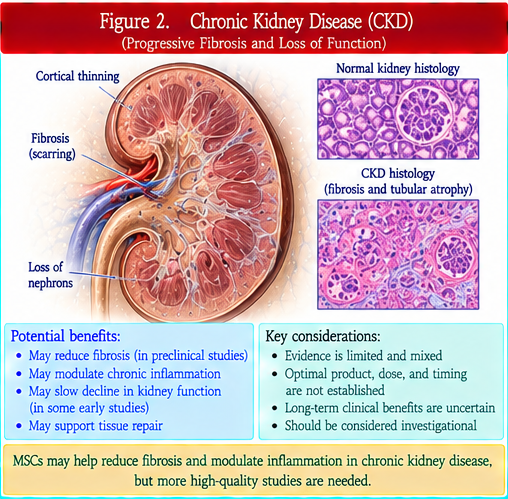
Chronic kidney disease (CKD) is persistent abnormal kidney structure or function with health consequences and includes diverse causes and stages. Progressive nephron loss can produce hyperfiltration in remaining nephrons, inflammation, vascular injury, interstitial fibrosis, and declining glomerular filtration. MSC and EV studies have explored anti-inflammatory, antifibrotic, endothelial, and trophic mechanisms. Human evidence has not established class-wide restoration of kidney function or reversal of advanced CKD. Clinical interpretation should prioritize estimated glomerular filtration rate trajectories, albuminuria or proteinuria, kidney failure, cardiovascular outcomes, quality of life, and survival while preserving cause-specific standard care.
Diabetic kidney disease
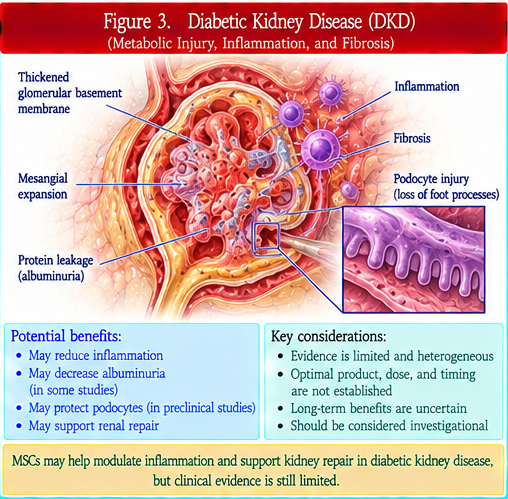
Diabetic kidney disease is a major complication of diabetes and reflects interacting metabolic, hemodynamic, inflammatory, vascular, and fibrotic injury. Hyperglycemia, glomerular hypertension, endothelial dysfunction, oxidative stress, and renin-angiotensin-aldosterone-system activity contribute to progression. MSC and EV research has proposed immunomodulatory, vascular, metabolic, and antifibrotic effects, predominantly in preclinical models. Improvement in experimental albuminuria or histology does not establish preservation of human kidney function. Glycemic management, blood-pressure control, renin-angiotensin-system blockade when appropriate, SGLT2 inhibition, and other evidence-based kidney and cardiovascular risk reduction remain central.
Transplant-related injury
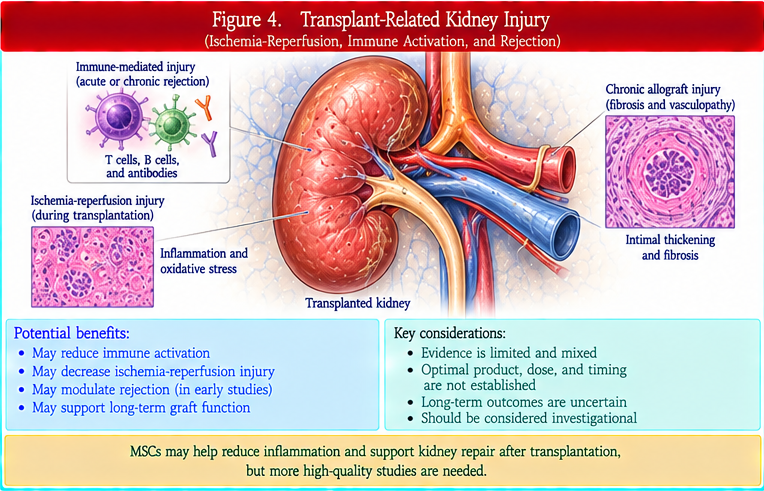
Transplant-related injury includes ischemia-reperfusion injury, delayed graft function, rejection, calcineurin-inhibitor toxicity, infection-related injury, recurrent disease, and chronic allograft dysfunction. These mechanisms are not interchangeable. MSC research has investigated peri-transplant immunomodulation, reduction of inflammatory injury, facilitation of immune tolerance, and possible reduction of immunosuppressive burden. Human trials require careful interpretation because induction therapy, maintenance immunosuppression, donor quality, ischemia time, HLA matching, rejection surveillance, infection, and graft function all influence outcomes. MSCs are not established substitutes for transplantation immunosuppression or standard rejection treatment.
Renal fibrosis
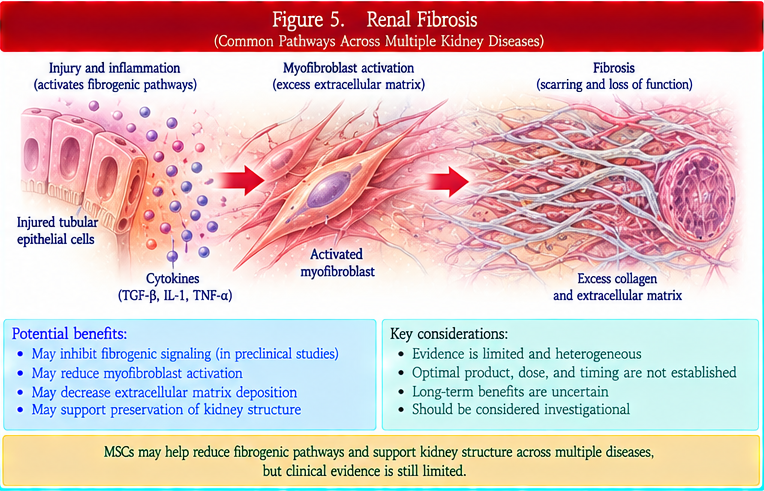
Renal fibrosis is a common final pathway of many chronic kidney injuries and involves extracellular-matrix accumulation, fibroblast and myofibroblast activation, tubular atrophy, capillary rarefaction, inflammation, and architectural distortion. MSC and EV research has examined antifibrotic signaling, modulation of transforming growth factor-beta pathways, endothelial support, and effects on maladaptive repair. Fibrosis is a mechanistic and histopathologic process rather than a stand-alone indication in most clinical settings. Reduced fibrosis in an animal model does not establish restored nephron number, durable glomerular filtration, freedom from dialysis, or improved survival in humans.
Clinical takeaway
Kidney disease is etiologically and temporally heterogeneous. Evidence must remain attached to the exact renal syndrome, product, route, dose, disease stage, background therapy, and clinically meaningful endpoint.
Biological rationale
Proposed mechanisms include tubular cytoprotection, immunomodulation, endothelial and microvascular support, antifibrotic signaling, trophic effects, and modulation of maladaptive repair.
Product identity
Autologous and allogeneic MSCs from different tissues, culture-expanded products, conditioned media, and EV preparations differ in composition, potency, dose, and manufacturing.
Preclinical evidence
Rodent and large-animal models support protective and antifibrotic hypotheses, but experimental AKI and CKD models may not reproduce human comorbidity, timing, disease heterogeneity, or contemporary therapy.
Human clinical evidence
Human evidence remains investigational and uneven. Small trials, surrogate endpoints, diverse renal diagnoses, and concomitant treatments limit inference.
Trial design
Renal trials should define baseline kidney function, etiology, AKI severity or CKD stage, albuminuria, dialysis status, transplantation context, background therapy, and durable kidney outcomes.
Dose and administration
Intravenous, intra-arterial, renal-artery-directed, and other delivery approaches differ in biodistribution, first-pass effects, procedural risk, and expected tissue exposure.
Safety
Potential concerns include infusion reactions, thrombo-inflammatory effects, infection, immune effects, vascular complications with invasive delivery, and uncertainty in patients with severe renal or transplant-related illness.
Regulatory status
Regulatory authorization is product-, indication-, route-, jurisdiction-, and date-specific. Trial participation or biologic plausibility does not imply routine authorization.
Standard care
Hemodynamic and cause-directed AKI management, CKD risk reduction, diabetes and blood-pressure treatment, kidney-protective pharmacotherapy, dialysis when required, and evidence-based transplantation care remain central.
Knowledge gaps
Major gaps include validated potency assays, optimal timing and dose, renal biodistribution, responder phenotypes, interaction with kidney-protective drugs and immunosuppression, and long-term safety.
Bottom-line evidence statement
MSC and EV approaches in kidney disease remain investigational; renal biomarkers, histology, or mechanistic signals are not proof of durable kidney recovery or improved patient-important outcomes.
Additional controlled terminology
A nephron is the functional unit of the kidney and begins with a glomerulus; a tubular epithelial cell participates in downstream filtration processing and is vulnerable in AKI. Serum creatinine and estimated glomerular filtration rate are common but imperfect measures of kidney function. Albuminuria and proteinuria reflect abnormal urinary protein loss. Kidney failure may require dialysis. Hyperfiltration and glomerular hypertension can contribute to progressive injury. An SGLT2 inhibitor and renin-angiotensin system therapy are established kidney-protective strategies in appropriate patients. Ischemia-reperfusion injury can contribute to delayed graft function after transplantation. Allograft rejection, calcineurin inhibitor toxicity, HLA matching, and chronic allograft dysfunction influence transplant outcomes. Interstitial fibrosis, tubular atrophy, capillary rarefaction, and myofibroblast activation contribute to chronic damage; transforming growth factor-beta signaling and maladaptive repair are major mechanistic concepts.