Plain-language overview
Kidney disease includes several very different problems. Acute kidney injury develops suddenly, chronic kidney disease persists over time, diabetic kidney disease occurs in the setting of diabetes, transplant-related injury affects a transplanted kidney, and renal fibrosis is a common pathway of chronic damage.
Research involving mesenchymal stromal cells (MSCs) and extracellular vesicles (EVs) has examined possible protective, anti-inflammatory, vascular, and antifibrotic effects. These mechanisms are reasons for research, but they do not prove that damaged nephrons are replaced or that kidney function will recover permanently.
MSC and EV approaches in kidney disease remain investigational. Evidence must remain tied to the exact kidney disorder, stage, product, route, dose, background treatment, and clinical outcome.
Acute kidney injury
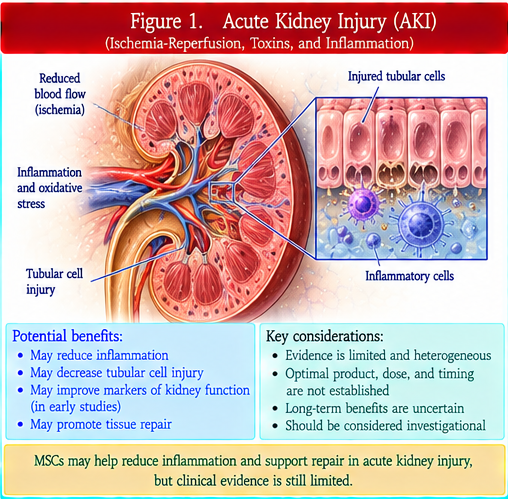
Acute kidney injury, or AKI, is a sudden decline in kidney function. Causes can include poor blood flow, sepsis, medications or toxins, urinary obstruction, inflammation, and major surgery.
A nephron is a functional unit of the kidney. It begins with a glomerulus and continues through tubules lined by tubular epithelial cells, which are especially vulnerable in many forms of AKI.
MSC and EV research has examined cell-protective, immune, vascular, and repair-related signaling. Changes in serum creatinine or early biomarkers do not by themselves prove less dialysis, faster lasting recovery, prevention of chronic kidney disease, or improved survival.
Chronic kidney disease
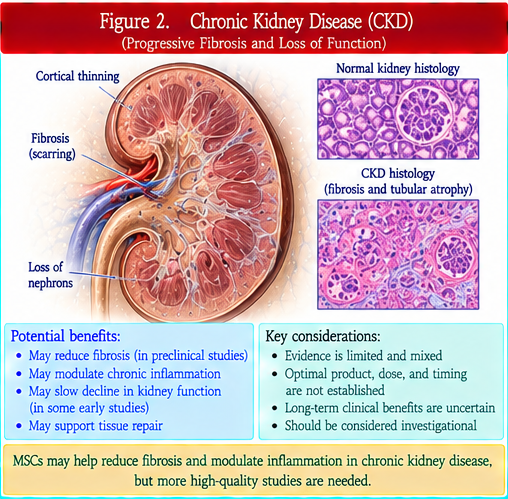
Chronic kidney disease, or CKD, means persistent abnormal kidney structure or function. It includes many causes and stages.
As functioning nephrons are lost, remaining nephrons may develop hyperfiltration. Progressive injury can involve inflammation, vascular damage, interstitial fibrosis, tubular atrophy, and capillary rarefaction.
Estimated glomerular filtration rate is commonly used to estimate kidney function, while albuminuria and proteinuria measure abnormal protein loss in urine. Meaningful outcomes include kidney-function decline, kidney failure, dialysis, cardiovascular events, quality of life, and survival.
Diabetic kidney disease
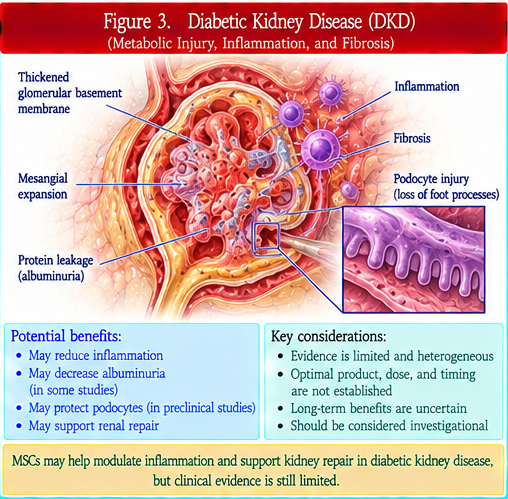
Diabetic kidney disease develops through interacting metabolic, blood-pressure, vascular, inflammatory, and fibrotic mechanisms. Hyperglycemia, glomerular hypertension, oxidative stress, and activation of the renin-angiotensin system can contribute.
MSC and EV research has proposed anti-inflammatory, vascular, metabolic, and antifibrotic effects, especially in laboratory and animal studies.
Improved albuminuria or kidney appearance in an experimental model does not prove preservation of human kidney function. Diabetes and blood-pressure treatment, appropriate renin-angiotensin-system therapy, and an SGLT2 inhibitor when indicated are examples of established kidney-protective strategies.
Transplant-related injury
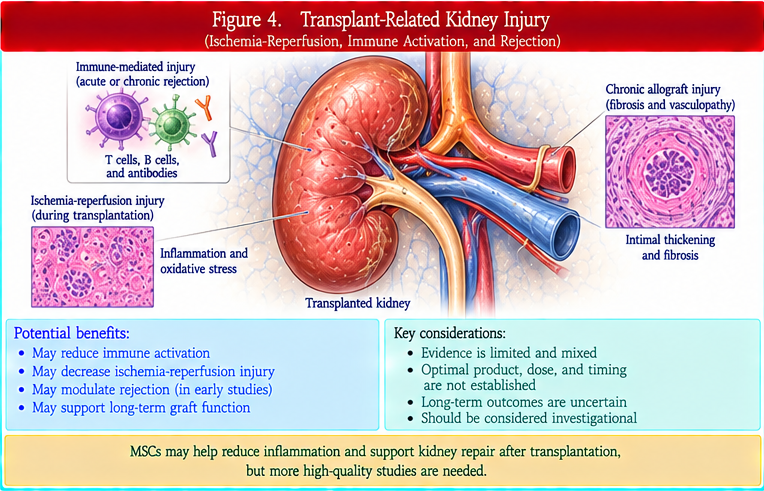
A transplanted kidney can be injured in several different ways, including ischemia-reperfusion injury, delayed graft function, allograft rejection, calcineurin inhibitor toxicity, infection, recurrent disease, and chronic allograft dysfunction.
HLA matching, donor quality, ischemia time, immunosuppression, rejection surveillance, infection, and many other factors can influence transplant outcomes.
MSC research has examined immune regulation and reduction of inflammatory injury around transplantation. MSCs are not established replacements for standard transplant immunosuppression or treatment of rejection.
Renal fibrosis
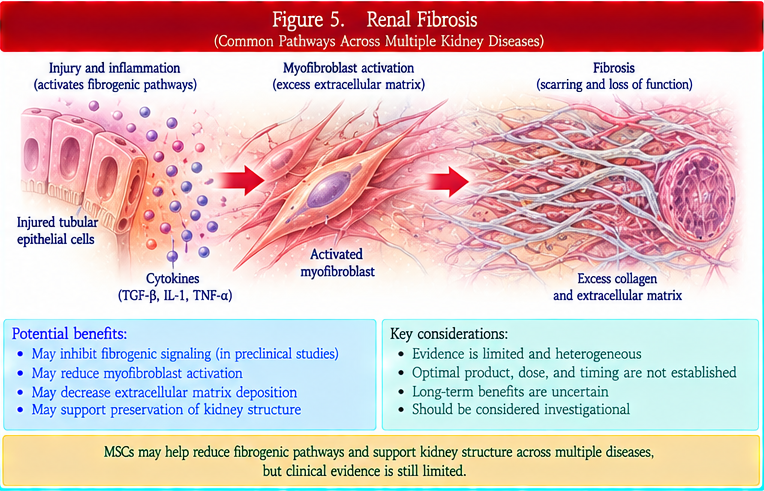
Renal fibrosis is a common pathway of long-term kidney damage rather than a single disease in most patients.
It can involve excessive scar-like extracellular matrix, myofibroblast activation, interstitial fibrosis, tubular atrophy, capillary rarefaction, inflammation, and distortion of normal kidney structure. Transforming growth factor-beta and maladaptive repair are important research concepts.
Reduced fibrosis in an animal model does not prove that human nephron number has been restored, kidney failure has been prevented, dialysis has been avoided, or survival has improved.
Why products and routes differ
Autologous and allogeneic MSCs, cells from different tissue sources, culture-expanded products, conditioned media, and EV preparations are not interchangeable.
Intravenous, intra-arterial, renal-artery-directed, and other delivery approaches differ in biodistribution, tissue exposure, invasiveness, and safety.
How kidney studies can mislead
Serum creatinine, estimated filtration rate, albuminuria, proteinuria, imaging, histology, and experimental biomarkers can all be useful without proving durable clinical benefit.
Strong studies should account for the cause and stage of kidney disease, dialysis status, transplantation context, background medications, and other treatments, and should measure outcomes that matter to patients.
Safety considerations
Potential risks depend on the product and route and can include infusion reactions, immune effects, infection, thrombo-inflammatory interactions, and vascular or procedure-related complications.
Patients with severe kidney disease or a transplant may already be medically complex, making careful evaluation of interactions with standard therapy especially important.
Questions patients should ask
What exact kidney diagnosis is being treated? How severe or advanced is it? What exact MSC or EV product was studied? What dose and route were used? Was there a control group? Did the study improve lasting kidney function or mainly biomarkers? Were dialysis, kidney failure, transplant outcomes, cardiovascular outcomes, or survival measured? What established kidney-protective treatments are available?
Bottom line
MSC and EV research in kidney disease is scientifically active but remains investigational.
Changes in biomarkers, kidney histology, inflammation, or fibrosis are not proof of durable kidney recovery. Claims of restored kidney function, avoidance of dialysis, improved transplant outcomes, or improved survival require appropriate human clinical evidence.
How this review was prepared
This Patient Edition was derived directly from the explicitly approved 0808 Professional Edition and preserves all five controlling kidney-disease Points.