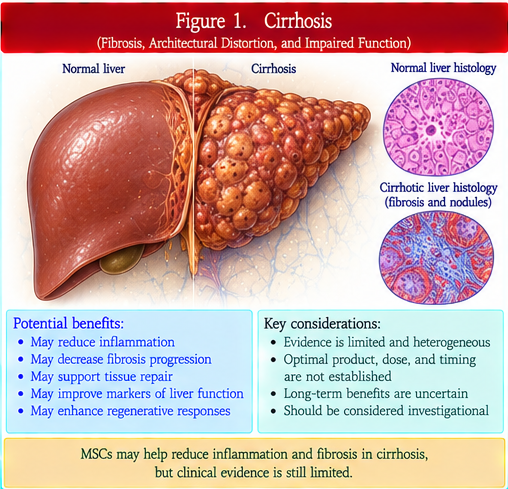
Cirrhosis is the advanced consequence of many chronic liver diseases and is characterized by diffuse fibrosis, regenerative nodules, architectural distortion, portal hypertension, and progressive loss of hepatic reserve. MSC and extracellular-vesicle research has explored immunomodulation, antifibrotic signaling, effects on hepatic stellate cells, angiogenic balance, and support of endogenous repair. Human studies have used heterogeneous cell sources, routes, doses, etiologies, and stages of cirrhosis, limiting class-wide conclusions. Changes in liver enzymes, albumin, fibrosis markers, or short-term severity scores do not establish reversal of cirrhotic architecture, prevention of decompensation, reduced portal-hypertension complications, transplant-free survival, or overall survival.
Acute liver failure
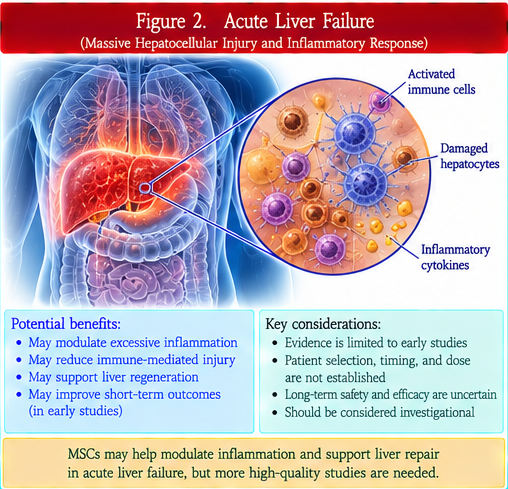
Acute liver failure is rapid development of severe hepatic dysfunction, coagulopathy, and often hepatic encephalopathy in a patient without preexisting cirrhosis. Causes include drug toxicity, viral hepatitis, autoimmune disease, ischemic injury, and other etiologies. MSC and EV research has investigated immunomodulatory, antiapoptotic, trophic, and regenerative signaling, but the clinical syndrome can deteriorate rapidly and requires cause-specific therapy, intensive supportive care, and urgent transplantation assessment when appropriate. Small or uncontrolled cell-therapy studies cannot establish rescue from a syndrome with substantial spontaneous variability and competing interventions.
Metabolic liver disease
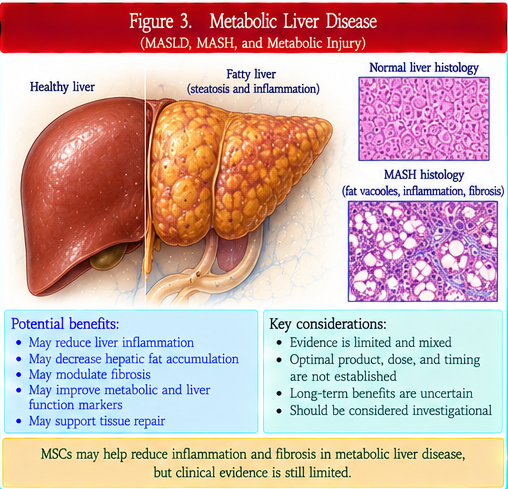
Metabolic liver disease includes metabolic dysfunction-associated steatotic liver disease (MASLD) and its inflammatory and fibrotic phenotypes. Pathobiology involves insulin resistance, lipotoxicity, oxidative stress, inflammation, hepatocyte injury, and variable fibrosis. MSC and EV studies have proposed metabolic, anti-inflammatory, mitochondrial, and antifibrotic effects, primarily in preclinical models. Improvement in steatosis, transaminases, or experimental biomarkers does not establish prevention of cirrhosis, liver-related events, cardiovascular events, or mortality. Weight management, cardiometabolic risk reduction, and disease-specific therapies remain central.
Crohn’s fistulas
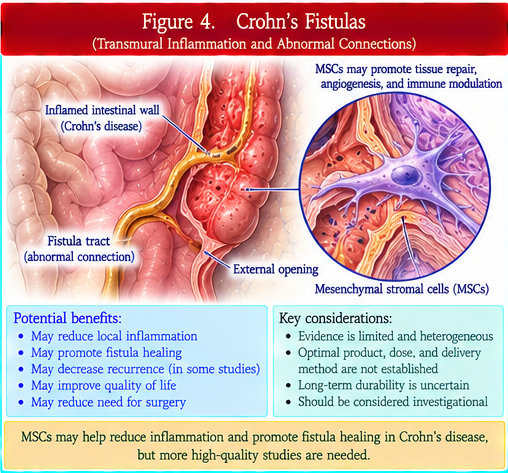
Crohn’s fistulas, particularly complex perianal fistulas, represent one of the most developed gastrointestinal applications of locally delivered MSC products. The therapeutic concept is primarily local immunomodulation and support of fistula healing rather than systemic treatment of all Crohn disease. Product-specific trials have evaluated combined remission using clinical closure and imaging, often in conjunction with surgical preparation and background medical therapy. Evidence from a defined local product cannot be generalized to intravenous MSCs, luminal Crohn disease, unrelated fistula types, or other inflammatory bowel diseases. Regulatory status is jurisdiction- and product-specific.
Ulcerative colitis
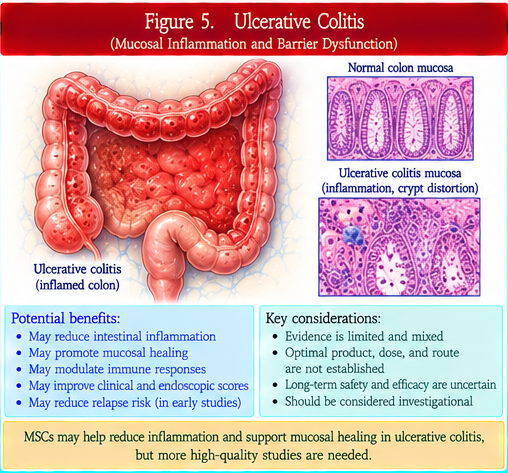
Ulcerative colitis is a chronic inflammatory disease limited to the colon, with continuous mucosal inflammation beginning in the rectum and extending proximally to variable degrees. MSC and EV research has investigated immune regulation, epithelial-barrier support, mucosal healing, and tissue-repair signaling. Human evidence is less mature than the local MSC literature for complex Crohn fistulas and remains investigational. Clinical interpretation should use validated disease-activity measures, endoscopic improvement, corticosteroid-free remission, hospitalization, colectomy, durability, and safety rather than mechanistic biomarkers alone.
Intestinal injury
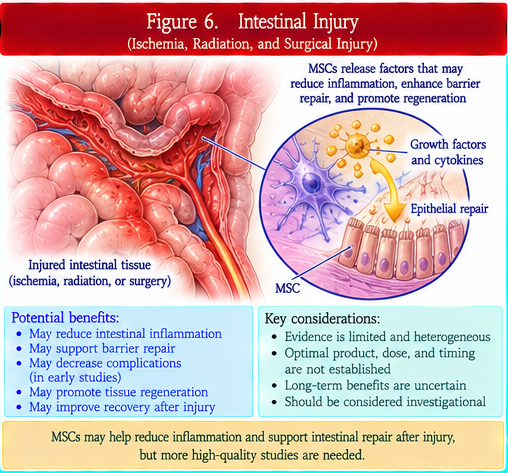
Intestinal injury is a broad category that can include ischemia-reperfusion injury, radiation injury, infection-related injury, treatment toxicity, short-bowel-associated damage, and other forms of epithelial and barrier disruption. MSC and EV research has explored epithelial restitution, barrier integrity, immunomodulation, angiogenesis, and modulation of fibrosis. Because these injuries differ substantially in cause and severity, findings from one model cannot be generalized to another. Demonstrating improved histology or permeability in a preclinical model does not establish restoration of human intestinal function, reduced sepsis, nutritional independence, or survival.
Clinical takeaway
Liver and gastrointestinal indications are highly heterogeneous. Evidence must remain attached to the exact disease, product, route, disease stage, background treatment, and clinically meaningful endpoint.
Biological rationale
Proposed mechanisms include immunomodulation, antifibrotic signaling, epithelial-barrier support, angiogenic regulation, trophic signaling, hepatic-stellate-cell modulation, and support of endogenous repair.
Product identity
Autologous and allogeneic MSCs from different tissue sources, locally delivered fistula products, systemic culture-expanded cells, conditioned media, and EV preparations are not interchangeable.
Preclinical evidence
Animal and organoid models support liver-protective, antifibrotic, mucosal-healing, and barrier-repair hypotheses, but experimental injury models may not reproduce chronic human disease.
Human clinical evidence
Human evidence varies sharply by indication. Local MSC treatment of defined Crohn fistulas has more developed product-specific evidence than systemic MSC/EV therapy for cirrhosis, acute liver failure, metabolic liver disease, ulcerative colitis, or generalized intestinal injury.
Trial design
Trials should stratify disease etiology and stage, account for background immunosuppression or hepatology therapy, define transplantation and surgical interventions, and use validated organ-specific outcomes.
Dose and administration
Intravenous, intra-arterial, portal or hepatic-directed, and local fistula injection create different biodistribution, exposure, procedural risk, and mechanistic expectations.
Safety
Potential concerns include infection, infusion reactions, thrombo-inflammatory effects, portal or vascular complications with invasive routes, procedure-related injury, and uncertainty in severely immunocompromised or decompensated patients.
Regulatory status
Regulatory authorization is product-, indication-, route-, jurisdiction-, and date-specific. Authorization of a local fistula product does not imply class-wide approval for MSCs or EVs.
Standard care
Cause-specific liver therapy, portal-hypertension management, transplantation when indicated, cardiometabolic treatment, established IBD therapy, surgery, nutritional support, and infection management remain central.
Knowledge gaps
Major gaps include validated potency assays, optimal dose and route, disease-stage selection, durability, interaction with standard therapies, long-term safety, and patient-important outcomes.
Bottom-line evidence statement
MSC and EV approaches in liver and gastrointestinal disease remain condition- and product-specific; biological repair signals are not proof of restored organ function or durable clinical benefit.
Additional controlled terminology
A hepatocyte performs major metabolic and synthetic liver functions, while a hepatic stellate cell can drive fibrosis after activation. Portal hypertension and loss of hepatic reserve contribute to decompensation. Acute liver failure can cause hepatic encephalopathy and coagulopathy. Metabolic dysfunction-associated steatotic liver disease can involve steatosis, lipotoxicity, and insulin resistance. A perianal fistula is a major Crohn disease complication; combined remission can integrate clinical closure with imaging. In ulcerative colitis, mucosal healing, epithelial barrier integrity, endoscopic improvement, corticosteroid-free remission, and colectomy are clinically relevant concepts. Intestinal permeability and epithelial restitution are barrier-repair measures. Ischemia-reperfusion injury and short bowel syndrome represent distinct intestinal-injury contexts. Liver transplantation may be definitive therapy for selected advanced or acute liver disease, and transplant-free survival is a patient-important endpoint.