Plain-language overview
Liver and gastrointestinal diseases include very different problems. Cirrhosis, acute liver failure, metabolic liver disease, Crohn’s fistulas, ulcerative colitis, and intestinal injury differ in cause, severity, treatment, and expected recovery.
Research involving mesenchymal stromal cells (MSCs) and extracellular vesicles (EVs) has examined immune regulation, fibrosis, blood-vessel signaling, epithelial-barrier support, and tissue repair. These mechanisms can justify research, but they do not prove that damaged liver or intestinal tissue has been restored.
Evidence must remain tied to the exact disease, product, route, stage, background treatment, and clinical outcome. Established hepatology, gastroenterology, surgical, transplantation, nutritional, and metabolic care remain the appropriate clinical standards.
Cirrhosis
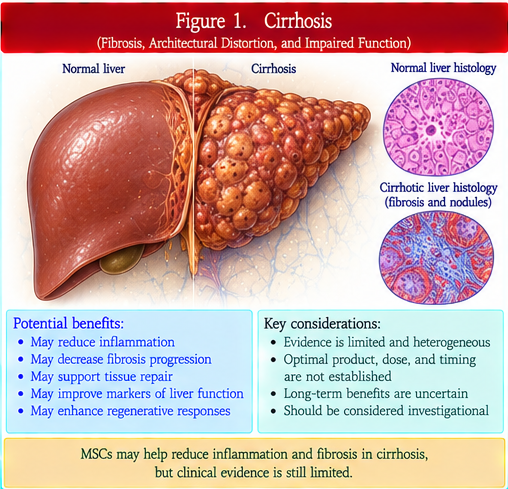
Cirrhosis is advanced chronic liver disease with widespread fibrosis, abnormal liver architecture, regenerative nodules, and often portal hypertension. As hepatic reserve falls, patients can develop decompensation and serious complications.
A hepatocyte performs many of the liver’s metabolic and synthetic functions. A hepatic stellate cell can become activated and contribute to fibrosis.
MSC and EV studies have examined immune, antifibrotic, vascular, and repair-related mechanisms. Changes in liver enzymes, albumin, fibrosis markers, or short-term severity scores do not prove reversal of cirrhosis, prevention of decompensation, or improved transplant-free survival.
Acute liver failure
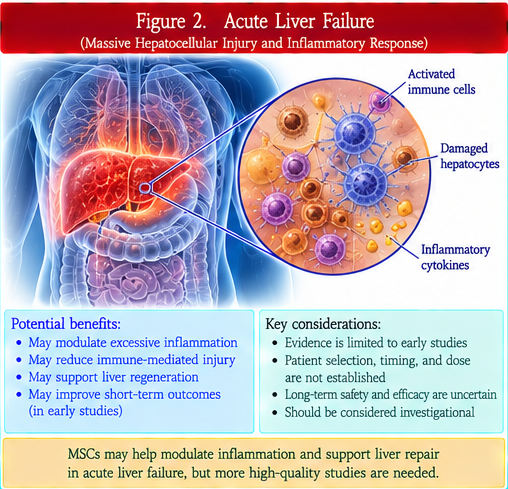
Acute liver failure is rapid severe loss of liver function in a person without preexisting cirrhosis. It can cause coagulopathy and hepatic encephalopathy and can worsen quickly.
Causes include drug toxicity, viral hepatitis, autoimmune disease, ischemic injury, and other conditions. Treatment depends on the cause and requires intensive supportive care and urgent liver transplantation assessment when appropriate.
MSC and EV research has examined anti-inflammatory, protective, and repair-related signaling, but small or uncontrolled studies cannot establish that these therapies rescue patients from acute liver failure.
Metabolic liver disease
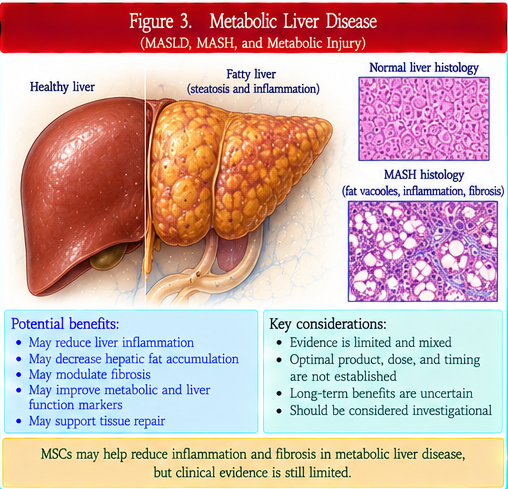
Metabolic liver disease includes metabolic dysfunction-associated steatotic liver disease. Important biological features can include steatosis, insulin resistance, lipotoxicity, inflammation, liver-cell injury, and fibrosis.
MSC and EV research has proposed metabolic, anti-inflammatory, mitochondrial, and antifibrotic effects, particularly in laboratory and animal models.
Improvement in liver enzymes, liver fat, or experimental biomarkers does not prove prevention of cirrhosis, liver-related complications, cardiovascular events, or death. Weight management and cardiometabolic risk reduction remain central.
Crohn’s fistulas
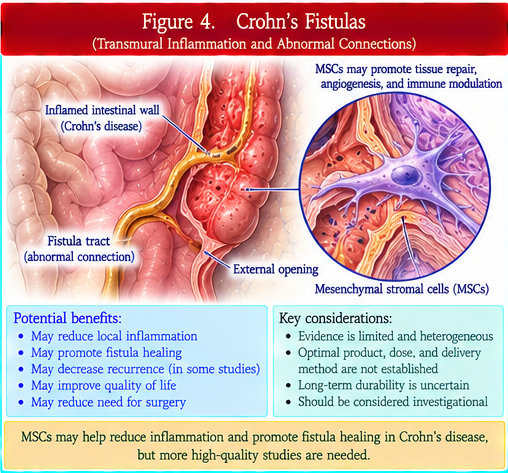
Crohn disease can produce a perianal fistula, an abnormal tract near the anus. Complex perianal fistulas are one of the more developed gastrointestinal settings for locally delivered MSC products.
The treatment concept is mainly local immune modulation and support of fistula healing. Some trials have used combined remission, which can include clinical closure together with imaging evidence.
This evidence is specific to defined local products and treatment protocols. It should not be generalized to intravenous MSCs, ordinary luminal Crohn disease, unrelated fistulas, ulcerative colitis, or other products.
Ulcerative colitis
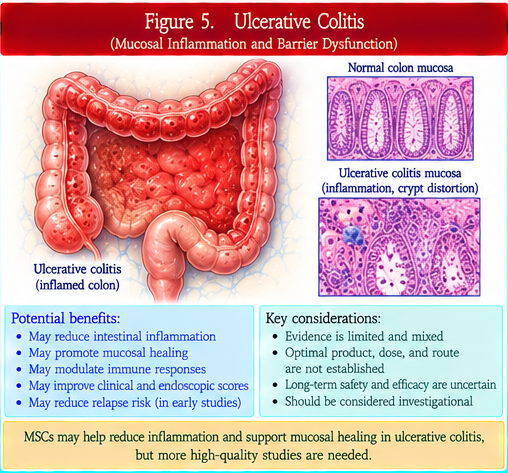
Ulcerative colitis causes continuous inflammation of the colon beginning in the rectum and extending upward to varying degrees.
MSC and EV research has examined immune regulation, epithelial barrier support, mucosal healing, and repair signaling.
Human evidence remains investigational. Meaningful outcomes include endoscopic improvement, corticosteroid-free remission, hospitalization, colectomy, durability of response, and safety—not only changes in inflammatory biomarkers.
Intestinal injury
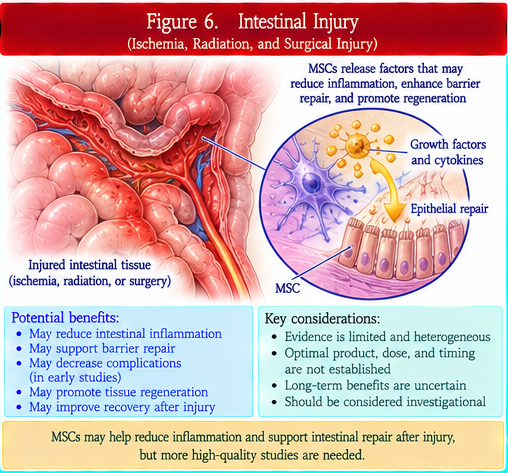
Intestinal injury is a broad category rather than one diagnosis. It can include ischemia-reperfusion injury, radiation injury, infection-related damage, treatment toxicity, short bowel syndrome, and other forms of intestinal damage.
Research has examined epithelial restitution, intestinal permeability, barrier repair, immune regulation, angiogenesis, and fibrosis.
Because these injuries differ greatly, findings from one model cannot simply be applied to another. Better tissue appearance or permeability in an animal study does not prove restored human intestinal function, nutritional independence, reduced sepsis, or improved survival.
Why products and routes differ
Autologous and allogeneic MSCs from different tissues, culture-expanded systemic products, locally injected fistula products, conditioned media, and EV preparations are different interventions.
Intravenous, intra-arterial, liver-directed, and local fistula injection routes create different exposures, procedures, risks, and expected mechanisms. Evidence from one should not automatically be transferred to another.
How liver and gastrointestinal studies can mislead
Laboratory markers, imaging, histology, liver enzymes, fibrosis markers, or measures of intestinal permeability may be useful research endpoints without proving that patients feel better, avoid complications, or live longer.
Strong clinical studies should account for disease cause and stage, background medications, surgery, transplantation, nutrition, and other treatments, and should measure durable patient-important outcomes.
Safety considerations
Potential concerns include infection, infusion reactions, thrombo-inflammatory effects, immune effects, and procedure-related complications. Patients with decompensated liver disease or severe intestinal disease may already be medically fragile.
Invasive vascular or local procedures can add risks that are separate from the biological product itself.
Questions patients should ask
What exact liver or gastrointestinal diagnosis is being treated? How advanced is the disease? What exact MSC or EV product was studied? What dose and route were used? Was the treatment local or systemic? What other medications, surgery, or transplantation-related care were given? Did controlled human studies improve meaningful clinical outcomes or mainly laboratory markers? What established treatments are available?
Bottom line
MSC and EV research in liver and gastrointestinal disease is active but remains condition- and product-specific.
Biological repair signals are not proof that cirrhosis has reversed, acute liver failure has been rescued, intestinal function has been restored, or long-term clinical outcomes have improved. Those claims require appropriate human evidence.
How this review was prepared
This Patient Edition was derived directly from the explicitly approved 0807 Professional Edition and preserves all six controlling liver and gastrointestinal Points.