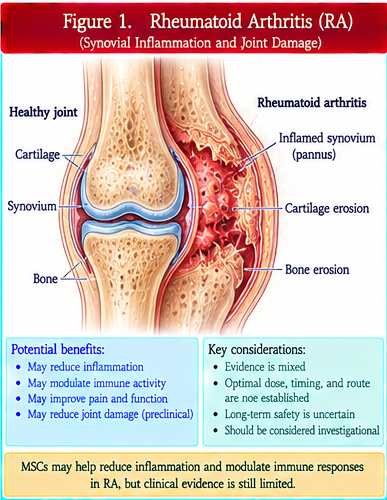
Rheumatoid arthritis (RA) is a systemic autoimmune disease in which persistent synovial inflammation can produce pain, swelling, cartilage damage, bone erosion, and extra-articular disease. MSC and extracellular-vesicle research has focused on immunomodulation rather than physical replacement of damaged joint structures. Proposed effects include modulation of T-cell and B-cell responses, macrophage phenotype, dendritic-cell function, cytokine networks, and regulatory T-cell activity. Human studies remain heterogeneous and generally early-phase; they do not establish MSCs or EVs as routine disease-modifying therapy. Established disease-modifying antirheumatic drugs and treat-to-target strategies remain the standard comparator.
Systemic lupus erythematosus
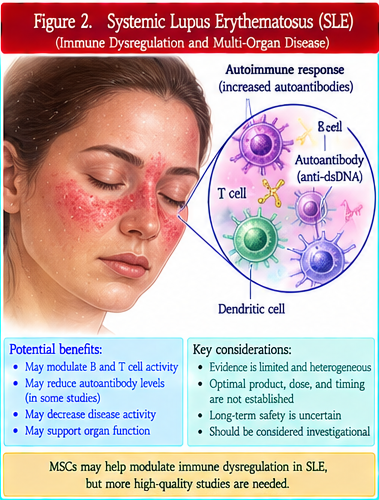
Systemic lupus erythematosus (SLE) is a heterogeneous autoimmune disease characterized by loss of immune tolerance, autoantibody production, immune-complex injury, complement activation, and variable organ involvement. Investigational MSC studies have often focused on refractory disease, including lupus nephritis, and propose broad immunoregulatory effects. Interpretation is complicated by fluctuating disease activity, background immunosuppression, organ-specific endpoints, and uncontrolled or nonrandomized designs. A reduction in an inflammatory marker or autoantibody does not by itself establish durable organ protection, steroid sparing, prevention of flares, or improved survival.
Systemic sclerosis
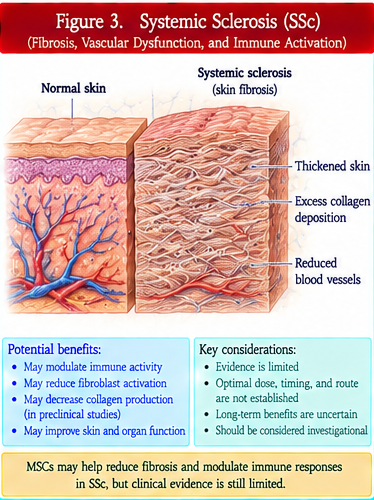
Systemic sclerosis is an autoimmune connective-tissue disease involving vasculopathy, immune activation, and progressive fibrosis of skin and internal organs. MSC and EV research has explored immunomodulatory, vascular, and antifibrotic mechanisms. These approaches are distinct from autologous hematopoietic stem-cell transplantation, which has been studied as intensive immune-reset therapy in selected patients with severe disease. Fibrosis is organ-specific, and changes in skin scores cannot automatically be extrapolated to lung, cardiac, renal, or gastrointestinal outcomes. Established organ-directed treatment and careful patient selection remain essential.
Sjögren syndrome
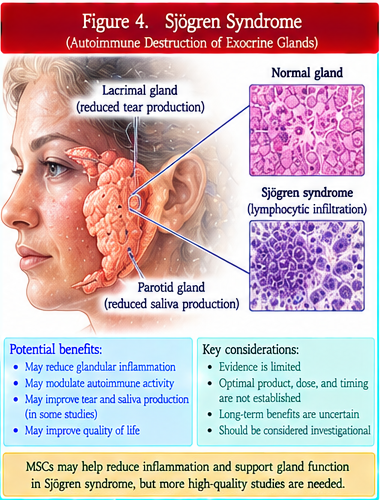
Sjögren syndrome is a systemic autoimmune disease characterized by lymphocytic injury of exocrine glands, especially salivary and lacrimal glands, with possible extraglandular manifestations. MSC and EV research has examined immunomodulation, epithelial support, and glandular repair, but human evidence is limited. Improvements in inflammatory biomarkers or salivary-flow measures do not necessarily establish restoration of gland architecture, durable relief of dryness, prevention of systemic complications, or reduced lymphoma risk. Established symptomatic and systemic therapies should remain distinct from investigational regenerative claims.
Inflammatory bowel disease
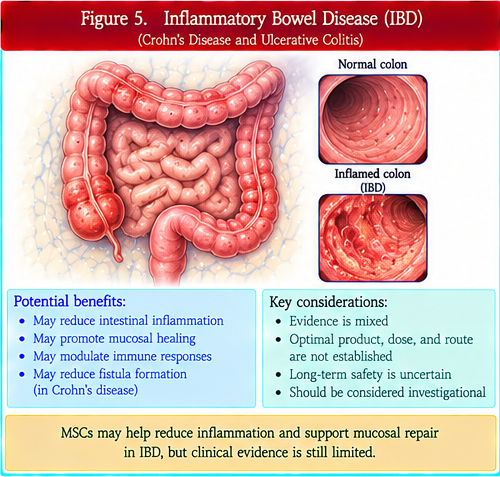
Inflammatory bowel disease (IBD) includes Crohn disease and ulcerative colitis, which differ in distribution, depth of inflammation, complications, and treatment. MSC therapy has its strongest condition-specific development in complex perianal fistulizing Crohn disease, where local cell products have been studied as adjuncts to surgical and medical management. That evidence cannot be generalized to luminal Crohn disease, ulcerative colitis, or systemic infusion of unrelated products. Outcomes should distinguish fistula closure, endoscopic activity, symptoms, steroid exposure, hospitalization, surgery, and durability. Product-specific regulatory status must be reported separately from class-wide efficacy.
Type 1 diabetes
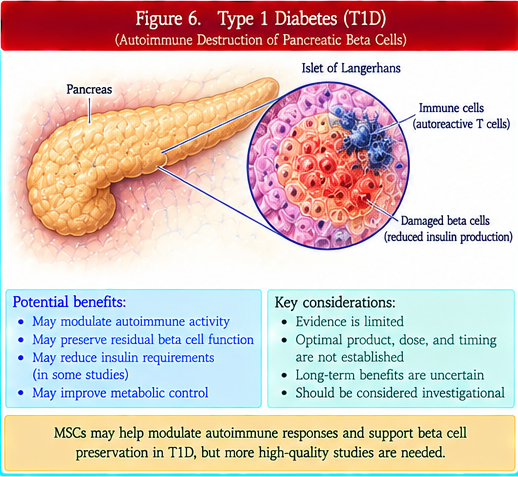
Type 1 diabetes is an autoimmune disease in which immune-mediated destruction of pancreatic beta cells causes absolute insulin deficiency. MSC and EV research has explored immune tolerance, inflammatory modulation, beta-cell support, and combination strategies, but MSCs do not constitute established beta-cell replacement. Cell-replacement approaches using donor islets or stem-cell-derived islet products are biologically distinct interventions and should not be conflated with MSC therapy. Clinically meaningful outcomes include endogenous insulin production, exogenous insulin requirement, glycemic control, severe hypoglycemia, safety, and durability.
Immune dysregulation
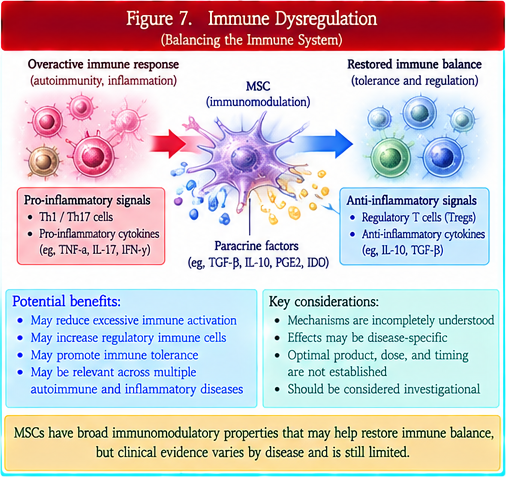
Immune dysregulation is a broad mechanistic concept rather than a single diagnosis. It can involve abnormal activation or suppression of innate or adaptive immunity, altered regulatory networks, cytokine imbalance, autoimmunity, autoinflammation, immunodeficiency, or combinations of these. MSCs can interact with T cells, B cells, macrophages, dendritic cells, natural-killer cells, complement, and soluble mediators, but the direction and magnitude of these effects depend on product, inflammatory context, dose, timing, and recipient biology. Demonstrating immunomodulation does not prove that the net clinical effect is beneficial, durable, or safe.
Clinical takeaway
Autoimmune and inflammatory diseases are mechanistically diverse. Evidence from one disease, organ, route, or MSC product should not be generalized to another.
Biological rationale
Proposed mechanisms include T-cell regulation, regulatory T-cell support, B-cell modulation, macrophage and dendritic-cell effects, cytokine modulation, complement interactions, epithelial support, and antifibrotic signaling.
Product identity
Autologous and allogeneic MSCs from different tissues, culture-expanded products, locally delivered preparations, and EV products are distinct interventions with different characterization and potency requirements.
Preclinical evidence
Laboratory and animal models demonstrate substantial immunologic activity, but model-specific immune pathways, timing, and disease induction may not reproduce heterogeneous human autoimmunity.
Human clinical evidence
Human evidence ranges from early exploratory studies to more developed product-specific programs in selected indications. Class-wide efficacy is not established.
Trial design
Trials should account for fluctuating disease activity, background immunosuppression, rescue treatment, organ-specific severity, placebo effects, and validated clinical endpoints.
Dose and administration
Intravenous, local tissue, intra-articular, fistula-directed, and other routes are not interchangeable. Dose, schedule, viability, and inflammatory priming can alter biological effects.
Safety
Potential concerns include infection, infusion reactions, immune or inflammatory effects, thrombo-inflammatory interactions, procedure-related complications, and uncertainty under concurrent immunosuppression.
Regulatory status
Authorization is product-, indication-, route-, jurisdiction-, and date-specific. A locally authorized product in one condition does not create class-wide approval for MSCs or EVs.
Standard care
Disease-modifying antirheumatic therapy, immunosuppression, biologic and targeted agents, organ-specific treatment, insulin, and established surgical care remain central according to diagnosis.
Knowledge gaps
Key gaps include validated potency assays, responder phenotypes, optimal dose and timing, interactions with standard immunotherapy, durability, infection risk, and long-term immune consequences.
Bottom-line evidence statement
MSC and EV approaches in autoimmune and inflammatory disease remain condition- and product-specific; immunomodulatory plausibility is not proof of clinical disease control.
Additional controlled terminology
Autoimmunity reflects immune reactivity against self, while immune tolerance normally restrains such responses. An autoantibody can participate in an immune complex, and complement activation may contribute to tissue injury. Synovitis is central in rheumatoid arthritis. A regulatory T cell helps constrain immune responses; B cell, macrophage, dendritic cell, natural-killer cell, and cytokine networks can all participate in inflammatory disease. Vasculopathy and fibrosis are prominent in systemic sclerosis. An exocrine gland is a major target in Sjögren syndrome. A perianal fistula is an important Crohn disease complication; Crohn disease and ulcerative colitis are distinct forms of IBD. A pancreatic beta cell produces insulin, and its autoimmune loss produces insulin deficiency in type 1 diabetes. Immunosuppression may control disease but also alters infection risk. A disease-modifying antirheumatic drug and a treat-to-target strategy are established concepts in rheumatoid-arthritis management.