Plain-language overview
Autoimmune and inflammatory diseases occur when immune activity becomes abnormal and contributes to tissue injury. Rheumatoid arthritis, lupus, systemic sclerosis, Sjögren syndrome, inflammatory bowel disease, type 1 diabetes, and broader forms of immune dysregulation are biologically different diseases and should not be treated as one category.
Mesenchymal stromal cells (MSCs) and extracellular vesicles (EVs) can interact with immune cells and inflammatory signals. This creates a scientific reason to study them, but demonstrating immunomodulation is not the same as proving that a disease is controlled or that damaged tissue is restored.
MSC and EV approaches in these conditions remain dependent on the exact disease, product, route, dose, background treatment, and outcome studied. Established disease-modifying and organ-specific treatments remain the appropriate clinical standard.
Rheumatoid arthritis
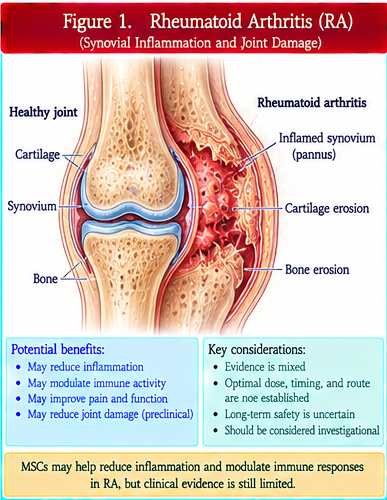
Rheumatoid arthritis is a systemic autoimmune disease in which synovitis can cause painful swollen joints and eventually damage cartilage and bone.
MSC and EV research has examined effects on regulatory T cell activity, B cell responses, macrophage and dendritic cell behavior, natural-killer cell activity, and cytokine signaling.
Human studies remain heterogeneous and generally early. MSCs and EVs are not established replacements for a disease-modifying antirheumatic drug or a treat-to-target treatment strategy.
Systemic lupus erythematosus
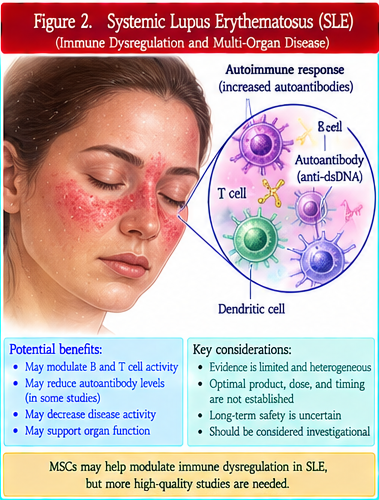
Systemic lupus erythematosus, or lupus, is a highly variable autoimmune disease involving loss of immune tolerance, production of an autoantibody or multiple autoantibodies, immune complex formation, and complement activation.
Different patients can have very different organ involvement. MSC studies have often focused on severe or treatment-resistant disease, including lupus kidney disease.
Changes in antibodies or inflammatory markers do not by themselves prove lasting organ protection, fewer flares, lower steroid requirements, or improved survival. Background immunosuppression also makes treatment effects and safety more difficult to interpret.
Systemic sclerosis
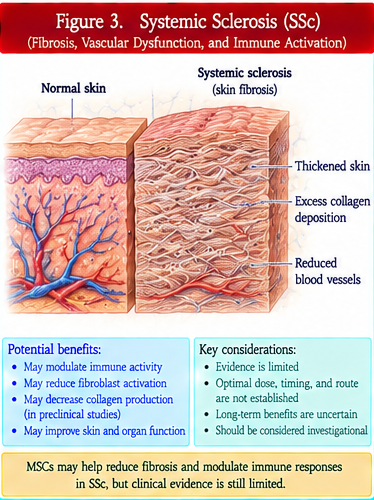
Systemic sclerosis is an autoimmune connective-tissue disease involving vasculopathy, immune activation, and fibrosis. It can affect the skin, lungs, heart, kidneys, and gastrointestinal tract.
MSC and EV research has examined immune, vascular, and antifibrotic mechanisms. These investigational approaches are different from autologous hematopoietic stem-cell transplantation used in selected patients with severe disease.
Improvement in skin findings does not automatically mean that fibrosis in the lungs or other organs has improved. Organ-specific outcomes must be evaluated separately.
Sjögren syndrome
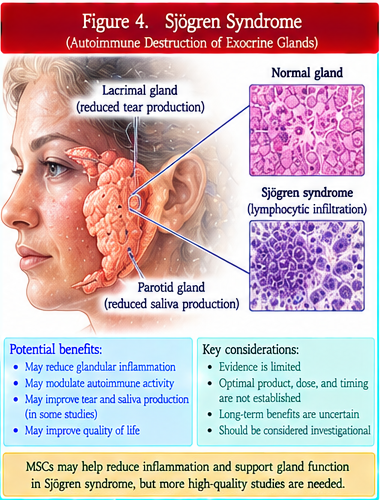
Sjögren syndrome is an autoimmune disease that commonly injures an exocrine gland, especially the salivary and tear-producing glands, and can also affect other organs.
MSC and EV research has examined immune regulation, epithelial support, and possible glandular repair.
Improvement in inflammatory markers or saliva production does not necessarily prove restoration of gland structure, lasting relief of dryness, prevention of systemic complications, or reduced lymphoma risk.
Inflammatory bowel disease
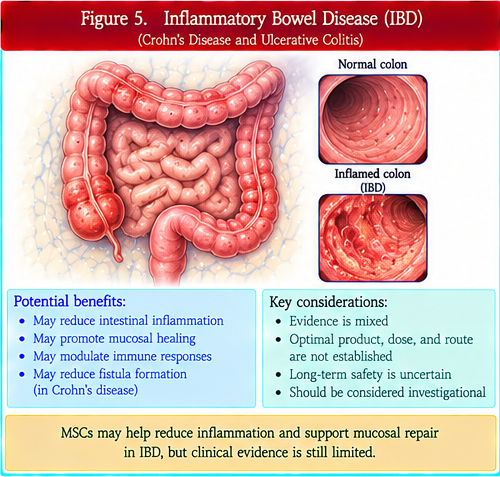
Inflammatory bowel disease includes Crohn disease and ulcerative colitis. They differ in where inflammation occurs, how deeply the bowel wall is affected, their complications, and their treatment.
One of the more developed MSC applications has involved local treatment of a complex perianal fistula in Crohn disease. This is a specific treatment setting and should not be generalized to ordinary luminal Crohn disease, ulcerative colitis, or unrelated MSC products.
Important outcomes include fistula closure, endoscopic disease activity, symptoms, steroid exposure, hospitalization, surgery, and durability of response.
Type 1 diabetes
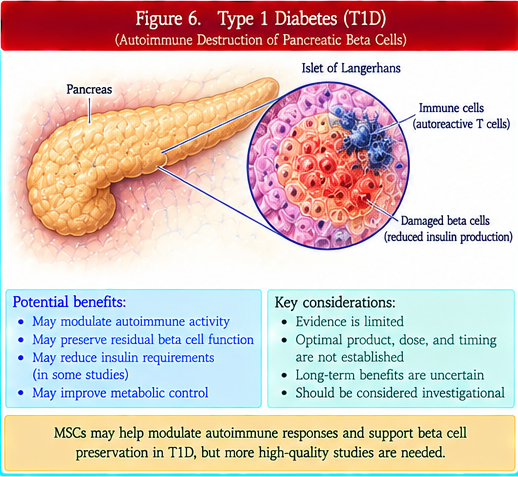
Type 1 diabetes is an autoimmune disease in which the immune system destroys the pancreatic beta cell, producing insulin deficiency.
MSC and EV research has examined immune tolerance, inflammation, and possible support of remaining beta-cell function. MSC treatment is not established beta-cell replacement.
Donor islets and stem-cell-derived islet products are different therapeutic strategies and should not be confused with MSC therapy. Meaningful outcomes include the body's own insulin production, insulin requirements, glucose control, severe hypoglycemia, safety, and durability.
Immune dysregulation
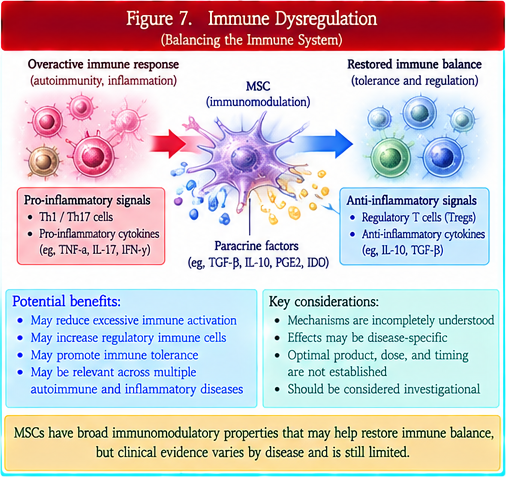
Immune dysregulation is a broad concept rather than one diagnosis. It can involve excessive or inadequate immune activity, abnormal regulatory networks, autoimmunity, autoinflammation, immunodeficiency, or combinations of these problems.
MSCs can interact with many parts of the immune system, but the direction and strength of the effect can depend on the product, inflammatory environment, dose, timing, and patient.
An immune marker moving in a desired direction does not prove that the overall clinical effect will be beneficial, durable, or safe.
Why products and routes differ
Autologous and allogeneic MSCs, cells from different tissue sources, culture-expanded products, locally delivered preparations, and EV products are not interchangeable.
Intravenous, intra-articular, fistula-directed, and other local delivery routes create different exposures and safety considerations. Evidence from one product and route should not automatically be applied to another.
How autoimmune studies can mislead
Autoimmune diseases can naturally fluctuate, and patients often receive several treatments at the same time. This can make improvement difficult to attribute to one investigational intervention.
Strong trials should account for background immunosuppression, rescue treatment, organ involvement, baseline disease severity, and validated clinical outcomes rather than relying only on laboratory markers.
Safety considerations
Potential concerns include infection, infusion reactions, immune or inflammatory effects, thrombo-inflammatory interactions, and complications related to the route of administration.
Safety is particularly important when an investigational product is added to therapies that already suppress immune function.
Questions patients should ask
What exact autoimmune or inflammatory disease is being treated? What organs are involved? What exact MSC or EV product was studied? What dose and route were used? What other immune treatments were given? Was there a control group? Did the study improve meaningful clinical outcomes or mainly laboratory markers? What established disease-modifying treatments are available? What infection and long-term safety data exist?
Bottom line
MSC and EV research in autoimmune and inflammatory disease is scientifically active but remains condition- and product-specific.
Immune effects are not the same as proven disease control. Appropriate human evidence must show meaningful, durable clinical benefit for the exact disease and treatment before broad therapeutic claims are justified.
How this review was prepared
This Patient Edition was derived directly from the explicitly approved 0806 Professional Edition and preserves all seven controlling autoimmune and inflammatory Points.