“Stem-cell-free” safety claims
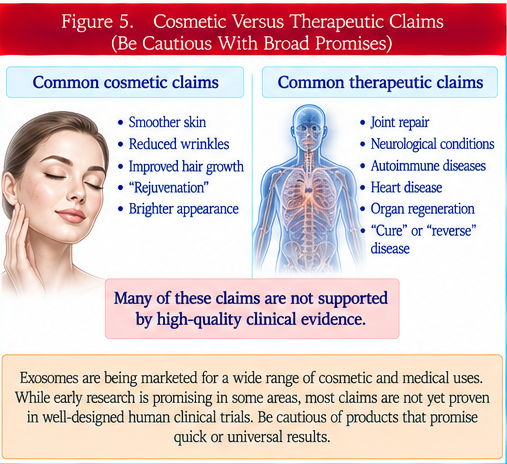
Cosmetic versus therapeutic claims
Research-use-only products used clinically
Particle counts without purity data
Particle counts without purity data are a common marketing shortcut. A stated concentration such as billions or trillions of particles may sound quantitative, but particle-counting instruments detect particles according to physical signals rather than biological identity. Protein aggregates, lipoproteins, media-derived particles, and other nanoparticles can contribute to the count. Even when most counted particles are EVs, particle number does not establish exosome biogenesis, cargo, potency, dose-response, safety, or clinical effectiveness. A defensible claim should pair particle measurements with product identity, purity, contaminant assessment, characterization methods, and evidence relevant to the intended use.
Figure 1 placeholder — Particle counts without purity data
Undefined source cells
Undefined source cells make it impossible to interpret an EV product adequately. EV composition depends on the producer-cell type, tissue source, donor, passage, culture conditions, cell health, stimulation, and manufacturing process. The term 'stem-cell exosomes' is therefore scientifically incomplete unless the actual producer cells and their qualification are defined. If mesenchymal stromal/stem cells are claimed as the source, the cell population, tissue origin, culture history, and relevant identity and safety testing should be documented. Source-cell ambiguity also undermines comparability between lots and prevents meaningful transfer of evidence from one product to another.
Figure 2 placeholder — Undefined source cells
Unvalidated potency
Unvalidated potency refers to claims of biological activity that are not supported by a qualified or validated assay linked to the intended mechanism or product function. Particle number, total protein, a selected marker, or the presence of an attractive cargo molecule does not by itself establish potency. A useful potency strategy measures a reproducible biological activity, has appropriate controls and acceptance criteria, and can detect meaningful product changes. Clinical effectiveness is a separate question: even a well-designed potency assay does not prove patient benefit unless human evidence supports the intended indication.
Figure 3 placeholder — Unvalidated potency
“Stem-cell-free” safety claims
“Stem-cell-free” safety claims can be misleading when they imply that removing viable cells eliminates meaningful biological or manufacturing risk. EV preparations are acellular, but they can contain biologically active proteins, lipids, nucleic acids, contaminants, residual processing materials, or adventitious agents. Risks can arise from source-cell qualification, manufacturing inconsistency, impurities, unwanted immune or coagulation effects, dose, route, biodistribution, and product handling. The absence of living stem cells changes the risk profile; it does not establish that the product is inherently safe.
Figure 4 placeholder — “Stem-cell-free” safety claims
Cosmetic versus therapeutic claims
Cosmetic versus therapeutic claims must be distinguished by intended use and jurisdiction-specific legal definitions rather than by branding alone. A product promoted for cleansing, beautifying, or altering appearance may be treated differently from one intended to diagnose, cure, mitigate, treat, or prevent disease or to affect body structure or function. Claims about wound healing, tissue regeneration, pain, inflammation, hair growth through physiological mechanisms, joint repair, neurologic recovery, or disease modification can move beyond ordinary cosmetic positioning. Regulatory classification does not itself prove or disprove efficacy; evidence and regulatory status remain separate analytical dimensions.
Research-use-only products used clinically
Research-use-only products used clinically create a fundamental mismatch between labeling and use. 'Research use only' generally signals that a product is intended for laboratory research rather than administration to patients. RUO labeling is not a substitute for clinical manufacturing controls, product specifications, sterility assurance, validated release testing, stability data, dose justification, or authorization required for human use. A clinic's decision to administer an RUO-labeled preparation does not convert it into a clinically validated product. Patients should be told the product's actual regulatory and investigational status and the evidence supporting the proposed use.
Figure 6 placeholder — Research-use-only products used clinically
Clinical takeaway
Exosome marketing should be evaluated by separating measurable product facts from biological hypotheses, clinical evidence, regulatory status, and promotional language. Large particle numbers, stem-cell terminology, or sophisticated laboratory vocabulary do not establish therapeutic quality.
Evidence hierarchy for claims
A composition claim requires analytical evidence; a mechanism claim requires mechanistic evidence; a safety claim requires appropriate safety data; and a therapeutic claim requires indication-specific human evidence. Evidence at one level should not be substituted for another.
Product identity before efficacy
Before interpreting clinical claims, the product itself should be defined: producer cells, manufacturing process, EV separation, characterization, purity, contaminants, potency, dose, formulation, storage, and lot consistency.
Testimonials and before-and-after images
Testimonials, clinician impressions, uncontrolled case series, and before-and-after photographs can generate hypotheses but are highly vulnerable to selection, placebo effects, natural history, co-interventions, regression to the mean, and reporting bias.
Regulatory language
Terms such as registered, listed, compliant, manufactured in a regulated facility, or produced under quality standards should not be interpreted as equivalent to regulatory approval for a therapeutic indication.
Clinical interpretation
A defensible EV claim identifies the exact product, intended use, evidence level, clinical-development stage, regulatory status by jurisdiction, manufacturing quality, safety data, and limitations. These dimensions should remain separate.
Questions to ask a clinic or manufacturer
Ask for the producer-cell source, lot-specific characterization, purity and contaminant data, potency assay, dose definition, stability data, human studies of the exact product, adverse-event information, regulatory status, and whether the administered material is labeled for research use only.
Knowledge gaps
EV science is advancing rapidly, but heterogeneous products, inconsistent terminology, variable analytical methods, and limited product-specific clinical trials make broad class-wide therapeutic claims especially unreliable.
Bottom-line evidence statement
Marketing language should never outrun product identity or evidence. A credible EV product claim is specific, testable, product-linked, appropriately qualified, and supported by evidence matched to the type of claim being made.
Additional controlled terminology
A marketing claim should be evaluated against product identity, including the producer cell, purity data, and contaminant assessment. Potency requires an appropriate potency assay and acceptance criteria. An acellular product can still contain an adventitious agent. Intended use helps distinguish a cosmetic claim, therapeutic claim, structure-or-function claim, or disease claim. Research use only does not provide clinical manufacturing controls or release testing. Regulatory status and clinical-development stage remain separate from evidence of effectiveness. A testimonial is vulnerable to reporting bias. Lot-specific characterization and an evidence hierarchy help prevent promotional language from exceeding the underlying evidence.