“Stem-cell-free” safety claims
Cosmetic versus therapeutic claims
Research-use-only products used clinically
Plain-language overview
Exosome marketing can sound highly scientific while leaving out the information needed to judge what a product actually is. Large particle numbers, references to stem cells, molecular cargo, or advanced laboratory methods do not by themselves establish that a product is pure, potent, safe, or effective.
A useful way to evaluate a claim is to separate several questions: What is the product? How was it manufactured and tested? What biological effect is actually demonstrated? What human evidence exists? What is its regulatory status for the proposed use?
Evidence supporting one of these questions should not be substituted for evidence supporting another.
Particle counts without purity data
Particle counts without purity data can make an EV product appear more precisely characterized than it really is. A label may report billions or trillions of particles, but a particle-counting instrument does not automatically identify every detected particle as an EV or exosome.
Protein aggregates, lipoproteins, particles from culture media, and other nanoparticles can contribute to the count. Even an accurate EV count does not tell you the product's potency, cargo, safety, or clinical effectiveness.
A credible description should therefore explain how particle number was measured and provide information about product identity, purity data, and contaminant assessment.
Figure 1 placeholder — Particle counts without purity data
Undefined source cells
Undefined source cells are a major problem because EV properties depend on the producer cell. The tissue source, donor, passage, culture conditions, cell health, stimulation, and manufacturing process can all change the resulting EV preparation.
A phrase such as 'stem-cell exosomes' is incomplete if it does not identify the actual producer cell and how those cells were qualified.
Without this information, it becomes difficult to compare manufacturing lots or determine whether evidence from another EV product applies to the product being offered.
Figure 2 placeholder — Undefined source cells
Unvalidated potency
Unvalidated potency means that claims of biological activity are not supported by an appropriate test showing that the product reproducibly performs the intended biological function.
A potency assay should measure an activity relevant to the proposed mechanism and should have suitable controls and acceptance criteria. Particle number, total protein, or the presence of an attractive molecular marker does not by itself prove potency.
Even validated potency does not prove that patients benefit. Clinical effectiveness still requires appropriate human evidence for the intended use.
Figure 3 placeholder — Unvalidated potency
“Stem-cell-free” safety claims
“Stem-cell-free” safety claims can be misleading when they imply that a product must be safe simply because it contains no living stem cells.
An acellular EV preparation can still contain biologically active proteins, lipids, nucleic acids, contaminants, residual processing materials, or an adventitious agent. Dose, route of administration, biodistribution, unwanted immune effects, and manufacturing consistency can also affect safety.
Removing living cells changes the possible risks, but it does not eliminate the need for product-specific safety evidence.
Figure 4 placeholder — “Stem-cell-free” safety claims
Cosmetic versus therapeutic claims
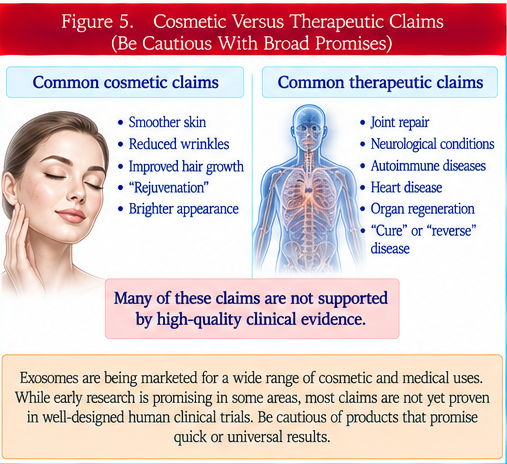
Cosmetic versus therapeutic claims are distinguished primarily by intended use and applicable jurisdiction-specific rules, not simply by what a manufacturer calls the product.
A cosmetic claim generally concerns cleansing, beautifying, or changing appearance. A therapeutic claim may involve treating disease, modifying an abnormal condition, or producing a medical effect on body structure or function.
Claims involving wound healing, tissue regeneration, pain, inflammation, joint repair, neurologic recovery, or disease modification can raise very different evidentiary and regulatory questions from ordinary cosmetic claims. Regulatory classification and proof of effectiveness should still be evaluated separately.
Research-use-only products used clinically
Research-use-only products used clinically create a serious mismatch between the stated purpose of a product and how it is being used.
Research use only generally indicates that the material is intended for laboratory research rather than administration to patients. RUO labeling does not provide clinical manufacturing controls, validated release testing, sterility assurance, dose justification, stability data, or evidence of authorization for human treatment.
A clinic does not convert an RUO product into a clinically validated therapy simply by administering it. Patients should be told the actual status of the product and the evidence supporting its proposed use.
Figure 6 placeholder — Research-use-only products used clinically
Match the evidence to the claim
An evidence hierarchy helps prevent one kind of information from being used to support a different kind of claim. A composition claim needs analytical evidence. A mechanism claim needs mechanistic evidence. A safety claim needs safety data. A therapeutic claim needs appropriate human clinical evidence.
A sophisticated laboratory measurement can be valid and still fail to answer whether a treatment helps patients.
Define the product first
Product identity should come before broad claims about effectiveness. Important information includes the producer cells, manufacturing process, EV separation method, lot-specific characterization, purity, contaminants, potency, dose, formulation, storage, and lot consistency.
If the product itself is poorly defined, clinical claims become much harder to interpret or reproduce.
Testimonials and before-and-after images
A testimonial, clinician impression, uncontrolled case report, or before-and-after image can be compelling but is weak evidence for cause and effect.
These observations can be influenced by patient selection, placebo effects, natural recovery, other treatments, regression to the mean, and reporting bias. They can generate hypotheses but should not replace controlled clinical evidence.
Regulatory language
Terms such as registered, listed, compliant, manufactured in a regulated facility, or produced under quality standards should not automatically be interpreted as meaning that a product has regulatory approval for a therapeutic indication. A structure-or-function claim describes an intended effect on body structure or function, while a disease claim concerns diagnosing, curing, mitigating, treating, or preventing disease; these categories can materially affect regulatory interpretation.
Regulatory status and clinical-development stage should be stated separately from evidence about effectiveness.
Questions patients should ask
What cells produced the EVs? Is there lot-specific characterization? What purity and contaminant data are available? How is potency measured? What dose is given and how was it selected? What stability data support storage and expiration? Have human studies tested this exact product for this exact condition? What adverse events have been reported? What is the product's regulatory status? Is the material labeled research use only?
Bottom line
Marketing language should never outrun product identity or evidence.
A credible EV claim is specific and testable. It identifies the actual product, states what the evidence directly demonstrates, separates laboratory findings from human clinical outcomes, accurately describes safety and regulatory status, and clearly acknowledges important limitations.
How this review was prepared
This Patient Edition was derived directly from the explicitly approved 0612 Professional Edition and preserves the same six controlling Points.