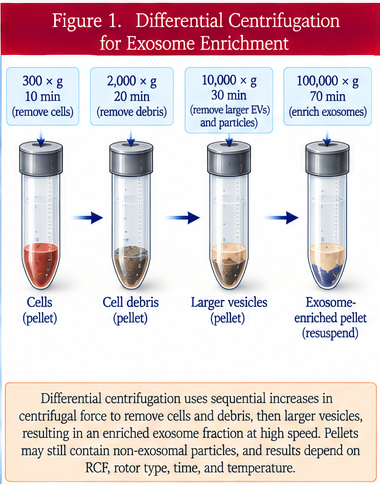
Differential centrifugation separates components by applying sequentially increasing centrifugal forces. Lower-speed steps remove intact cells, large debris, and larger particles; higher-speed steps progressively enrich smaller extracellular particles. The method is operational rather than biologically specific: sedimentation depends on particle size, density, shape, viscosity, rotor geometry, time, and applied force. Differential centrifugation is scalable for laboratory workflows and often used as a preliminary clarification or enrichment step, but pellets can contain mixed EV subtypes, protein aggregates, organelles, and other contaminants. Reporting actual relative centrifugal force, duration, rotor type, temperature, and sample handling is more informative than reporting revolutions per minute alone.
Ultracentrifugation
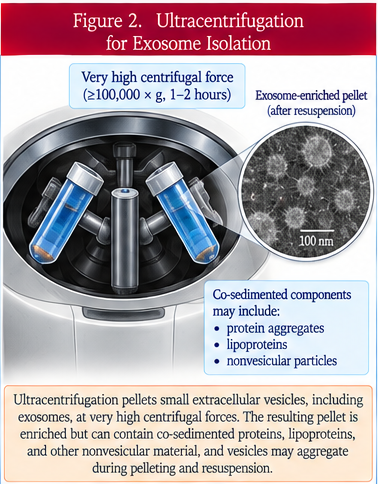
Ultracentrifugation uses very high centrifugal forces to sediment small extracellular vesicles and other nanoparticles. It remains common in research because it requires no affinity reagent and can process substantial volumes, but recovery and purity vary with rotor, path length, viscosity, run time, acceleration, and wash steps. High-force pelleting can co-sediment protein aggregates, lipoproteins, and nonvesicular particles and can promote aggregation or difficult resuspension. A pellet obtained by ultracentrifugation should therefore be described as an enriched preparation rather than a pure exosome population unless additional characterization supports that claim.
Density gradients
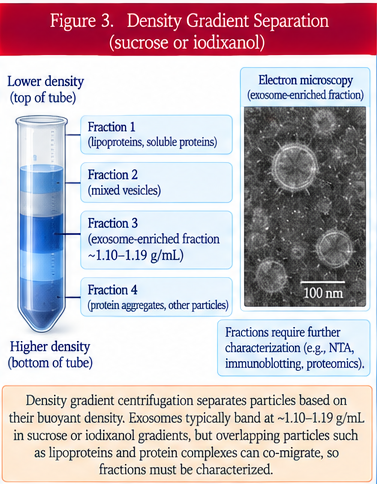
Density gradients separate particles according to buoyant density using media such as sucrose or iodixanol. Samples may be layered onto a preformed gradient or incorporated into a density cushion, then centrifuged until particles distribute according to density. Density-based separation can improve discrimination between EVs and some contaminants that overlap in size, but lipoproteins and other particles may still overlap relevant density ranges. The approach is relatively labor-intensive, can reduce yield, and often requires subsequent removal of gradient medium. Density fractions should be characterized rather than assigned an EV subtype solely from where they migrate.
Size-exclusion chromatography
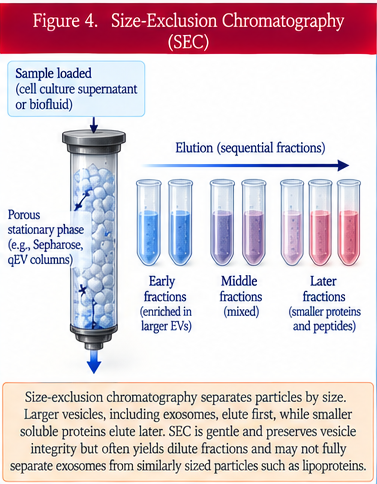
Size-exclusion chromatography (SEC) separates particles according to hydrodynamic size as they pass through a porous stationary phase. Larger particles are excluded from more pores and typically elute earlier, whereas smaller proteins and solutes enter more pores and elute later. SEC is relatively gentle and can separate EV-enriched fractions from much soluble protein, but similarly sized lipoproteins and other nanoparticles can co-elute. Column matrix, dimensions, sample volume, flow rate, fraction size, and pooling strategy influence recovery and purity. SEC often produces a dilute EV preparation and may therefore be combined with a concentration step.
Ultrafiltration
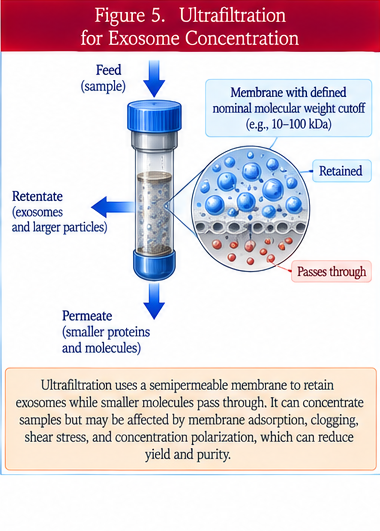
Ultrafiltration uses membranes with defined nominal molecular-weight or size-retention properties to concentrate samples or separate material by size. Pressure or centrifugal force drives fluid and smaller solutes through the membrane while larger particles are retained. It can be faster than ultracentrifugation and useful for concentrating EV-containing fluids, but membrane adsorption, clogging, shear, concentration polarization, and incomplete separation can affect recovery. Nominal membrane cutoffs do not function as absolute particle-size boundaries, so ultrafiltration alone does not establish EV identity or purity.
Tangential-flow filtration
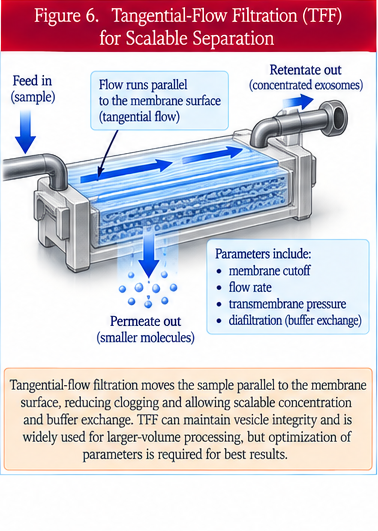
Tangential-flow filtration (TFF) moves feed parallel to a membrane surface while a portion of fluid passes through as permeate. The cross-flow configuration reduces cake formation compared with dead-end filtration and supports scalable concentration and diafiltration. TFF is attractive for manufacturing because process variables such as membrane area, transmembrane pressure, cross-flow rate, permeate flux, concentration factor, and diafiltration volume can be controlled. Nevertheless, membrane material, pore characteristics, shear exposure, fouling, hold-up volume, and process duration can influence EV recovery and quality. TFF is a unit operation for separation and concentration, not proof of purity.
Precipitation
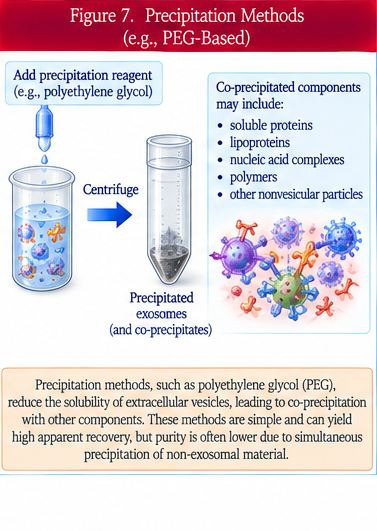
Precipitation methods reduce EV solubility or alter solution conditions so extracellular particles can be collected at relatively low centrifugal force. Polyethylene-glycol-based reagents and commercial precipitation kits are common examples. These methods are simple and can yield high particle recovery, but they frequently co-precipitate soluble proteins, lipoproteins, nucleic-acid complexes, polymers, and other nonvesicular material. Residual precipitating reagent can interfere with downstream assays or biological testing. High apparent particle yield after precipitation therefore requires especially careful assessment of purity and contaminants.
Immunoaffinity capture
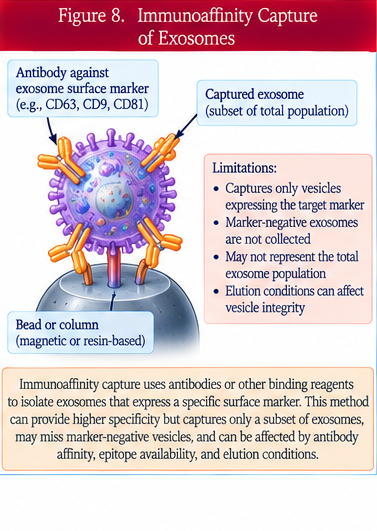
Immunoaffinity capture uses antibodies or other binding reagents directed against selected surface molecules to isolate EV subsets. Targets may include tetraspanins or cell-source-associated surface proteins. The method can provide high selectivity for particles expressing the chosen epitope and is useful for analytical enrichment of defined subpopulations. It is not a universal EV-isolation method because EVs lacking the target epitope will be missed, while target expression may vary with cell state and product. Binding capacity, reagent specificity, nonspecific adsorption, elution conditions, cost, and scalability are important limitations. The captured population is marker-selected, not automatically representative of the entire EV preparation.
Clinical takeaway
No EV separation method simultaneously guarantees high recovery, high purity, biological specificity, scalability, and preservation of function. The method selected changes what is recovered and therefore becomes part of the product definition.
Separation versus purification
Separation enriches material according to physical or biochemical properties. Purification implies removal of unwanted components to a defined degree. Most EV workflows provide enrichment rather than absolute purification.
Recovery versus purity trade-off
Methods that maximize particle recovery may also recover more contaminants, whereas stringent purification can reduce yield or exclude relevant EV subpopulations. Both recovery and purity should therefore be measured.
Combination workflows
Many rigorous workflows combine complementary methods—for example clarification followed by TFF or ultrafiltration, then SEC or density separation. Combining methods can improve specific quality attributes but also increases processing time and opportunities for particle loss.
Manufacturing relevance
For clinical-scale products, separation methods must be reproducible, closed or controllable where appropriate, scalable, compatible with sterility strategy, and supported by in-process controls. A research-scale method is not automatically suitable for manufacturing.
Clinical interpretation
A product labeled 'exosomes' cannot be validated by its separation method alone. Centrifugation, filtration, chromatography, precipitation, or affinity capture enrich particles according to operational properties; particle identity and purity require independent characterization.
Knowledge gaps
No universal separation workflow is optimal for every biological fluid, cell-culture system, analytical purpose, or therapeutic product. Standardized reference materials and cross-platform comparability remain important needs.
Bottom-line evidence statement
EV separation is an engineering and analytical process that shapes the recovered product. Method details, recovery, purity, contaminants, reproducibility, scalability, and preservation of biological activity must be evaluated together.
Additional controlled terminology
Differential centrifugation depends on relative centrifugal force, rotor geometry, and sedimentation. Density gradients use buoyant density, commonly with a sucrose gradient or iodixanol and sometimes a density cushion. Size-exclusion chromatography separates by hydrodynamic size through a stationary phase, producing sequential elution fractions. Ultrafiltration uses a molecular-weight cutoff but can be affected by membrane adsorption and concentration polarization. In TFF, feed generates permeate across a membrane under transmembrane pressure and controlled cross-flow rate; diafiltration can exchange buffer or remove smaller solutes. Precipitation may use polyethylene glycol and can cause co-precipitation of contaminants. Immunoaffinity capture recognizes an epitope. EV separation therefore defines an enriched operational fraction rather than biological identity.