Plain-language overview
Pulmonary disease includes several very different problems involving the lungs and pulmonary blood vessels. Acute respiratory distress syndrome, COPD, pulmonary fibrosis, bronchopulmonary dysplasia, pulmonary hypertension, and postinfectious lung injury do not have one shared cause or treatment.
Research involving mesenchymal stromal cells (MSCs) and extracellular vesicles (EVs) has examined possible effects on inflammation, the lung’s air-blood barrier, blood vessels, fibrosis, and tissue repair. These mechanisms are scientifically interesting, but they do not prove that damaged lung tissue is regenerated or that patients have better long-term outcomes.
MSC and EV approaches for these pulmonary conditions remain investigational. Established critical care, inhaled treatment, pulmonary rehabilitation, antifibrotic or disease-specific therapy, neonatal respiratory care, and pulmonary-hypertension treatment should not be displaced by unproven regenerative claims.
Acute respiratory distress syndrome
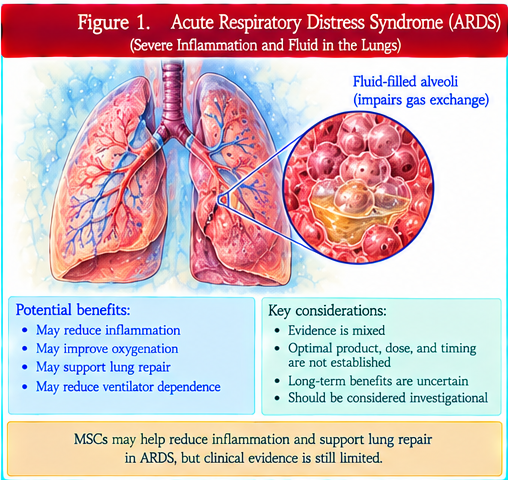
Acute respiratory distress syndrome, or ARDS, is a severe inflammatory lung injury. Damage to the alveolar-capillary barrier allows fluid to enter the air spaces, causing pulmonary edema and impaired gas exchange.
An alveolus is a tiny air space where oxygen and carbon dioxide are exchanged. Its alveolar epithelium lies next to pulmonary endothelium in the surrounding capillaries. ARDS can also reduce lung compliance and interfere with alveolar-fluid clearance.
MSC and EV research has examined immune regulation, barrier support, fluid clearance, and protection from secondary injury. These treatments are not established ARDS therapy. Lung-protective ventilation, prone positioning when appropriate, treatment of the underlying cause, and evidence-based critical care remain central.
Chronic obstructive pulmonary disease
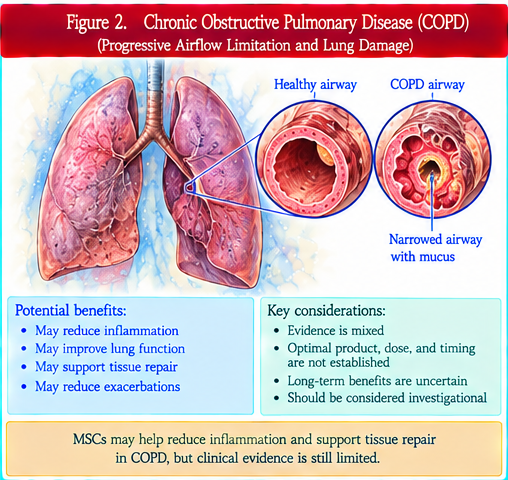
Chronic obstructive pulmonary disease, or COPD, causes persistent airflow limitation and can include emphysema, chronic bronchitis, airway inflammation, and systemic effects.
MSC and EV studies have examined anti-inflammatory, immune, vascular, and tissue-supportive mechanisms. Small human studies have not established durable reversal of airflow obstruction or a class-wide reduction in exacerbations.
A change in inflammation or symptoms should not be described as regeneration of lung destroyed by emphysema. Smoking cessation, vaccination, inhaled therapy, pulmonary rehabilitation, oxygen when indicated, and selected procedures remain established care.
Pulmonary fibrosis
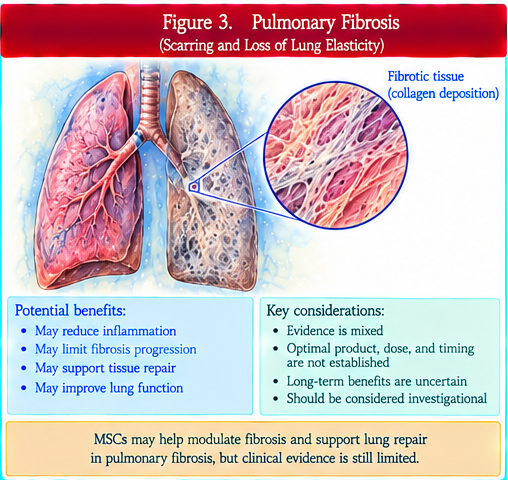
Pulmonary fibrosis involves abnormal repair with excessive extracellular matrix and distortion of normal lung structure. Fibroblast and myofibroblast populations contribute to this process.
MSC and EV research has explored anti-inflammatory and antifibrotic signaling and possible effects on matrix remodeling.
Laboratory or animal evidence does not prove that established human fibrosis can be reversed. Important human outcomes include diffusing capacity and other lung-function measures, exercise ability, hospitalization, transplantation, and survival.
Bronchopulmonary dysplasia
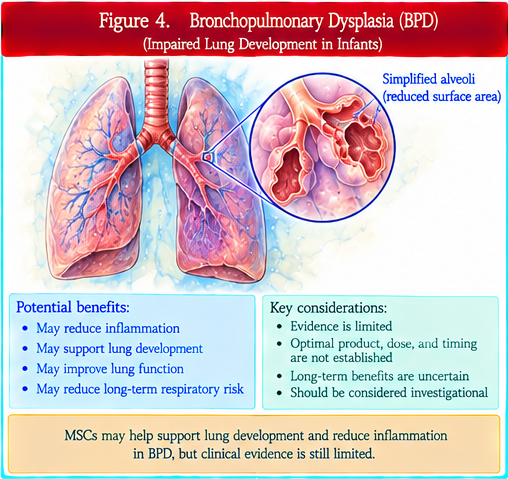
Bronchopulmonary dysplasia, or BPD, is a chronic lung disease of prematurity. The immature lung can be affected by oxygen exposure, mechanical ventilation, inflammation, infection, and other stresses.
Normal alveolarization and pulmonary vascular development are still occurring in premature infants, making BPD fundamentally different from adult lung disease.
Early MSC studies have explored whether biological signaling can support lung development or reduce injury. Because these patients are infants, product manufacturing, dose, timing, consent, safety, and long-term developmental follow-up require especially careful evaluation.
Pulmonary hypertension
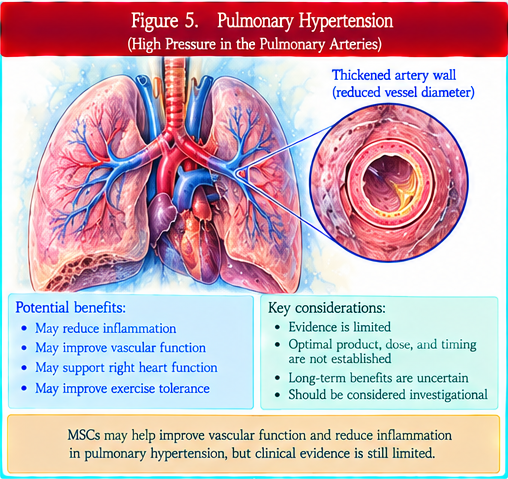
Pulmonary hypertension means abnormally elevated pressure in the pulmonary circulation. It includes several disease groups with different causes and treatments.
Pulmonary arterial hypertension is one form involving endothelial dysfunction, vasoconstriction, and vascular remodeling. As pulmonary vascular resistance rises, the right ventricle must pump against greater resistance and can eventually fail.
MSC and EV research has examined vascular and inflammatory mechanisms, mostly in preclinical models. A favorable laboratory effect does not prove better exercise capacity, less clinical worsening, or improved survival. Established disease-specific therapies remain the appropriate standard comparator.
Postinfectious lung injury
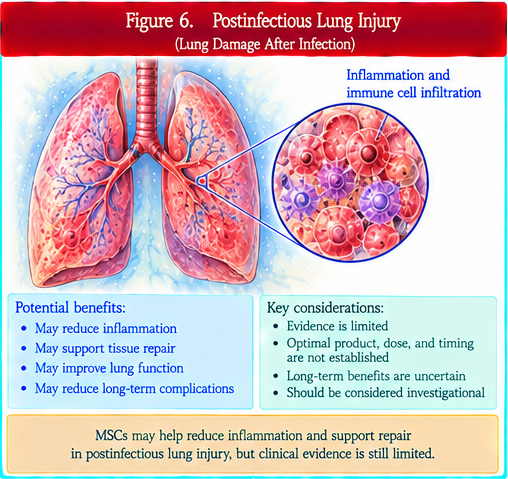
Postinfectious lung injury can follow severe viral, bacterial, or other pulmonary infections. Persistent problems may involve inflammation, airway disease, vascular abnormalities, organizing pneumonia, impaired gas transfer, or fibrosis.
This is not one uniform diagnosis. Improvement can also occur through natural recovery after infection, which makes uncontrolled treatment reports difficult to interpret.
MSC and EV research expanded during severe viral pneumonias, but changing background care, different products, changing viral variants, and study quality limit broad conclusions. Persistent symptoms require diagnosis-specific evaluation rather than a generic regenerative treatment claim.
Why products and routes differ
MSCs from different tissues, autologous and allogeneic products, culture-expanded cells, conditioned media, and EV preparations are different interventions.
Intravenous, intratracheal, inhaled, and other airway-directed approaches also differ in dose exposure, biodistribution, retention, invasiveness, and safety.
How pulmonary studies can mislead
Early trials often focus on safety, feasibility, biomarkers, oxygenation, imaging, or physiologic measurements. These can be useful without proving durable clinical benefit.
Strong clinical evidence should measure outcomes appropriate to the disease, such as survival, ventilator-free days, exacerbations, lung-function decline, exercise capacity, hospitalization, development, or meaningful functional recovery.
Safety considerations
Potential risks depend on the product, patient, and route. They can include infusion reactions, immune effects, infection, thrombo-inflammatory interactions, and complications of airway or local delivery.
Long-term uncertainty is especially important when treatment is proposed for premature infants whose lungs and other organs are still developing.
Questions patients should ask
What exact pulmonary diagnosis is being treated? What exact MSC or EV product was studied? Was the evidence from people with the same disease and severity? What dose and route were used? Was there a control group? Were the outcomes meaningful clinical outcomes or mainly biomarkers and imaging? What established treatments are available? What short- and long-term safety data exist?
Bottom line
Pulmonary MSC and EV research is active but remains investigational.
The strongest interpretation keeps each lung condition separate, distinguishes early mechanistic or physiologic signals from meaningful clinical benefit, and requires appropriate human evidence before claims of restored lung architecture, reversed fibrosis, or improved survival are made.
How this review was prepared
This Patient Edition was derived directly from the explicitly approved 0805 Professional Edition and preserves all six controlling pulmonary Points.